
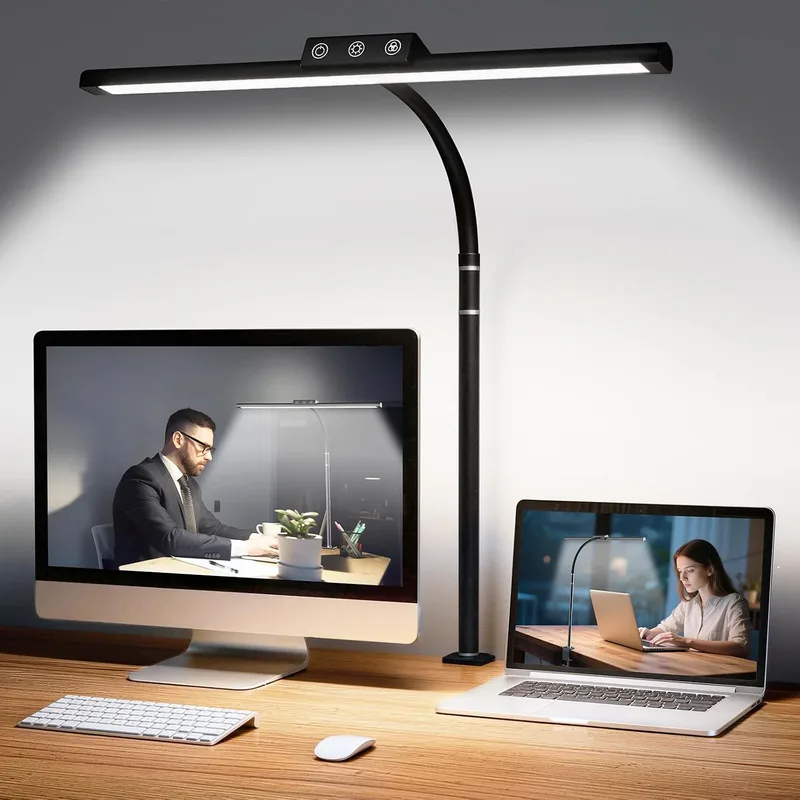
For reading, studying and paperwork, aim for a desk lamp rated around 400 to 600 lumens, positioned roughly 40 to 50 cm (16 to 20 inches) from the page. That setup usually lands somewhere between 300 and 500 lux on the paper, which is the range most people find comfortable for long stretches of reading and writing. If your desk work is fine detail — miniature painting, cross-stitch, soldering, model building — go higher, into the 800 to 1,000 lumen range or a lamp with a narrow, focusable head. If the lamp is mainly for a computer desk, 300 to 400 lumens of soft, indirect light is usually enough, because the monitor already emits light and extra brightness on the desk mostly creates glare.
Those numbers are starting points, not regulations. Two lamps with the same lumen rating can produce very different results on your desk, because brightness at the page depends on how far the head sits from the paper, how tight the beam is, and how much light bounces off the walls. What follows is how to translate a spec sheet into a lamp that actually works for the task in front of you.
The short answer, by task
- Reading printed books and magazines: 300 to 500 lux on the page, roughly 400 to 600 lumens from a focused lamp at normal desk distance.
- Writing, note-taking, studying, paperwork: the same range, with the light coming from the side opposite your writing hand so your arm does not cast a shadow.
- Computer work and video calls: 300 to 400 lux of ambient or bounced light, kept off the screen surface.
- Makeup, grooming, close-up mirror work: 500 lux or more, ideally from both sides of the face and with high color rendering.
- Miniature painting, cross-stitch, needlework, soldering, jewelry work: 750 to 1,000 lux in a tight pool, plus a magnifier if the work is very small.
- Late-night reading in a dark room: 100 to 200 lux, warm, well shielded so the light does not spill into the rest of the room.
Lumens, lux and watts: what each number actually tells you
Lumens measure how much visible light a lamp emits in total. Lux measures how much of that light lands on a square meter of surface. The two are related but not interchangeable, which is why a 500-lumen lamp can be dim on your desk and a 350-lumen lamp can be perfectly bright: a narrow beam concentrates the same output into a smaller area.
Watts measure power consumption, not light. On modern LED lamps the wattage printed on the box tells you almost nothing useful about brightness; a 6 W LED can outperform a 40 W incandescent. If a listing only quotes watts, treat it as an incomplete spec.
If you want to know what you actually have, measure it. A phone light-meter app is not calibrated, but it is consistent enough to compare your lamp against a target.
Why the same lamp performs differently on different desks
Distance is the biggest factor. Illuminance falls off quickly as the lamp head moves away from the work surface, so a lamp that feels generous at 35 cm can feel weak at 60 cm. This is why an adjustable arm matters more than an extra 200 lumens on the box: being able to bring the head down to the page beats raw output aimed at the ceiling.
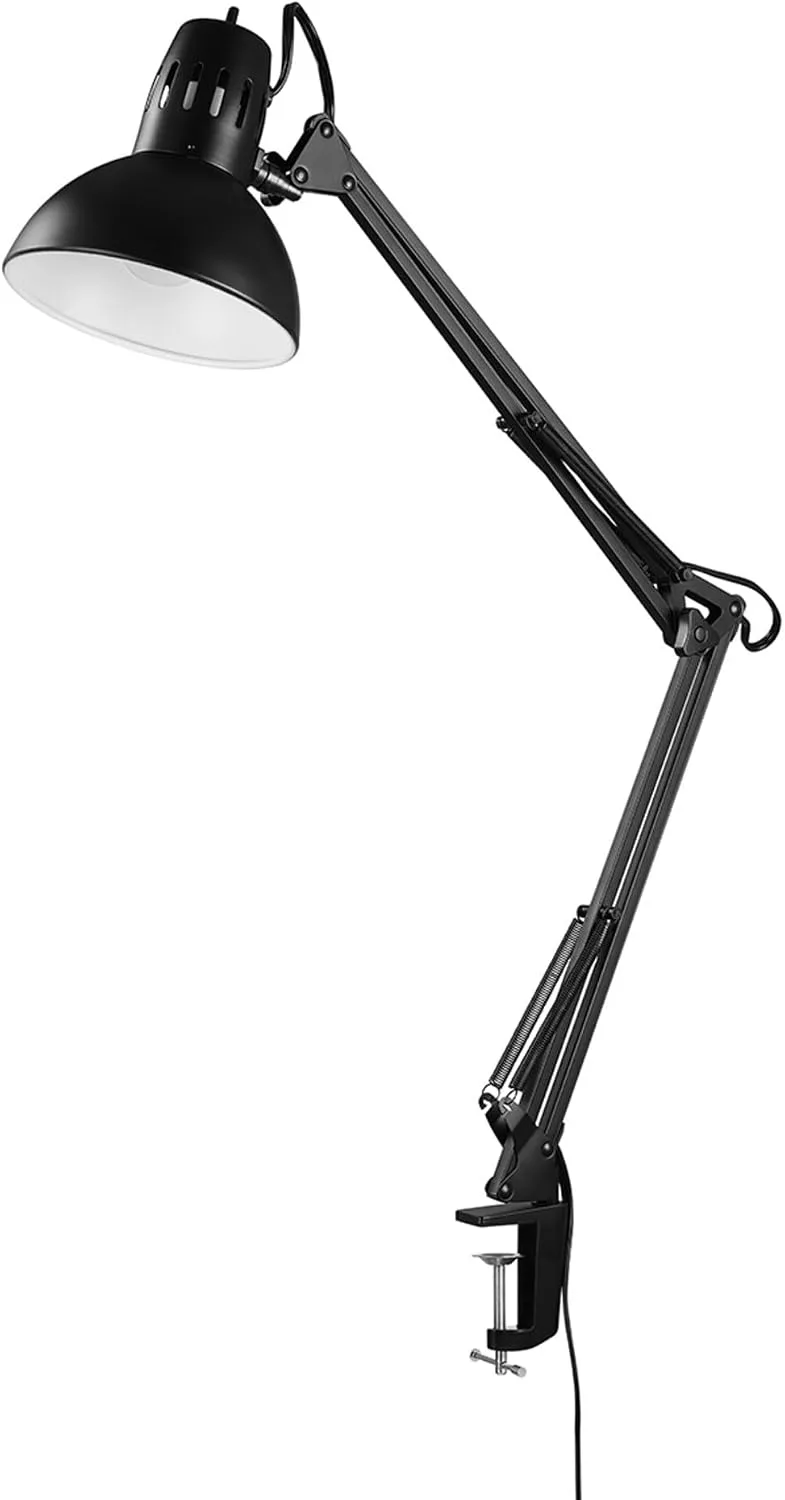
Beam angle is the second factor. A wide, soft panel spreads light evenly across a keyboard and a notebook but gives you nothing concentrated for detail work. A narrow reflector throws a bright pool that is excellent for a single page and unpleasant for a broad desk. Many good desk lamps solve this with a rotating head or a two-zone design: a wide wash for the desk plus a focused spot for the task.
Surroundings matter too. A white wall behind the desk bounces light back and effectively raises the perceived brightness; a dark wall or a monitor with a glossy panel absorbs or reflects it. In a dim room your eyes adapt to the pool of light and the contrast feels harsh, which is why a small amount of background light — a second lamp, a wall washer, or a dimmed ceiling fixture — often makes a bright task lamp more comfortable rather than less.
Matching brightness to the task
Task lighting guidance generally clusters around a few bands: roughly 300 to 500 lux for ordinary reading and writing, higher levels for inspection and fine assembly, and lower levels for ambient and evening use. The practical translation for a desk lamp shopper is simpler than the standards suggest.
If you do one thing at the desk, buy for that thing and make sure the head is adjustable. If you do several, buy for the most demanding task and make sure the lamp dims low enough for the least demanding one. A lamp that only goes from bright to slightly less bright will be unpleasant at night; a lamp that dims to a few percent gives you a reading setting and a detail setting from the same fixture.
For fine work, lux matters more than lumens, and a magnifier lamp is often a better purchase than a brighter lamp. Doubling brightness helps up to a point, then glare and heat become the limiting factors. For makeup and grooming, evenness matters more than peak brightness: two softer sources at an angle beat one harsh source directly in front of the face.
Color temperature: not brightness, but it decides comfort
Color temperature, measured in kelvin, describes how warm or cool the light looks. Warm white sits around 2,700 to 3,000 K, neutral white around 4,000 K, and cool white around 5,000 to 6,500 K. None of these is brighter than the others at the same lumen rating, but they change how a room feels and how long you can work in it comfortably.
For evening reading and bedrooms, warm white is the usual choice. For task work during the day, neutral white is a reasonable default because it keeps paper looking white without the blue cast of cool white. Cool white is common in workshops and utility areas where the priority is seeing edges and contrast rather than relaxing.
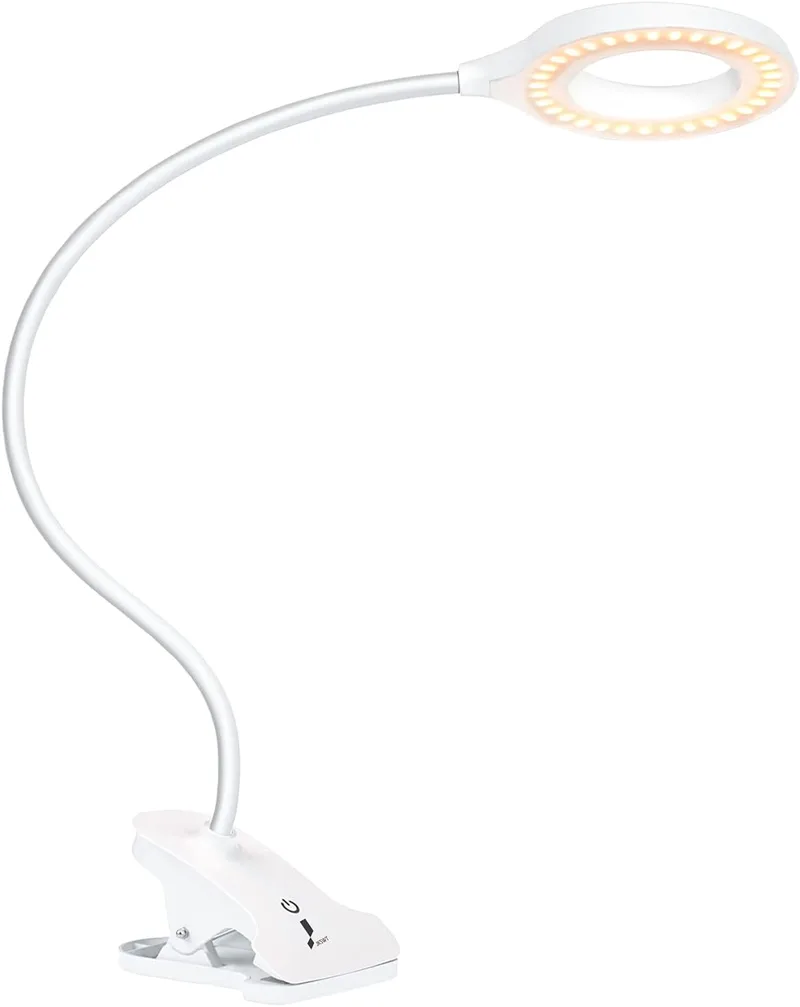
Many desk lamps now offer adjustable color temperature. That flexibility is genuinely useful if the lamp doubles as a bedside reading light and a work light, but a fixed neutral white lamp is not a compromise for most desk work.
CRI: the specification that decides whether colors look right
Color rendering index describes how faithfully a light source shows colors compared with daylight. A lamp with poor color rendering makes wood look grey, fabric look flat, and paint colors look wrong — the classic complaint about cheap LEDs. For craft work, makeup, and anything where you judge color, look for a CRI of 90 or above; 80 is acceptable for general desk lighting, and figures below that are a warning sign on a lamp sold for detailed work.
CRI is rarely printed on budget packaging. When it is missing, reviews that mention color accuracy, or a lamp marketed specifically to artists and crafters, are the better signal.
Dimming, flicker and the details that make a lamp usable
Dimming quality matters as much as the maximum output. Cheap dimming produces a visible flicker at low settings and a color shift toward green or blue. If you plan to use the lamp in the evening, check that the lowest setting is genuinely dim rather than merely less bright.
Flicker is worth a moment’s attention: a phone camera pointed at the lamp is a crude but effective test, and strong rolling bands usually mean a lamp some people find tiring over long sessions.
Finally, consider the physical design against your actual desk. A clamp lamp frees surface area but needs a thick enough edge. A base lamp needs room. An arm that reaches over the work keeps the light from being blocked by your hand. None of these are lumen questions, but they decide whether the brightness ends up where you need it.
A simple shopping checklist
- Decide the hardest task the lamp must support, and note the lux band it needs.
- Choose a lamp whose head can be brought within about 40 to 50 cm of the work.
- Prefer an adjustable beam or a rotating head over a higher lumen number.
- Check that the lowest dim setting is low enough for evening use.
- Pick a color temperature you can live with at night; neutral white is the safest single choice.
- Look for CRI 90 or above if you judge color at the desk.
- Ignore wattage as a brightness proxy.
If you would rather start from a shortlist than from specifications, our roundup of the best desk lamps groups options by use case and includes clamp, arm and base styles. Readers who mostly read in bed may find the features that matter for a reading light that is easy on the eyes more relevant than raw output, and anyone doing close visual work should look at lamps built for miniature painting, where the beam is deliberately narrow. If the lamp is for a vanity or a dressing table, the priorities shift toward even, high-CRI light, which is what our guide to the best desk lamp for applying makeup covers.
Frequently asked questions
Is 1,000 lumens too bright for a desk lamp?
Not if the lamp dims and the head can be aimed away from your eyes. A 1,000 lumen lamp at full output aimed at a single page is uncomfortable for long reading, but the same lamp at 40 percent, or aimed at a wall, is fine. Buying more output than you need is only a mistake when the lamp cannot dim or be adjusted.
How many lumens do I need for a 40 cm distance?
At around 40 cm, a 400 to 600 lumen focused lamp typically produces 300 to 500 lux on the page, which suits reading and writing. For fine detail work at the same distance, look for 800 lumens or a tighter beam.
Is a brighter lamp always better for my eyes?
No. Comfortable task lighting is about contrast and evenness as much as level. A single very bright source in an otherwise dark room creates glare and makes the surrounding area feel dim, which is tiring. Moderate task light plus a little background light is usually the more comfortable arrangement.
Does color temperature affect how bright a lamp seems?
It affects perceived brightness even when measured lux is identical. Cool white tends to read as brighter and more clinical; warm white reads as softer. That is one reason two lamps with the same lumen rating can feel completely different in use.
Can I just use the ceiling light?
For reading and paperwork, a ceiling fixture rarely delivers enough light at the desk surface, and it usually puts your shadow between the light and the page. A dedicated task lamp is the more efficient solution; the ceiling light is there to reduce contrast.
The bottom line
Buy for the task, not for the highest number on the box. A 400 to 600 lumen lamp with an adjustable head, honest dimming and decent color rendering will outperform a 1,200 lumen lamp that cannot be aimed or dimmed. Measure your current setup with a phone app if you want a baseline, then choose a lamp that can put 300 to 500 lux where your work actually is — and a lot more only if the work is genuinely fine.


