Workshop tools · Saws
One saw holds the work flat on a table and cuts along a line you steer by hand. The other carries its motor to the timber. Both cut curves, and they reward very different projects.
A scroll saw clamps a blade between two arms, tensions it like a band, and holds the workpiece on a cast iron table. A jigsaw carries its motor, blade and shoe across the timber, cutting from above. Both will cut a curve in a board, which is roughly where the family resemblance stops.
The choice usually comes down to how thick the stock is, how much of the work arrives at the bench already assembled, and how willing you are to change blades in the middle of a project. This guide compares the two as working habits, not as lists of features.
The short answer
- If your work is panels, inlay, toys or anything with tight inside curves, a scroll saw will do more for you than a jigsaw will.
- If you cut installed trim, sheets too large for a table, or anything on site, a jigsaw earns its place first.
- A jigsaw rewards a steady hand and a fresh blade; a scroll saw rewards patience and correct blade tension.
- Buy for the cuts you already make every month, not for the ones you imagine making.
One saw holds the wood, the other follows the line
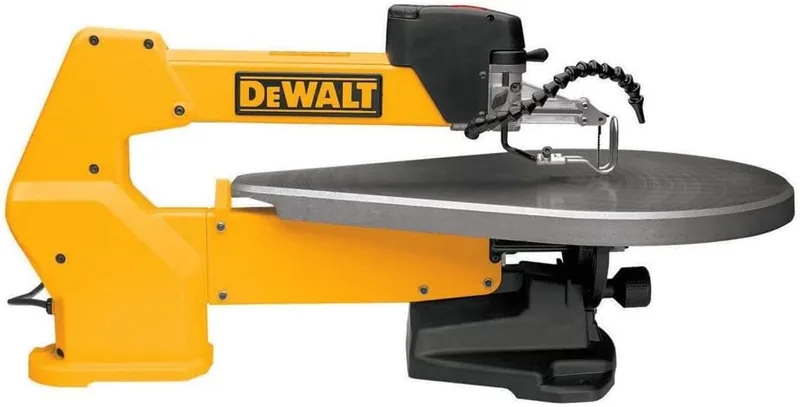
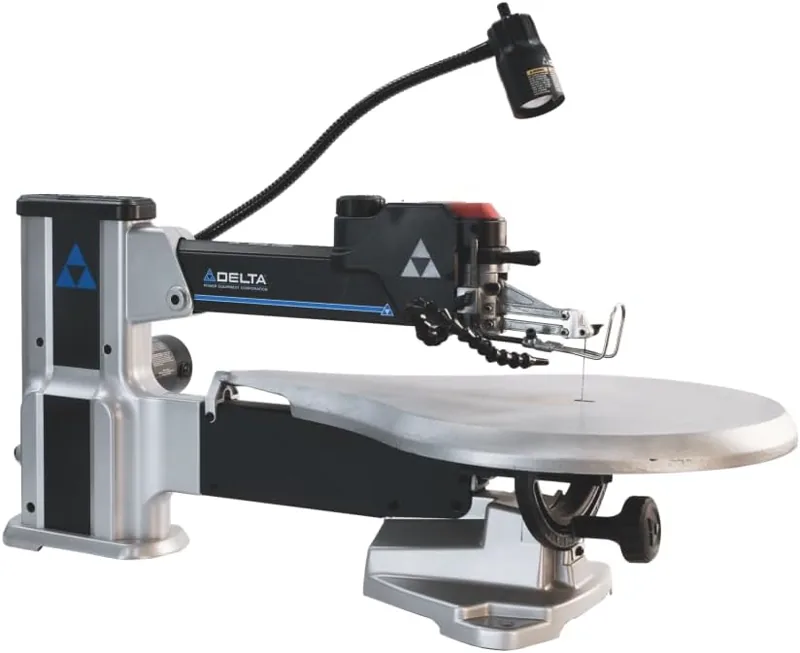
A scroll saw is a stationary machine. Its blade is stretched between an upper and a lower arm, and the work rests on the table and pivots as you steer it into the cut. The blade only travels up and down, so the table sets the angle and your hands decide the path.
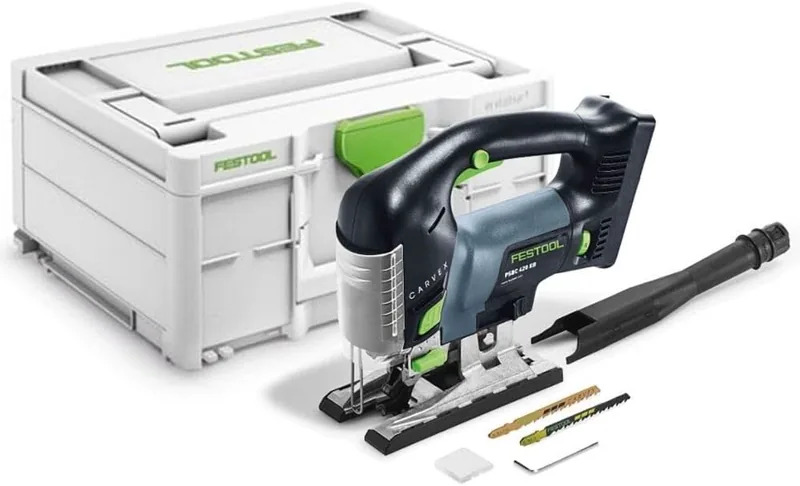
A jigsaw is the opposite arrangement. The motor, blade and shoe travel together over the timber, and the shoe keeps the blade at a consistent depth. Nothing holds the work except your off hand, a clamp or a guide. The cut follows the line you drew, not a table.
The comparison at a glance
The table below compares how the two saws behave in use. On a phone, swipe it sideways to read the second column.
| Aspect | Scroll saw | Jigsaw |
|---|---|---|
| How the blade is held | Stretched between two arms | Clamped in a reciprocating shoe |
| What holds the work | A cast iron table and both hands | Your hand, a clamp or a guide |
| Inside cuts | Thread the blade, re-tension, cut | Plunge or drill, then follow |
| Tightest curve | Very tight, the blade turns in place | Wider, limited by blade width |
| Thick stock | Unhappy beyond thin panels | Cuts deeper with a long blade |
| Finish quality | Fine and easy to control | Rougher, tear-out on the top face |
| Where it works | At one fixed bench | Anywhere the cable reaches |
| Usual mistake | Forcing a thick blank through it | Cutting curves with a dull blade |
What a scroll saw does that a jigsaw cannot
The scroll saw’s real talent is the inside cut. Drill a small hole, thread the blade through it, re-tension, and you can cut a window out of a panel without touching its outer edge. Repeat that twenty times in one board and the machine never complains. A jigsaw can do it too, but each blade change costs more time and accuracy.
Tight radii are the second talent. A narrow scroll blade turns inside a curve that a jigsaw blade cannot follow, which is why inlay, lettering and pierced panels belong to this machine. The blade is short and thin, so it follows a line rather than fighting it.
The third is control at the edge. Because the table supports the work and both hands guide it, you can stop mid-cut, back out and restart without the blade wandering. That sounds minor until the piece takes an hour to prepare.
Where a jigsaw earns its place in a small shop
A jigsaw goes to the work. It cuts a sink opening in a countertop that is already fixed, trims a door that is already hung, and shapes a sheet too large to balance on a scroll saw table. In a small shop, that mobility replaces a great deal of floor space.
It also cuts thicker material than its size suggests, provided the blade is long enough and the curve is not too tight. Rough openings, notches and curved brackets are its natural work. The finish is coarser, and the top face is where tear-out shows, so the direction of the cut matters.
The price of that flexibility is paid at the wrist. A jigsaw is hand guided, so cut quality depends on how steadily you hold it and how fresh the blade is. Two cuts in the same board can look like they came from different tools.
Inside cuts and the order you cut them in
Both saws can make an inside cut, and both punish poor planning. Cut the outer profile first and the panel loses the stiffness that made it easy to handle. Cut the smallest openings last and the waste pieces stay attached long enough to support the work while you finish the big ones.
On a scroll saw an inside cut is routine: drill, thread, tension, cut, release. On a jigsaw a plunge cut can start a window without drilling, but the entry point shows on the face unless you start from a drilled hole anyway. Either way, mark both faces before you cut.
Threading a blade through a drilled hole
A hole just large enough for the blade is all you need. On a scroll saw the blade clamps at both ends, so you release the top clamp, pass the blade through the work, and re-tension. On a jigsaw the blade drops out of the shoe with the quick release, which takes seconds but asks you to check that the teeth face the right way.
Blade changes decide your real working speed
The blade is the cheapest part of either machine and the part that sets the pace. Scroll saw blades are sold by the dozen, pinned or plain ended, and they dull on hard stock faster than most people expect. A dull blade does not simply cut slowly; it pushes the work sideways.
Jigsaw blades are longer, thicker and cheap to replace, but every change interrupts the cut. If your work mixes curves, straight runs and tight corners, you will change blades several times per project. Count those changes honestly before comparing the two saws.
Whichever saw you own, buy blades in quantity and treat them as consumables. More on tooth patterns is in our guide to scroll saw blades, including how fine a blade you need for a given radius.
How each saw handles thick and figured stock
A scroll saw is at its best in thin stock: panels, veneered boards, and parts cut from material that would flex under a larger blade. Push a thick hardwood blank into one and the blade deflects, the cut wanders and the motor labours. The machine will attempt it, but not happily.
A jigsaw handles thickness better because its blade is supported along its working length and the cut is shorter. Figured and reversing grain still tears, especially on the upstroke side, so score the line or cut from the face that matters. Neither saw is the right answer for resawing or heavy ripping.
If blades snap more often than they wear out, the cause is usually tension or feed rate rather than the machine, which is what our note on broken scroll saw blades covers.
Table, throat and the size of the work that fits
Scroll saw capacity is described by throat depth, the distance from the blade to the rear arm. A 20 inch saw can swing a panel that a 16 inch saw cannot, and that gap matters the moment you cut a cabinet door or a wide sign. The table itself also sets how much weight you can rest on it.
A jigsaw has no throat at all, because the work never passes around an arm. Its limits are the length of the cut and the reach of your arms. Large sheets are easy. Deep, closed shapes are not, especially when the shoe has to travel over an already finished surface.
Noise, dust and where the saw sits in the shop
A scroll saw is quiet enough to run in a spare room, and most of its dust lands on the table or falls through the blade opening. A small blower helps. A jigsaw is louder, throws chips toward the operator and needs a vacuum port or a helper with a hose.
Placement follows from that. A scroll saw wants a dedicated bench at a comfortable height, with light directly above the blade. A jigsaw wants a bench you can clear, a pair of sawhorses, and enough cable to reach wherever the work happens to be.
Accuracy you can expect from a hand-guided cut
Neither saw is a precision instrument in the way a table saw is. A scroll saw can follow a drawn line closely, but it will not produce a machined edge. A jigsaw cuts straight with a guide and drifts without one. Both leave marks that need sanding before finish.
The realistic expectation is that the scroll saw gives a finer, more controllable curve and the jigsaw gives a faster, rougher one. If a project needs a joint-ready edge, neither saw is the last tool you will use on it.
Straight lines are not the job
Long straight cuts belong to a circular saw or a table saw. A jigsaw will cut straight for a short distance and then wander. A scroll saw will hold a straight line only while the blade is wide enough to resist deflection, which is not long. Plan straight cuts on another machine and keep these two for shapes.
Which saw suits veneer, inlay and model work
Veneer, inlay, marquetry and small parts are scroll saw territory. The table supports the fragile piece, a fine blade enters a corner, and the machine can be run slowly enough to watch the line. It is also where a foot switch earns its keep, because both hands stay on the work.
A jigsaw can cut a curved component from veneered plywood, but tear-out on the top face is likelier and the shoe scratches finished surfaces unless it is taped. For finish-grade sheet goods, use a fine downward-cutting blade and accept that the scroll saw is the gentler of the two.
Three saws that show the range
The three machines pictured above illustrate the spread of the category rather than a ranking. Two are stationary scroll saws with cast iron tables and blade tension set by hand. The third is a barrel-grip jigsaw that travels to the work and stows in a case.
Look at the base and the table first. A large table with a tilting mechanism makes angled and compound work easier, and a heavy base keeps the machine from walking across the bench when you cut a long curve.
More buying context sits in the tools section of the site, alongside the other workshop guides.
A decision test before you spend
Before you buy either saw, spend two hours with the work you actually do. The test is not about the machine. It is about the shape of the jobs that keep arriving at your bench.
The two-hour test
- Lay out the last five finished projects and count how many needed an inside cut.
- Measure the thickest part you cut in a normal month.
- Note how often the work was installed already or too large for a bench.
If the answers point to flat panels and inside cuts, a scroll saw will be used. If they point to installed trim, sheet goods and rough openings, a jigsaw earns its keep first. Owning both is common, and the order you buy them in rarely matters as much as keeping fresh blades in the drawer.