Workshop tools · Joinery
One machine chops a square hole with a chisel. The other cuts a slot for a loose tenon. Both make a strong joint, and they ask for very different habits.
A mortise and tenon can be cut two ways in a small shop. A benchtop mortiser drives a hollow chisel into the wood and leaves a square hole. A Domino joiner plunges a spinning cutter into the end grain and leaves a slot for a loose tenon. From the outside, the finished joint looks like the same piece of furniture.
Inside the joint, and inside the workflow, they are very different machines. One is stationary, mechanical and cheap to feed. The other is portable, precise and expensive to keep supplied. The choice depends less on strength than on how you build.
The short answer
- If you build frames, doors and table bases in the shop, a benchtop mortiser covers that joinery for the price of one machine.
- If you assemble on site, work in a spare room, or cut joints on parts that are already too big to lift, a Domino joiner earns its price.
- A mortiser needs a sharp chisel, a solid setup and patience; a dull chisel burns its way through a joint rather than cutting it.
- Buy the machine that matches how you move timber, because both methods produce joints that outlast the furniture.
Two ways to make the same joint
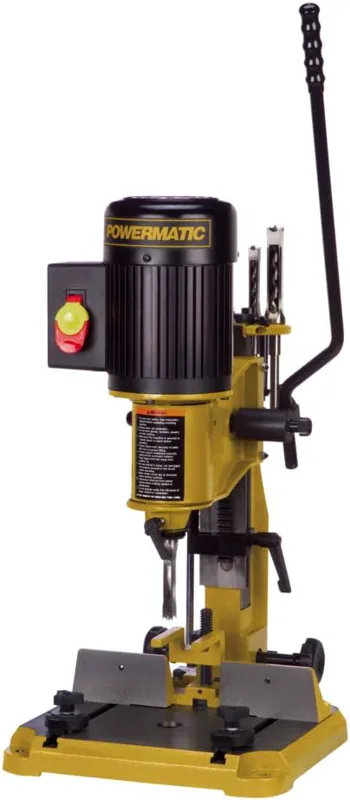
A benchtop mortiser is a drill press with a square chisel bolted to its quill. The auger clears the waste and the chisel squares the corners, in one plunge, with the work clamped to a table that moves on an X-Y carriage. It is a stationary machine, and it wants a bench that does not flex.
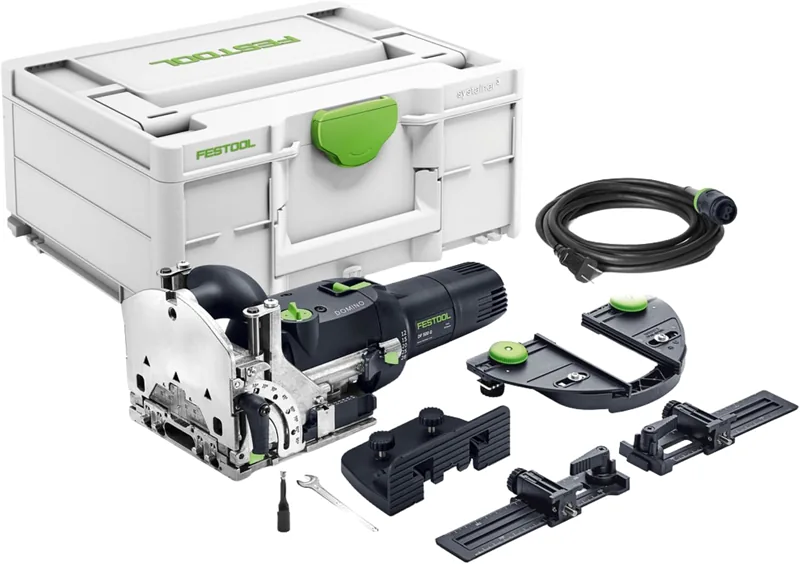
A Domino joiner is a hand-held cutter with a reference fence. You press it against a marked line, plunge, and repeat on the mating piece. The tenon is a loose piece of beech or hardwood that goes into both slots, so the machine never has to cut a matching tenon on the end of a rail.
The comparison at a glance
This table compares behaviour rather than specifications. On a phone, swipe it sideways for the second column.
| Aspect | Benchtop mortiser | Domino joiner |
|---|---|---|
| How the hole is cut | Hollow chisel plunges in one stroke | Cutter plunges a slot, tenon added loose |
| Workholding | Part clamped to a moving table | Machine held against the part |
| Where it works | At the bench, on parts you can lift | Anywhere, including on assembled frames |
| Setup per joint | Centring the chisel, setting the fence | Setting the fence and depth stop |
| Tooling cost | Chisel and bit sets, sharpened often | Tenons by the box, cutters replaced rarely |
| Error that hurts | Chisel drift and burning | Fence registration on the wrong face |
| Best batch size | Long runs of identical frames | Small batches and one-off assemblies |
| Usual mistake | Buying it and never sharpening the chisel | Using it where a real tenon is expected |
What a benchtop mortiser does well
It makes a true mortise, with square ends, in one movement. That matters when you want a traditional through mortise, a wedged tenon, or a joint where the tenon is cut on the rail itself. The machine also repeats: set the stops once and every stile in the batch gets the same hole in the same place.
Because it is a stationary machine with a clamp, it is forgiving of awkward shapes. Curved aprons, tapered legs and short offcuts all hold still while the table moves under the chisel. The operator’s hands stay on the levers rather than on the workpiece.
Its rhythm is slow and deliberate. Each joint is a plunge, a clearance, a move and another plunge. Shops that cut forty mortises in an afternoon learn to like that rhythm; shops that cut four find it tedious.
What a Domino joiner does that a mortiser cannot
It goes to the work. A Domino joiner can cut a slot in a cabinet side that is already standing, in a door frame fixed to a wall, or in a rail that is too long to swing on a mortiser table. That portability changes what is possible in a small shop far more than any specification does.
It also removes the hardest part of traditional joinery: cutting a tenon that fits. There is no shoulder to saw, no cheek to pare, no gauge line to chase. The loose tenon does that work, and the machine only has to place two slots accurately relative to each other.
The trade is that the joint is a loose-tenon joint, not a mortise and tenon in the traditional sense. For most furniture that distinction is invisible. For restoration work, or for a client who specifies draw-bored joinery, it matters.
Where the Domino becomes the wrong purchase
If your work is frames, doors and heavy table bases built at the bench, a Domino joiner is an expensive way to avoid learning one machine. It is also a poor first purchase for someone who has not yet built a bench, because its accuracy assumes parts are already square and flat.
The machine also assumes you will keep buying tenons. That is a small cost per joint, but it is a cost that never ends, and it is the reason some shops keep a mortiser for production work and use the Domino for site repairs.
Tooling and consumables decide the real cost
Both machines look affordable next to a cabinet saw until you price what they eat. The mortiser eats chisels; the Domino eats tenons. Neither bill is dramatic, but they arrive on different schedules.
Hollow chisel sets wear out quietly
A hollow chisel cuts on four faces at once, which is a hard life. It dulls from the inside, and a dull chisel burns rather than slices, so the first symptom is a smell rather than a bad fit. Sharpening needs a conical file or a jig, and most shops keep two or three sizes in rotation.
Domino tenons are bought by the box
Tenons come in a handful of sizes and cost little per piece, but they are a consumable you cannot make at the bench without a thickness planer and a lot of patience. Cutters last a long time in clean stock and a short time in stock with grit in it, which is worth remembering if you work with reclaimed timber.
The practical hybrid
Many small shops end up with both, bought years apart. The mortiser handles frames and anything that can be clamped; the Domino handles casework, mitres and repairs. If you must choose one first, choose the one that matches the joints you cut most often this year, not the ones you admire in photographs.
Registration, layout and the errors each method tolerates
Registration is where joints succeed or fail. A mortiser references the face of the work against a fence and the end against a stop, so a mistake in layout shows up as an offset hole rather than a loose joint. A Domino joiner references the fence against a face you choose, which means the choice itself is the risk.
- Mark every joint from the same reference face, and never flip a part to save a setup.
- Cut a test mortise in the same species and thickness before committing to the batch.
- Keep the chisel or cutter sharp enough that feed pressure stays constant; pressure changes move the joint.
- Dry fit with the actual tenon stock, not with a scrap that happens to be the right width.
Dust, chips and shop air
A mortiser throws chips down and sideways, and the hollow chisel packs sawdust into the flutes if extraction is weak. A Domino joiner collects most of its chips in an internal port but still leaves a plume at the cut. In a basement shop, neither machine is acceptable without extraction running.
Bench height, space and the height of the work
A mortiser needs a bench at a height where you can lean on the lever without hunching, and it needs clearance behind the table for long rails. A Domino joiner needs almost nothing, which is exactly why it gets used on kitchen floors, in stairwells and on scaffolding.
Power, noise and travel
The mortiser is a stationary tool with a cord, so it stays where the socket is. The Domino joiner is either corded or battery powered, and the battery version is the reason site work has become practical for small shops. Noise is comparable, but the Domino’s short bursts are easier to live with in a shared building.
Strength and glue surface, honestly
A well-cut mortise and tenon has long grain glued to long grain on the tenon cheeks and a mechanical shoulder to resist racking. A loose tenon joint has glue surfaces on both slots and no shoulder unless you cut one. In practice both hold up in furniture; in a racking test, the traditional joint has more to resist with.
- Use a tenon that fills the mortise without forcing, and size the mortise to the rail rather than to the chisel you happen to own.
- Glue both the mortise walls and the tenon, and clamp long enough for the glue to cure rather than until it stops moving.
- Where racking matters, add a shoulder or a mechanical fastener instead of relying on glue alone.
Three machines that show the range
These three illustrate the two approaches rather than ranking them. Two are benchtop mortisers at different points on the price ladder; one is the hand-held joiner that made loose tenons mainstream.
The JET JBM-5 is the machine most small shops start with: a compact mortiser with a movable table and a fence that holds a setting once it is tightened. It is the least expensive way to cut a square hole all afternoon.
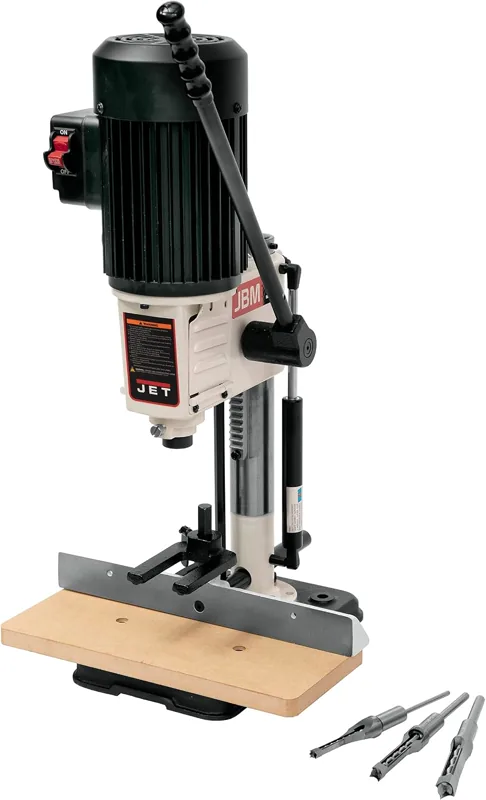
The Powermatic PM701 moves up in capacity, with a longer stroke and a heavier head that stays put under load. It is the mortiser you buy when the JBM-5 has become the machine you queue behind.
The Festool DF 500 Q is the other approach entirely: a fence, a plunge and a box of tenons. It cuts joints on parts that never leave the assembly, which is why it appears on site far more often than a mortiser does.
A decision test before you spend
Ask where the joint is cut. If the answer is always at the bench, on parts you can lift, a mortiser is the cheaper and more traditional route. If the answer is sometimes in a room, on a frame, or on a part that is already glued up, a Domino joiner is the only one of the two that can help.
Then ask what the joint has to do. Frames, doors and table bases reward a real tenon with a shoulder; casework, mitres and repairs reward speed and portability. Shops that build both usually end up owning both, and the order they buy them in tends to follow the first project that hurts. The sequence of machines in a small shop matters here, because joinery is the second problem after stock preparation.
If the budget only covers one, spend it on the method you will use weekly rather than the one that looks more capable on paper. The workshop tool guides cover the rest of the sequence, and the comparison between a table saw and a band saw follows the same logic.