Workshop tools · Drilling
The head of a drill press is much the same at either height. What changes is the column, and with it the work that can stand under the chuck.
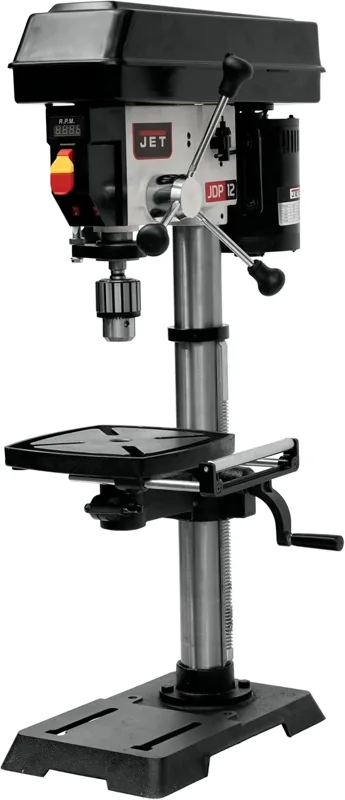
A benchtop drill press sits on a bench and puts the chuck at a comfortable height for standing work. A floor drill press stands on its own base and lifts the head clear of the tallest part you are likely to drill. The heads are often the same casting. The column is the decision.
That decision touches where the machine lives, how a long session feels at the end of the day, and what you can drill without turning the work on its side. This guide compares the two by the work each one allows rather than by a list of numbers.
The short answer
- If your drilling is brackets, hinges, dowels and holes in parts you can lift onto a table, a benchtop press does the job and leaves the floor free.
- If you drill assembled frames, long rails, or anything taller than the column allows, a floor press is the only one of the two that works.
- A benchtop press on a tall stand is not the same as a floor press; the base and the table height still limit what fits.
- Buy for the tallest part you expect, then check that the table still reaches a comfortable height for small work.
The difference is the column, not the head
Both machines consist of a base, a column, a table that slides on the column, and a head that carries the spindle. On a benchtop model the column is short and the base is small enough to bolt to a workbench. On a floor model the column is long and the base sits directly on the floor.
Because the table runs on the same column, column length sets the distance between the table and the chuck. A short column means a tall part cannot stand upright under the bit. A long column means small work sits low, which is the complaint that sends people looking for a taller bench.
Everything else, from the motor to the chuck to the depth stop, is usually shared across both versions of the same model. That is why the choice is rarely about drilling power and almost always about clearance.
The comparison at a glance
The table below compares the two formats as they behave in a shop. On a phone, swipe it sideways to read the second column.
| Aspect | Benchtop | Floor |
|---|---|---|
| Where it stands | On a bench or a stand | On its own base at floor level |
| Head height | Fixed by the bench | Set by the column |
| Tallest part | Limited by bench-to-chuck distance | Long rails and assembled frames |
| Table height for small work | Close to standing eye level | Low, sometimes awkwardly low |
| Footprint | Takes bench space | Takes floor space |
| Moving it | Lifts, or rolls on a stand | Heavy, plan the move first |
| Changing speeds | Belts within easy reach | Belts changed at head height |
| Usual mistake | Short column, tall workpiece | Buying capacity you never use |
What a benchtop drill press does well
It puts the work at eye level. Standing at a bench, you can watch the bit enter the stock without bending, and you can change belts, set the depth stop and swap bits without reaching above your shoulder. For small parts and short sessions that convenience is the whole argument.
It also fits places a floor machine cannot: a bench against a wall, a corner of a garage shared with a car, a spare room where the floor belongs to something else. Because the machine is lighter, it can be moved out of the way and put back in a minute.
The limit is what can stand under the chuck. A tall box, an assembled frame or a post that needs a hole near its end will not fit, and no amount of care at the bench changes that geometry.
Where a floor machine changes the work you can do
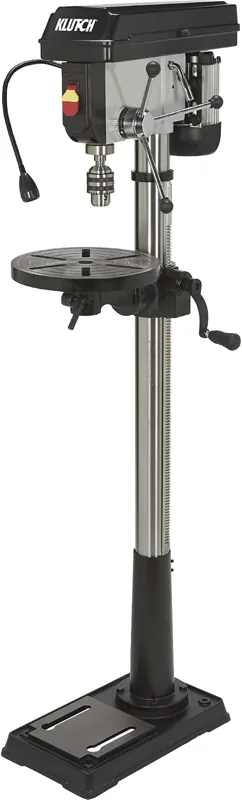
A floor drill press lets a long part stand on the floor and pass beside the column while the table is lowered around it. That single ability covers cabinet frames, door stiles, table legs, jigs and fixtures, and anything assembled before it is drilled.
The second gain is stability. More mass in the base and a longer column mean less vibration when a large bit bites, so holes in hardwood come out cleaner and the machine does not walk. That matters more as the bit gets bigger.
The cost is comfort and space. The table of a floor machine sits low, so small work is drilled at hip height unless you build a platform or buy a taller table. And the footprint is permanent unless you plan for casters.
Throat depth and the parts that fit under the chuck
Throat depth is the distance from the column to the centre of the chuck. It decides how far from its edge you can drill into a panel. A short throat forces you to drill from both edges and meet in the middle, which rarely lines up perfectly.
Floor models often carry a larger throat because the head casting is bigger, but the difference is not automatic. Check the figure for the specific machine rather than assuming that more height means more reach, and remember that a wide panel also needs support at the height of the table.
Measuring a part before you buy
Stand your tallest workpiece on the floor beside a wall, mark the height you need to drill, and measure it. Do the same for the widest panel you expect, measuring from its edge to the hole. Those two numbers, not the motor size, decide whether a machine can do the job.
Table height, comfort and the long session
A benchtop press on a bench puts the table around waist to chest height, which is where most people naturally work. A floor press puts it much lower. For a dozen holes that difference is invisible; for an afternoon of them it decides whether your back hurts.
The usual fix is a raised platform under the work, or a taller auxiliary table bolted to the existing one. Both are simple, both cost some rigidity, and neither is a reason to reject a floor machine if the clearance is what you need.
If your drilling is mostly small parts and only occasionally tall ones, this is the argument for owning the benchtop version and borrowing floor capacity when a project demands it.
Quill travel and drilling a deep hole
Quill travel is how far the spindle moves down in one stroke. It sets whether a deep hole can be drilled in a single pass or needs the table raised midway. Short travel is not a defect; it is a reason to plan the depth stop and the table height before the bit goes in.
On a floor machine the table can be dropped a long way, which is useful for tall parts but makes deep holes in small stock awkward unless the table comes back up. On a benchtop machine the table range is shorter and easier to sweep through in one movement.
For most shop work the practical question is not maximum travel but whether you can position the table so the quill has room to finish the hole without the chuck meeting the work.
Speed changes and how often you make them
Both formats usually change speed by moving a belt between pulleys. On a benchtop machine the pulleys are at chest height and the change takes a minute. On a floor machine they sit at the top of a long column, which is fine for a tall operator and a stretch for everyone else.
That difference quietly shapes how the machine is used. When a speed change is easy, bits last longer and holes come out cleaner, because the operator actually changes speed for the material instead of running one setting for everything.
If you drill wood, plastic and metal in the same week, put ease of speed change near the top of your list, above motor size.
Footprint, mobility and the small shop
A benchtop press occupies a rectangle of bench you could otherwise use for assembly. A floor press occupies a rectangle of floor you could otherwise use for walking. Neither is free, and the cost is paid in a different currency.
Floor machines are heavy, and the weight is the point. Moving one across a garage is a two-person job with a plan. If the shop is shared, that permanence is worth thinking about before the machine arrives rather than after.
Casters and the wobble tax
A mobile base solves the moving problem and creates a new one: any flex in the base shows up as vibration at the bit. Retracting casters or a base that lifts the machine onto fixed feet removes most of it. A machine that rocks while drilling produces oval holes and dull bits.
Heavier work asks for mass, not just power
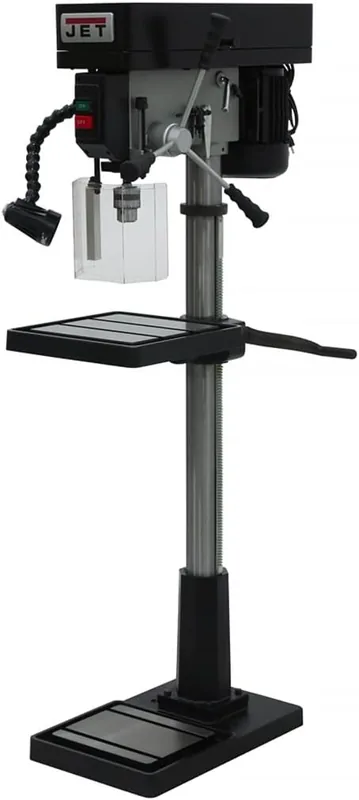
A drill press does its best work when nothing moves except the spindle. Mass in the base, a rigid column and a table that locks firmly all contribute more to hole quality than a larger motor does, especially with large bits in hardwood.
This is where floor machines usually win, not because they are more powerful but because they are heavier. A benchtop press bolted to a solid bench can behave very well, but a bench that flexes will undo the advantage in a single afternoon.
Dust, chips and the table you actually want
Drilling makes chips, not dust, and they pile up under the table. A table with slots or a removable centre insert is easier to clear than a solid one, and a fence or a clamp kit turns a drill press into a repeatable machine for a row of holes.
A floor machine with a large table gives you more room for clamps and fixtures. A benchtop machine with a small table needs a drill vise or an auxiliary table for anything that has to stay put, which is a cost worth planning for.
Three presses that show the range
The three machines pictured above illustrate the spread of the category rather than a ranking. Two stand on the floor and one sits on a bench; all three use the same basic layout of base, column, table and head.
Look at how the table locks and how much cast iron surrounds the column. A table that locks firmly at both ends resists tipping when a heavy bit bites, and that is the difference you feel in the finished hole rather than in a specification.
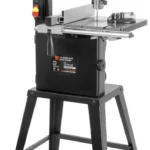
More buying context sits in the tools section of the site, and the same benchtop-or-floor question is worked through for another machine in our guide to benchtop and floor-standing band saws.
A decision test before you spend
Before you choose a format, spend an hour with a tape measure and the parts waiting for holes. The answers are usually obvious once the numbers are written down, and they rarely match the machine people expect to buy.
The tallest part test
- Measure the tallest part you drilled in the last year, from its base to the hole.
- Measure the widest panel, from its edge to the hole, for throat depth.
- Note how often you drill parts that are already assembled.
If the tallest part is short and the work is small, a benchtop press on a solid bench will drill it well. If the numbers point to long rails, frames and repeated deep holes, a floor machine is the one that will still be useful in five years. Both answers are common, and either machine beats a hand drill held at an angle.