Home appliances · Freezers
A plain comparison of the two freezer shapes, decided by how you shop, cook, and store food rather than by a spec sheet.
A second freezer rarely arrives by plan. It shows up after a bulk shop, a garden harvest, or a delivery of half a cow, and then it has to live somewhere in a house that was never designed around it. By the time you are choosing between the two common shapes, the useful question is no longer which one freezes food. Both do. The question is which shape matches the way you load it, find things in it, and cook from it.
This comparison stays on behavior. It looks at access, organization, footprint, and the small friction of living with each shape, so you can decide before you measure the corner of a garage. The same logic applies to other cold storage decisions, such as how a beverage fridge differs from a wine cooler: match the appliance to the habit first, and to the room second.
The short answer
- Chest freezer if you buy in bulk, freeze in bags and boxes, and can spare a corner that does not need to look tidy.
- Upright freezer if you shop weekly and want the whole inventory visible in one look.
- Convertible models if your needs swing between freezing and extra fridge space with the seasons.
- Whichever you choose, put it where loading is easy. An awkward freezer stays half empty.
The shape of the box decides how you live with it
One shape is a deep well with a lid on top. The other is a tall cabinet with shelves behind a door. That single difference drives everything that follows: how far you reach, how much cold air spills out, how the unit sits in a room, and how quickly you stop bothering to organize it.
Freezer shopping starts with capacity because that is the number printed largest on the box, yet it is the easiest thing to compare and the least useful alone. A freezer you can load in one motion and read at a glance holds more usable food than a larger one you avoid opening.
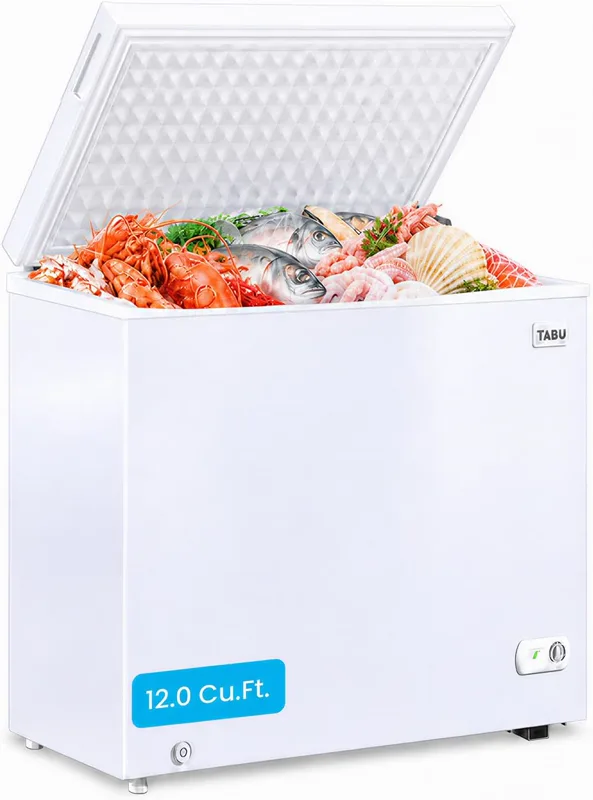
A chest freezer keeps cold air where it belongs
Cold air sits low. In a chest freezer it stays in the well when the lid comes up, so the food inside is not hit by a wash of room-temperature air. The compressor does not have to work its way back down afterward. This is why a chest freezer can be opened repeatedly during a canning weekend without the contents softening at the edges.
What that means for a full freezer
The benefit grows as the freezer fills. A packed chest freezer is a mass of frozen food with very little air to move around, so temperature holds steady and a brief power interruption is less dramatic. The same fullness is also its weakness: once the well is full, reaching the bottom means unloading the top, and the bags nearest the lid are the ones you see every day.
An upright freezer keeps your inventory visible
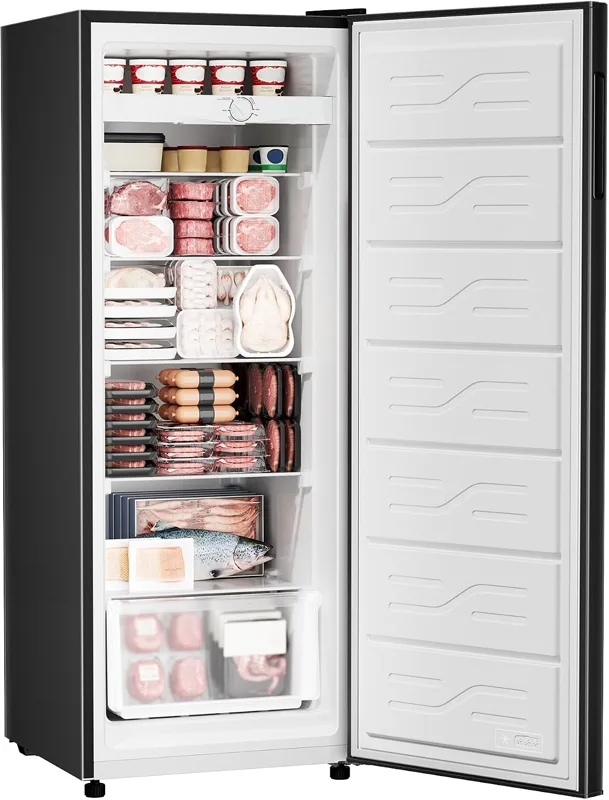
An upright freezer behaves like the freezer half of a refrigerator. Shelves and drawers put the whole stock in front of you when the door opens, so you can find the oldest package without lifting anything. For households that cook from what is on hand, that visibility is worth more than a little extra volume.
The trade is air. Each time the door opens, cold air slides out and room air moves in, so the unit recovers more often. Uprights also concentrate cold at the bottom, which makes the top shelf the warmest place in the cabinet.
Finding food is the daily difference, not the yearly one
The cost of the wrong shape is paid in small moments. You buy a second bag because the first is buried. You defrost a roast you did not plan to cook because it was the only thing you could reach. Those moments separate a freezer that earns its footprint from one that becomes a shelf.
- Freeze flat and label the flat side. Bags stack like files in a chest and like books in an upright.
- Keep one basket for the next meal so the daily dig does not make the unit feel like work.
- Write the date on the outside every time. A freezer rewards the household that can read it.
Footprint matters more than capacity on paper
A chest freezer needs a wide, deep patch of floor and room for the lid to lift, but almost no height. An upright delivers the same storage in a tall narrow column that fits a utility room, a closet, or the gap beside a fridge. In a tight kitchen, the upright often wins because the floor is spoken for.
Measuring the corner you actually have
Measure the opening, not the empty floor. Door frames, baseboards, water lines, and that one shelf bracket you forgot about all narrow the real space. Then measure the swing: a lid needs room to stand open, and a door needs room to hang. If the freezer will sit against a wall in a basement stairwell, check that you can stand behind the lid while holding a bag.
Lid clearance and door swing decide what fits
A chest freezer opened under a low shelf is a daily annoyance and a long-term hazard, because you will start leaving the lid ajar rather than lifting it fully. An upright door that opens into a walkway gets propped open and left that way. Both mistakes cost more cold air than the difference between the two shapes ever will.
Direction matters too. Reversible doors exist on many uprights, but a chest lid only lifts up. If the ceiling is low or a shelf hangs above, that decides the choice, not the capacity label.
Side by side on the points that matter
The table puts the two shapes side by side on the points that show up in daily use. On a phone, swipe sideways to see both columns.
| Aspect | Chest freezer | Upright freezer |
|---|---|---|
| Getting food out | Reach down into a well | Pull forward off a shelf |
| Seeing what you have | Needs baskets and labels | Visible as the door opens |
| Cold air when opened | Stays low in the well | Spills out and refills |
| Floor space needed | Wide and deep footprint | Tall narrow column |
| Loading a big haul | Fast, drop and close | Slot by slot on shelves |
| Defrosting cycle | Manual, usually one deep clean | Manual or frost-free, easier access |
| Best room to place it | Garage, basement, utility corner | Kitchen, pantry, beside the fridge |
| Freezer burn risk | Lower with a full load | Higher on the top shelf |
Frost and defrost behave differently in each shape
Manual defrost models build frost where moist air meets cold surfaces, and moisture arrives every time the unit is opened. In a chest freezer that frost tends to collect around the rim and the upper walls, out of the way of the food. In an upright it forms on shelves and door gaskets, where it interferes with drawers and seals long before it becomes a problem for the food.
It asks for a plan: a cool day, somewhere to park the food, towels, and an afternoon. Households that plan it once a year find manual defrost trivial. Households that wait for the door to stop closing find it a half-day project.
Where you put the freezer changes what you buy
A freezer in the kitchen gets used for everyday cooking. A freezer in a garage or basement gets used for storage, and the difference in behavior is enormous. The kitchen unit is opened many times a day and should be the one that is easy to read. The outbuilding unit can be the deep well that holds the harvest and the bulk meat.
Check the room first. Some freezers are rated for garage use and some are not, and an unheated space swings more than a kitchen does. If the corner is damp, keep the unit off bare concrete. For a beverage or wine cabinet in that same corner, the rules tighten further, as our comparison of a wine cooler and a beverage refrigerator explains.
Convertible models blur the line
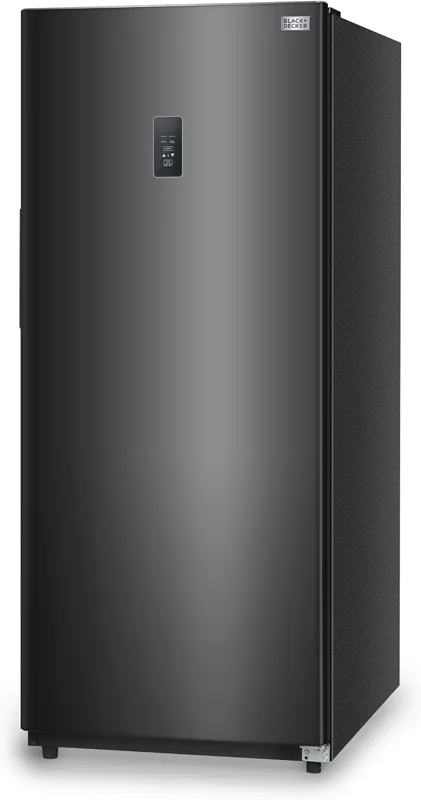
A convertible model can run as a freezer or as a refrigerator, and that flexibility changes the buying decision. Households that host, hunt, or garden seasonally can use the same box for overflow fridge space in one month and deep freezing in another. The compromise is usually that the unit does neither job quite as single-mindedly as a dedicated appliance.
Think about what you freeze before you think about size
What goes in decides what works. Bags of blanched vegetables, vacuum-sealed fish, and portioned meat stack and slot. A whole turkey or a tray of stock does not. Walk through a normal month of your own cooking and be honest about how much of the freezer holds items in odd shapes.
Bulk meat, garden harvest, batch cooking
A bulk meat order favors a chest freezer, because boxes and awkward cuts drop in without negotiation. A garden harvest favors whichever unit you will actually process into, and that is usually the one nearest the kitchen. Batch cooking favors an upright, because containers stack best on shelves and you will want to see what is left before the next cooking day.
If you are not sure yet, start by counting how many times a week you open the freezer you already have. That number tells you more about the right shape than any capacity comparison. For the wider set of kitchen buying decisions, our kitchen and cooking guides collect the comparisons that come up most often.
Loading habits decide whether the space gets used
Every freezer has a loading motion, and a household either adopts it or fights it. A chest rewards the person who drops bags in flat and stacks by date. An upright rewards the person who slides a new package behind the old one. Skip the habit and you end up with unidentified frozen lumps.
- Decide where the newest food goes before the first shop.
- Keep the baskets or drawers in the same order every time so anyone can find the vegetables.
- Leave a small gap at the top or front for the next thing that arrives. A freezer with no slack stops being useful.
Power outages and warm days test both shapes
A full freezer holds temperature longer than an empty one, and a chest freezer holds it longer than an upright at the same fill, because the food is packed tighter and less cold air escapes. That matters in storm season or a house with an unreliable circuit.
The response is the same for both: keep the unit full, keep it shut during an outage, and know which food you will cook first. A thermometer in plain view turns a guess into a decision.
A short checklist before you commit
Run through these before you order. Most regrets trace back to one of them rather than to the appliance.
- Measure the opening, the lid or door swing, and the path to the room, not just the floor.
- Confirm the room is suitable for the unit, including temperature and damp.
- Count how often you open the freezer in a normal week, then pick the shape that matches that habit.
- Plan where the newest food goes and how it gets labeled, and write it on the inside of the door.
Whichever shape you choose, the goal is the same: a freezer you open without dread and close without guilt. The shape either supports that habit or works against it.