Kitchen appliances · Cooling
One is built to hold bottles on their side at a steady temperature. The other is built to keep cans cold and within reach. They look almost identical under a counter.
A wine cooler and a beverage refrigerator are sold in the same aisle, in the same black cabinet with the same glass door, and they are not the same appliance. One manages temperature, humidity and vibration for bottles that may sit for years. The other spends its design budget on shelf space, cold cans and a door that opens easily with one hand.
This guide compares the two on the questions that decide a purchase: what fits inside, how steady the temperature has to be, where the unit goes, how loud it is and what it costs to run.
The short answer
- Choose a wine cooler if bottles will sit for months and the point is to keep them in good condition.
- Choose a beverage refrigerator if the unit is for cold drinks that get replaced every week.
- Choose a dual-zone unit only if you genuinely store two kinds of drink at two temperatures.
- Measure the opening before anything else. Most of these units are designed to fit a standard under-counter gap.
A wine cooler is built around bottles
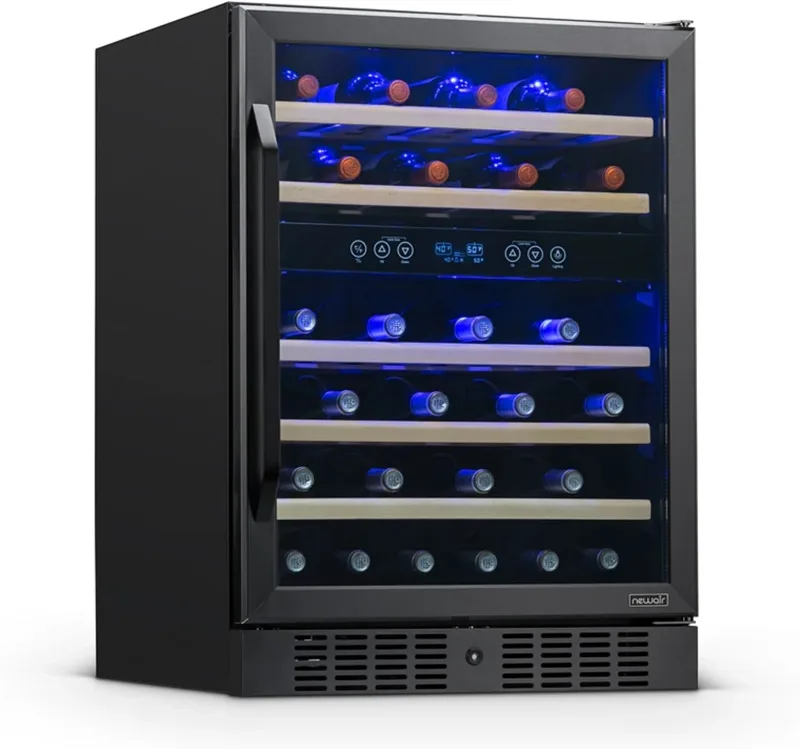
The interior of a wine cooler is a set of racks. Bottles lie on their side, which keeps the wine in contact with the cork and keeps the cork from drying out. Racks are spaced for the diameter of a bottle rather than the height of a can, and the result is a cabinet that holds fewer items than its outside suggests.
Everything else in the design follows from that layout. Air moves gently around the cabinet instead of blasting through it, the compressor cycles less aggressively, and the shelves are often wood or coated wire so bottles do not roll. The unit is a storage cabinet first and a fridge second.
That matters because wine is a slow-moving product. A bottle may sit in the unit for a season or for several years, and the appliance is judged on whether the bottle is in the same condition when it comes out.
A beverage refrigerator is built around cans
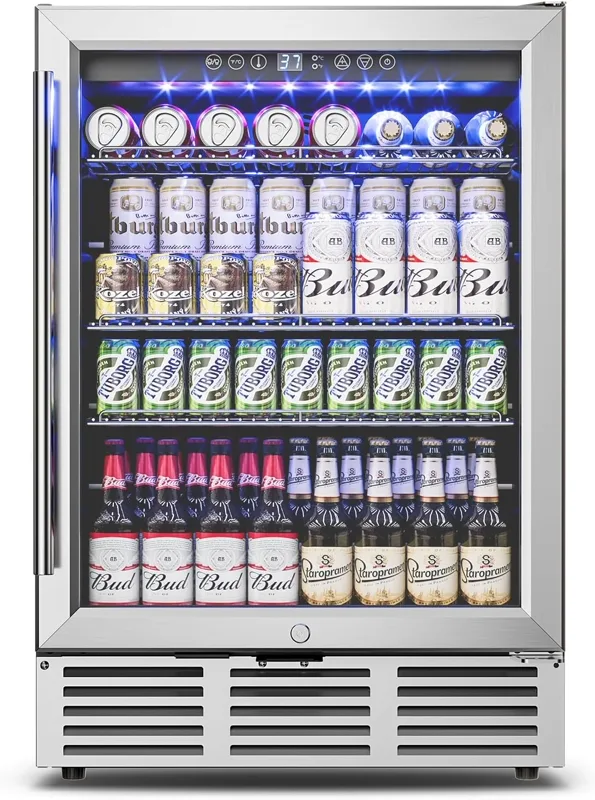
A beverage refrigerator is a cupboard of flat glass shelves. Cans stand upright, bottles stand upright, and the shelves adjust in height rather than in bottle diameter. The same cabinet volume holds noticeably more drink, because nothing is lying down and nothing is wasting space between rack wires.
Most units in this category also run colder at the low end. That is exactly right for soda and beer and exactly wrong for a bottle you plan to keep.
Temperature range and zones decide what you can store
The useful comparison is not the coldest setting but the narrow band each appliance is designed to hold. A wine cooler spends its range in the cellar band, where reds and whites are served and stored. A beverage refrigerator reaches colder and holds there, because a cold can is the point.
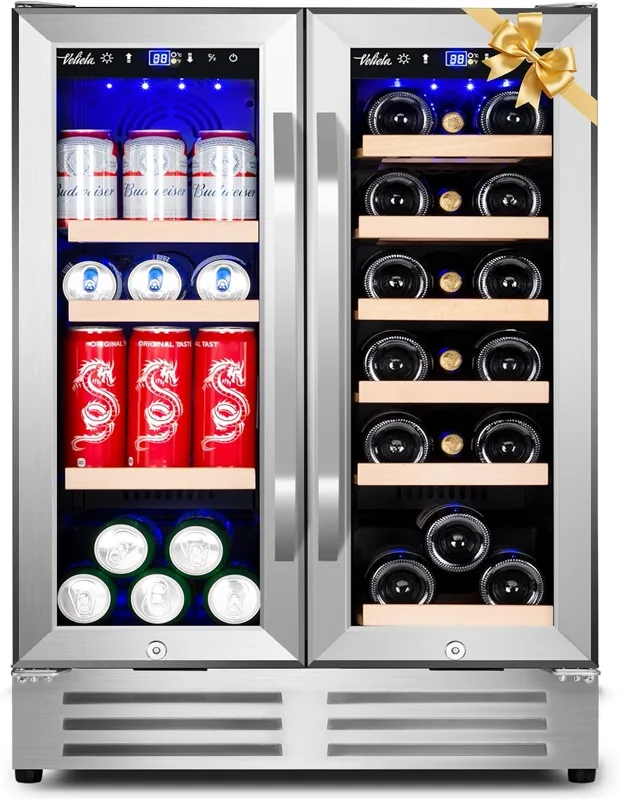
Dual-zone models split the cabinet into two compartments with separate controls. In a wine cooler that usually means a warmer section for reds and a cooler one for whites. In a beverage unit it often means one section for cans and one for bottles, or a small wine section beside the drink shelves.
Two zones only help if you have two things that need different treatment. Otherwise a single zone with a steady setting is simpler, cheaper to run and less to go wrong.
Humidity and vibration matter for long storage
Corks need moisture. In a very dry cabinet the cork shrinks slightly and air reaches the wine, which is the failure mode wine coolers are designed to avoid. That is why the better units manage humidity as well as temperature, and why a beverage fridge with a fan pushing dry cold air is a poor place to keep a bottle for a year.
Vibration is the second difference. Compressors vibrate, and a bottle that sits on a vibrating shelf for months is not in the same condition as one that sits still. Wine coolers damp the compressor and mount it so the cabinet stays quiet; beverage units care much less, because the can is going to be drunk this week.
For anyone buying a unit to hold a mixed collection for everyday drinking, neither point is decisive. For anyone buying storage, both are.
Shelving geometry decides what actually fits
A wine cooler that claims a bottle count is counting standard Bordeaux shapes. Burgundy bottles, sparkling bottles and anything with an oversized shoulder take more room, and a rack built for one shape will hold fewer of another. The stated count is a ceiling, not a promise.
A beverage refrigerator counts cans, and cans are uniform. That is why the capacity figure on a beverage unit is usually closer to the truth, and why the same cabinet feels much bigger when the shelves are flat.
If the plan is a mix of wine, beer, soda and water, a beverage unit with one adjustable shelf and one bottle rack is the practical compromise. It will not store wine for years, but it will keep a mixed household supplied.
Three kitchens, three different answers
The same comparison lands differently depending on how the household drinks. These three cases cover most buyers.
A dozen bottles a week
If wine is opened most evenings and replaced most weeks, the storage argument is weak. A beverage unit with a small bottle section keeps everything cold and reachable, and nobody has to move a rack to get to the white.
Entertaining with cans and bottles
A party fridge needs volume and fast recovery. Flat shelves, a wide temperature range and a door that opens and closes without ceremony matter more than humidity. This is the case a beverage refrigerator was designed for.
A collection that sits for years
If bottles are bought to hold, the unit is furniture for the wine. Steady temperature, managed humidity and a damped compressor become the whole purchase, and a beverage fridge with a glass door and a fan is the wrong cabinet to put them in.
Door glass and light change how the unit lives in the room
Both appliances usually come with a glass door, and both usually have an interior light. In a wine cooler the glass is often tinted to block ultraviolet light, which degrades wine, and the light is on a switch rather than on all the time. In a beverage unit the glass is there to show off the cans.
If the unit is on show, the door frame and the handle matter as much as the cooling. These cabinets are bought partly as furniture, and a unit that looks wrong in the room is a unit that gets moved to the garage.
How the two compare side by side
The table below compares the two appliance types on the points that decide a purchase. On a narrow screen the table stacks into one card per row, so nothing is cut off.
| Aspect | Wine cooler | Beverage refrigerator |
|---|---|---|
| Designed for | Bottles stored on their side | Cans and upright bottles |
| Temperature | Narrow cellar band | Wider range, colder at the low end |
| Zones | Often dual zone | Usually single zone |
| Shelving | Bottle racks | Flat glass shelves |
| Humidity | Managed for corks | Not a design goal |
| Vibration | Damped for long storage | Not a priority |
| Door | Tinted glass, light on demand | Clear glass, display lighting |
| Best for | Holding a collection | Everyday cold drinks |
Where each unit goes in a real kitchen
Most of these cabinets are sized to sit under a counter, which is why the opening decides the purchase more often than the specification sheet does. A unit that fits under the counter looks built in. A unit that stands beside the cabinets looks like an appliance, and in a small kitchen that is a different room.
A wine cooler wants a spot away from the oven and away from direct sun, because both make it work harder. A beverage refrigerator wants to be near where drinks are used, which usually means the end of the run nearest the living space rather than the far corner by the sink.
Both need air at the back or through a vent at the front. Built-in units are designed for that; freestanding ones are not, and a freestanding cabinet pushed into a tight slot will run hot and fail early.
Noise and heat in a small room
Compressors make noise, and the smaller the room the more you hear it. Open-plan kitchens hide the sound in the general noise; a pantry or a snug does not. A wine cooler is usually quieter because it runs less aggressively and does not need to pull the cabinet down to a hard chill.
Heat is the other half of the trade. Every one of these units dumps warmth from the back or the base, and in a small kitchen that warmth is not free. A unit tucked into a closed cabinet with no airflow will run longer, sound louder and last less time.
Running cost and the second-fridge argument
A second cooling appliance always costs something to run, and the honest question is whether it saves more than it costs. For a household that opens the main fridge twenty times a day to reach a can at the back, a drinks cabinet takes pressure off the main appliance and keeps the cold air where it belongs.
For a household that drinks one bottle of wine a month, the same cabinet is a piece of furniture that hums. The running cost is small but the space it occupies is not, and space in a kitchen is the expensive part.
A decision rule for a first unit
If the bottles are for drinking this month, buy the beverage refrigerator. It holds more, it gets colder, and the shelves adapt to whatever the household actually drinks.
If the bottles are for keeping, buy the wine cooler. The racks, the humidity and the damped compressor are all doing a job that a drinks fridge cannot do, and the difference shows up a year later in the bottle, not on the spec sheet.
If the household is both, buy a dual-zone cabinet with one bottle section and one flat shelf. It is a compromise, but it is the compromise most kitchens actually need. For the drinks side of the same counter, our guide to espresso machines versus pod coffee makers covers the other appliance that tends to appear beside it.
What to buy first when you can only buy one
Three questions settle it without more reading.
- Will any bottle stay in the cabinet for more than a season? If yes, buy the wine cooler.
- Is the cabinet mostly for cans, water and beer? If yes, buy the beverage refrigerator.
- Is there a clear, ventilated opening under the counter? If not, fix that before choosing the appliance.
Spend the money where the unit is weakest. On a wine cooler that is the temperature control and the door seal. On a beverage refrigerator it is the shelves and the fan, because a drinks fridge that cannot recover after the door opens is just a cupboard with a light in it.
More kitchen buying guides sit in our kitchen and cooking archive, from countertop appliances to the small cabinets that hold them.