Home improvement · Water heaters
A practical comparison of a storage tank and an on-demand unit, judged by how your household actually draws hot water.
Hot water is invisible until it fails. Then it becomes the most important appliance in the house, and the replacement decision arrives on a bad morning with a contractor asking what you want. The two options sound like a technology question, but they are really a question about your household: how many people draw hot water at once, and how quickly you need it back.
This guide compares a storage tank and a tankless unit on the things that change daily life: waiting, space, install work, maintenance, and the small annoyances nobody mentions. It stays on behavior rather than specifications, the same way our other home improvement and tool comparisons are framed around how a choice plays out in a real house.
The short answer
- Keep a tank if your home already has one, the closet was built for it, and hot water has never been short.
- Go tankless if space is tight and your household rarely draws several hot taps at once.
- Choose tankless only after the electrical or venting work is priced in, because that work decides the project.
- Either way, fix the layout before the appliance: a short, insulated run beats a better heater on a long pipe.
The question is how your household uses hot water
A tank serves a crowd well because the hot water is already made and waiting. A tankless unit serves a steady demand well because it heats as water moves. Neither is better in the abstract. The mismatch shows up when two showers, a dishwasher, and a laundry cycle overlap, or when the first shower of the morning has to wait for a tank to recover.
A tank stores heat; a tankless unit makes it on demand
A storage tank keeps a volume of water hot around the clock, ready for the next tap. A tankless unit sits cold until a tap opens, then heats water as it passes through. The first gives you a reserve you can spend quickly. The second gives you an endless supply, but only at the rate it can heat, which is the part most buyers underestimate.
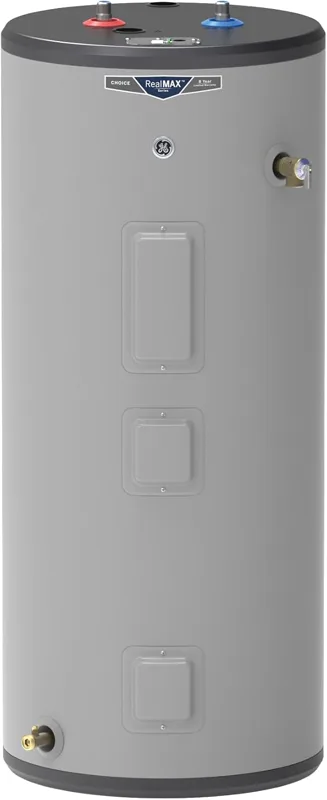
The reserve is the point. A tank absorbs a burst of demand: several taps at once, a long shower, a sink filled for dishes. A tankless unit handles the same burst only if it can heat that volume fast enough at the incoming water temperature, and cold groundwater is the variable that catches people out.
Recovery time decides whether the third shower stays warm
With a tank, the question is recovery. After a long draw, the unit refills and reheats, and the household waits. Whether that wait matters depends on your morning: staggered showers rarely notice it, and three people leaving at the same time notice it every day. With a tankless unit the question changes to capacity, because there is no reserve to spend and no recovery to wait for.
The practical test is to count simultaneous draws. Two showers plus a dishwasher is a heavier load than five showers spread over an hour, and a tank often handles the first case better while a tankless unit handles the second case easily.
- Three showers back to back: watch the recovery, not the tank size.
- A shower running with the dishwasher: watch the shared capacity.
- One long soak: a tankless unit keeps going where a tank runs cold.
Tankless units never run dry, but they can throttle
A tankless unit will keep producing hot water for as long as you run the tap, which is genuinely useful for a long soak or a big laundry day. What it will not do is keep the same temperature when a second tap opens, because the same heating capacity is now shared. The usual symptom is a shower that turns lukewarm when someone starts the kitchen sink.
What flow rate means in practice
Flow rate is the honest way to compare a tankless unit to your habits. It describes how much hot water the unit can deliver at once, so the question becomes how many fixtures you run together. If your household almost never overlaps draws, a modest unit is fine. If it does, you are either buying more capacity or accepting a temperature dip.
Space is where tankless earns its keep
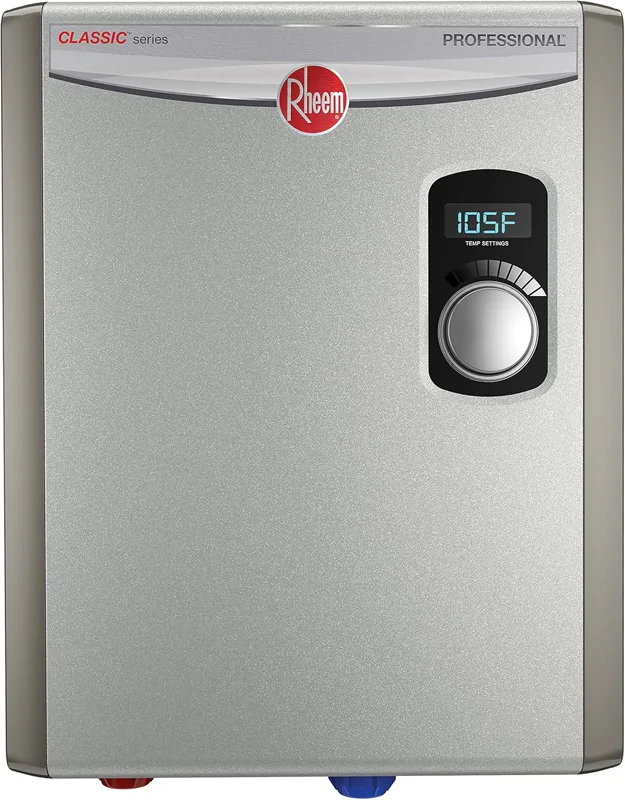
A tank occupies a cylinder of floor or closet space permanently, and it needs clear access for service. A tankless unit mounts on a wall and frees the floor, which in a small house can turn a cramped utility closet into storage or reclaim a corner of a garage. If space is your real constraint, this is the argument that decides the question.
Look at the whole footprint, though, not just the appliance. A tankless install often brings a larger electrical panel, a disconnect, or a vent run, and those additions can eat the space you thought you were recovering.
Install work differs more than the appliance does
Replacing a tank with a tank with the same fuel type is usually a short job: drain, disconnect, swap, refill, test. Moving to tankless is a project. It usually means new electrical capacity, new pipe routing, and in many homes a different venting arrangement. The appliance is the small part of the invoice, and the work is the part that decides whether the idea survives contact with a quote.
Electrical and venting realities
Electric tankless units draw a large current, so the panel needs the capacity and the circuit needs to be dedicated. Gas units need venting that suits their location. Either way, the location has to allow the work: a closet with no clearance, or a wall that cannot be penetrated, will redirect the whole plan. Ask about this before choosing a model, not after.
- Room in the panel for a dedicated circuit.
- A venting route that can legally leave the building.
- A short pipe run to the fixtures that matter most.
Standby heat loss is the tank’s quiet cost
A tank spends energy keeping water hot while nobody is home. That is the price of having a reserve ready, and it is the reason tankless units look attractive on paper. The saving is real but it is spread across a year, while the install cost arrives in one invoice, so the two numbers land very differently in a household budget.
Insulating the tank and the first stretch of pipe narrows the gap, and it is the cheapest improvement available to anyone keeping a tank. If the tank sits in a cold garage or basement, that insulation is doing more work than a change of appliance would.
Noise at the wall is part of living with it
A tank is silent. A tankless unit is not: it starts when a tap opens, and the sound travels in a small house, especially at night. Some households never notice. Others find the fan and the ignition cycle noticeable in a bedroom-adjacent closet. If the unit will share a wall with a bedroom, listen to one running before you decide.
Hard water treats the two types differently
Hard water leaves scale, and scale lands wherever water is heated. In a tank it settles in the bottom and on the element. In a tankless unit it coats the heat exchanger, which is a narrower passage and less forgiving. Neither is a reason to avoid the technology, but hard water makes maintenance the deciding habit rather than an afterthought.
If your water is hard, plan for flushing from the first year. A household that will not do it is usually better served by the simpler appliance, because the failure mode of a neglected tankless unit is expensive.
Side by side on the points that matter
The table compares the two on the behaviors that show up in a normal week. On a phone, swipe it sideways to read both columns.
| Aspect | Storage tank | Tankless unit |
|---|---|---|
| Hot water supply | Limited reserve, then recovery | Continuous while the tap runs |
| Several taps at once | Handled from the reserve | Shared capacity, temperature may dip |
| Space needed | Floor or closet cylinder | Wall mounted, floor freed |
| Install work | Usually a like-for-like swap | Panel, circuit, or vent changes |
| Standby losses | Keeps water hot all day | Heats only when water runs |
| Maintenance | Flush and check the anode | Descale the heat exchanger |
| Noise | Silent in operation | Fan and burner audible at the wall |
| Best fit | Busy mornings, several bathrooms | Tight space, steady single draws |
Maintenance habits decide how long either one lasts
Both types reward a household that keeps a schedule and punish one that does not. A tank asks for a flush and, in many models, a look at the anode rod. A tankless unit asks for a descale, and possibly a filter on the inlet if sediment is a problem. The tasks are small, and skipping them is the difference between a long service life and an early replacement.
Flushing and filter habits
Flushing is a bucket-and-hose job that most homeowners can do once a year with the right fittings. If that sounds unrealistic, factor the cost of a service visit into the decision, because a tankless unit that is never descaled loses capacity quietly and then fails without warning.
Replacement timing: like-for-like or replan the closet
When a tank fails, the household is under time pressure. That is the worst moment to attempt a technology change, because the work has to be designed, permitted, and scheduled. If you want tankless, plan it as a project in advance and keep the old unit running until the new one is ready. Replacing like-for-like buys time to do that properly.
If the current tank is already oversized for the household, a like-for-like swap is also the cheapest path. Right-sizing matters more than the technology: a tank matched to the number of bathrooms and people performs better than a larger one that is never fully used.
Rentals and shared walls change the math
In a rental, the decision usually belongs to the owner, and the simplest reliable option tends to win. In a shared building, venting and panel capacity are shared constraints, and a tankless install may be impossible for reasons that have nothing to do with the appliance. Confirm what the building allows before you fall in love with a wall-mounted unit.
In a house you own, the calculation flips: you can plan the work, choose the location, and treat the install as an upgrade to the utility closet rather than a like-for-like swap.
A short decision order that keeps the project small
Work through these in order. Each one can end the decision early, which is usually a good thing.
- Check whether the existing closet and panel can support the option you want.
- Count simultaneous hot-water draws in your busiest hour, not the average day.
- Price the install work before the appliance, then compare the total.
- Decide who will flush or descale the unit, and how often.
If the answers point in different directions, choose the option that keeps the project small. A well-installed storage tank in the right place will outperform a badly planned tankless unit every winter.