Kitchen appliances · Countertop cooking
Both appliances promise crisp food without heating a full oven, and they get there by two completely different routes.
The comparison gets confusing because the marketing has already merged the two products. Plenty of countertop ovens now carry an air fry button, and a few air fryers claim to bake. That overlap is real, but it hides the decision that actually matters: one appliance moves hot air fast around a small basket, the other radiates heat from elements into a box. Everything else — capacity, cleaning, what fits on the counter, what you stop using — follows from that difference.
This guide is about behaviour rather than shopping tiers. It explains what each machine does well, where each one quietly fails, and which one earns counter space in a normal kitchen that already has a range. Prices quoted are the US listings seen when the picks were checked.
The short answer
- Choose a basket air fryer if the food you cook is mostly frozen, breaded, or vegetables, and you want it fast with very little oil.
- Choose a toaster oven if you want one box that toasts, bakes, broils, and reheats, and you regularly cook for two or more people.
- Choose an air fryer toaster oven when the counter only has room for one appliance and your meals are small.
- Whatever you pick, measure your counter depth and your cupboard clearance first. Both appliances vent hot air, and both need a few inches of air behind them.
What each appliance actually does well
A basket air fryer is a small convection oven with a fan at the top and a perforated floor. Because the volume is tiny, the air moves fast and the surface of the food dries out quickly. That is the entire mechanism behind the crispness people describe as fried. Fries, chicken wings, nuggets, Brussels sprouts, and anything breaded come out with a crust because the moisture leaves the surface faster than the interior overcooks.
A toaster oven is a box with heating elements above and below, and in better models a fan that turns it into a convection oven. It cooks by radiation plus air. That combination browns the top of a casserole, melts cheese, and handles toast in a way a basket cannot, because you can see the surface and the elements are close to it. It also accepts a pan, a tray, or a small dish, which is why it can replace the big oven for small meals.
The practical difference is shape. A basket constrains food into a deep cylinder. A box constrains food into a shallow rectangle. If your meals are portions, the cylinder is more efficient. If your meals are dishes, the rectangle is the only one that fits.
Capacity is measured in food, not in quarts
Air fryer capacity is quoted in quarts, toaster oven capacity in cubic feet, and neither number tells you how much dinner you get. The useful comparisons are on the box: a five-quart basket typically holds about four pounds of fries or five pounds of wings, and a 0.6 cubic foot oven holds six slices of toast, a twelve-inch frozen pizza, or a nine by eleven inch pan.
That gap matters more than it looks. A basket holds one layer of food if you want it crisp; stack it and the middle steams. A box holds a tray of food and lets you use two rack positions in some models. So a five-quart air fryer that claims to serve four is really serving four portions of a side, while a modest toaster oven is genuinely cooking a small main course for four.
The toaster oven’s quiet second job
The strongest argument for a toaster oven is not that it air fries. It is that it replaces preheating a full-size oven for small jobs. A range oven takes ten to fifteen minutes to come to temperature and then heats a cavity large enough for a turkey, for a tray of six cookies. A countertop oven reaches temperature in a few minutes and heats roughly a cubic foot. In summer that difference is comfort; in a small kitchen it is the difference between cooking and ordering in.
It is also the appliance that reheats best. Leftover pizza, a sandwich, a plate of roasted vegetables, all come back with texture that a microwave cannot produce. None of that has anything to do with air frying, and it is why a toaster oven tends to stay plugged in.
Where the air fryer wins without argument
Speed on small quantities, and cleanup. A basket air fryer preheats in two or three minutes and finishes a portion of frozen food in ten to fifteen. The basket and crisper plate come out and go in the sink, and many are dishwasher safe. There is no rack to scrub, no crumb tray to empty, no interior walls to wipe.
It is also far more forgiving about oil and about mess. A breaded cutlet cooked on a tray spits onto the walls of an oven; the same cutlet in a basket drips through the perforated floor into a cup below. If you cook breaded food several times a week, that alone justifies the appliance.
The catch is that a basket is poor at anything wet, anything with batter, and anything large. You cannot put a whole chicken in most five-quart models, you cannot bake a cake with a loose batter, and you cannot cook a casserole. Buyers who expect an air fryer to replace an oven end up disappointed for exactly this reason.
Where a toaster oven wins back the counter
Versatility per square inch. One box toasts, bakes, broils, roasts, and in the better models runs a convection setting close enough to air frying that most people stop noticing the difference. It accepts real cookware, which means a small lasagna, a sheet-pan dinner for two, or a batch of cookies is on the table without touching the range.
The trade is time and cleaning. Toaster ovens preheat more slowly than a basket, they hold less food, and they get dirty in ways that need attention: crumb trays, racks, splatter on the door glass and the interior walls. Their elements are exposed, so anything that spits lands on a heating tube and stays there.
Smaller countertop ovens also have a hard limit that the specs do not advertise: because the elements sit close to the food, the top of a tall item browns before the inside cooks. Bread, a tall cake, anything domed needs a lower rack position and often a foil shield.
The hybrid is a real category now
The appliance that has quietly taken over the middle of this market is the air fryer toaster oven: a box with a strong top-mounted fan and four elements, sold as a seven-in-one. It is not a basket air fryer in disguise. It is a toaster oven with enough airflow to crisp, and in practice it does both jobs at roughly eight out of ten.
If you have room for exactly one countertop appliance and you cook a mix of portions and dishes, this is the type to buy. If you have room for two and you cook breaded food constantly, a cheap basket plus a basic toaster is still the better pair, because each one is excellent at its own job and neither is compromised.
Heat, smell, and the counter you actually have
Both appliances dump a lot of heat into the room and both need clearance. A basket air fryer vents from the back or top and will fog a cupboard shelf that sits too close; a toaster oven radiates from the door and the sides and needs several inches above and behind. Neither belongs under a low wall cabinet with a shelf directly overhead.
Noise is the other difference nobody mentions. A basket air fryer is a fan running at close range, and it is loud enough to make a phone call awkward. A toaster oven with a convection fan is quieter but still audible for the length of the cook. If your kitchen is open to a living room, notice that before you buy.
Three appliances, three different jobs
The three picks below are not a ranking. Each one stands for a case you might actually be in, and each was checked as a live US listing with delivery to a New York ZIP code and a working add-to-cart button at the time of writing.
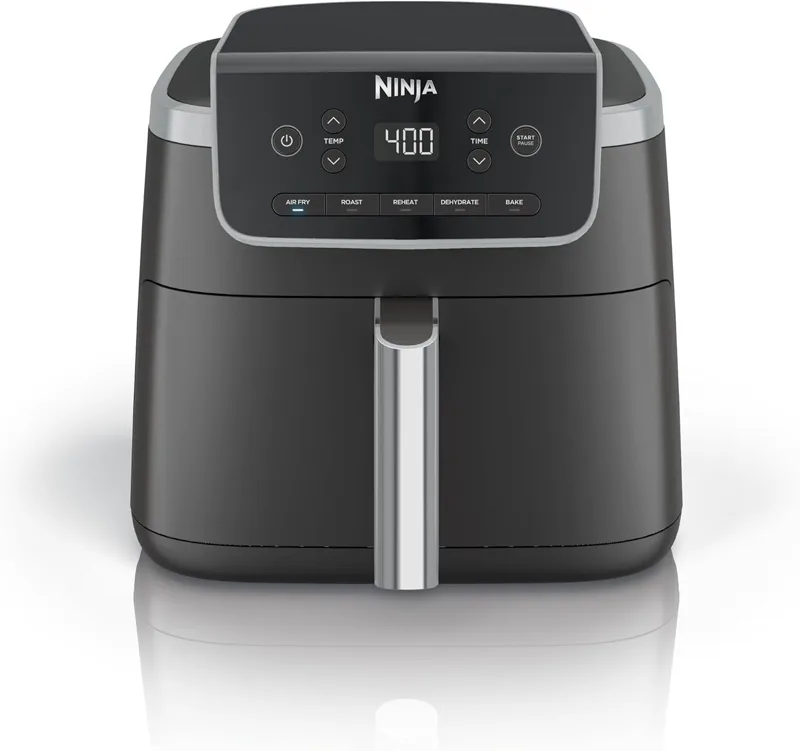
- Basket case, about $110: the Ninja Air Fryer Pro AF142 is a five-quart, 1,750-watt basket machine with five functions, a nonstick basket and crisper plate, and a 400 F ceiling. It fits four pounds of fries or five pounds of wings and is the cheapest way to find out whether you actually cook this way.
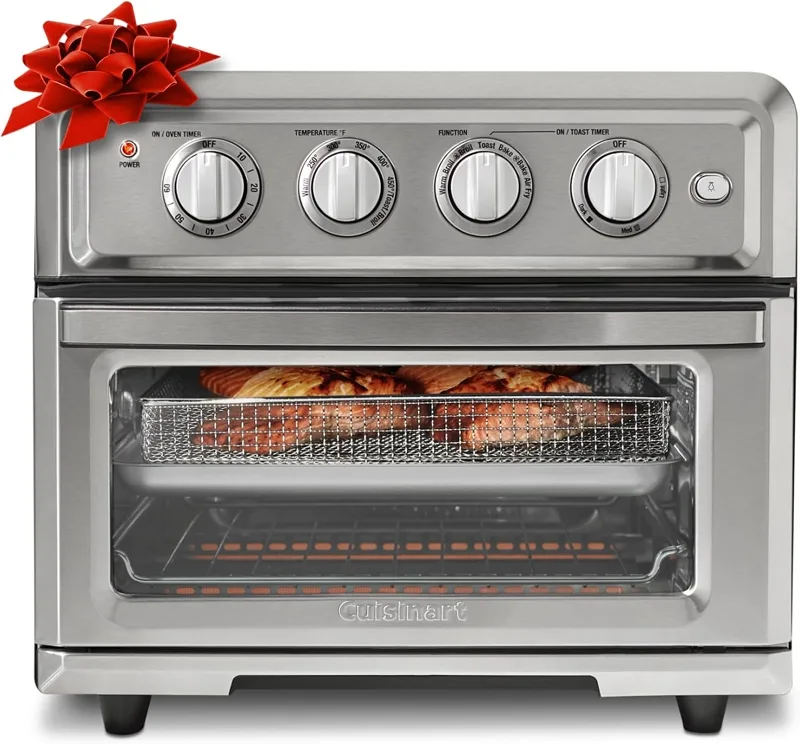
- One-appliance case, about $130: the Cuisinart TOA-55 is a 0.6 cubic foot air fryer toaster oven with seven functions, four elements, a top-mounted fan and a sixteen-inch footprint. It handles six slices of toast, a twelve-inch pizza, or a nine by eleven pan, which is the widest range of jobs per dollar here.
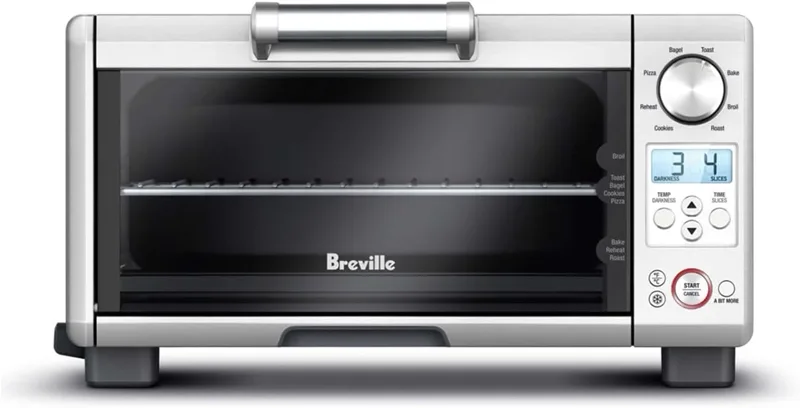
- Small-kitchen case, about $160: the Breville BOV450XL Mini Smart Oven runs eight functions from five quartz elements with an 1,800-watt preheat, in an interior of eleven by ten by four inches. It is the most precise of the three and the one that fits where a full-size oven will not.
A decision rule for a normal kitchen
If your meals are portions and your freezer is full of things that go crispy, buy the basket and stop reading. If your meals are dishes and you want to stop preheating a range oven for two people, buy the toaster oven. If you cannot answer either question yet, buy the hybrid, because it is the one that will still be on the counter after a year of not knowing.
- Mostly frozen and breaded food, one or two people: basket air fryer.
- Toast, pizza, small bakes, reheating: toaster oven.
- One appliance only, mixed cooking: air fryer toaster oven.
- Daily breaded food plus daily toast: buy both, and buy the basket cheap.
For the basket side of the question in more depth, the earlier guide to oil-free air fryers covers model-level detail, and the kitchen and cooking archive collects the rest of the countertop comparisons.
The table below compares the two appliance types on the points that decide the purchase. Swipe sideways on a phone to see the full row.
| Aspect | Basket air fryer | Toaster oven |
|---|---|---|
| Cooking method | Fast air through a small basket | Radiant elements plus convection air |
| Best at | Frozen, breaded, vegetables | Toast, bakes, pizza, reheating |
| Cookware | Basket and crisper plate only | Rack, tray, small pans |
| Preheat | Two to three minutes | Five to ten minutes |
| Cleaning | Basket in the sink | Crumb tray, rack, door glass |
| Fits a whole chicken | Rarely | In larger models |
| Counter footprint | Tall, narrow | Wide, shallow |
| Heat and smell | Vents up and back | Radiates from door and sides |
| Typical US price | Roughly $80 to $200 | Roughly $100 to $350 |
One last note on expectations. Neither appliance replaces a range for a family of five, and neither is a good grill. What they replace is the decision to turn on a large oven for a small job. Once that is the question, the answer is usually whichever one you will actually clean.