Workshop tools · Jointers
Two inches of capacity sounds like a small upgrade until you are squaring a board that is three inches too wide for the machine you own.
A jointer is the one machine in the shop that makes a board flat before anything else can be square. The capacity question is simple to state and surprisingly hard to answer: six inches of cutterhead or eight. The difference looks like a number on a spec sheet, and it behaves like a different workflow once the first wide board comes through the door.
This comparison is about behaviour rather than specifications: how much stock each width actually covers, what a second pass costs in time and glue lines, and where the extra capacity stops earning its footprint in a small shop. It is not a ranking of individual machines.
The short answer
- Measure the widest board you regularly flatten, not the widest board you can imagine buying.
- Choose six inches when the shop is small, the stock is dimensional, and the budget goes further elsewhere.
- Choose eight inches when you buy rough lumber, build panels, or glue up more than one board at a time.
- Decide on table length and cutterhead before you decide on width, because both change the result more.
Capacity is about the board you flatten, not the fence width
A jointer does not make a board thinner; it makes one face flat and one edge square. The cutterhead width sets the widest pass you can take in a single stroke. Everything wider has to be jointed in two passes or flattened by another method, and that single limitation drives the whole decision.
The useful question is not how wide the machine is but how wide the stock is. A shop that works from dressed lumber rarely needs more than six inches. A shop that buys rough boards will meet the limit on the first afternoon.
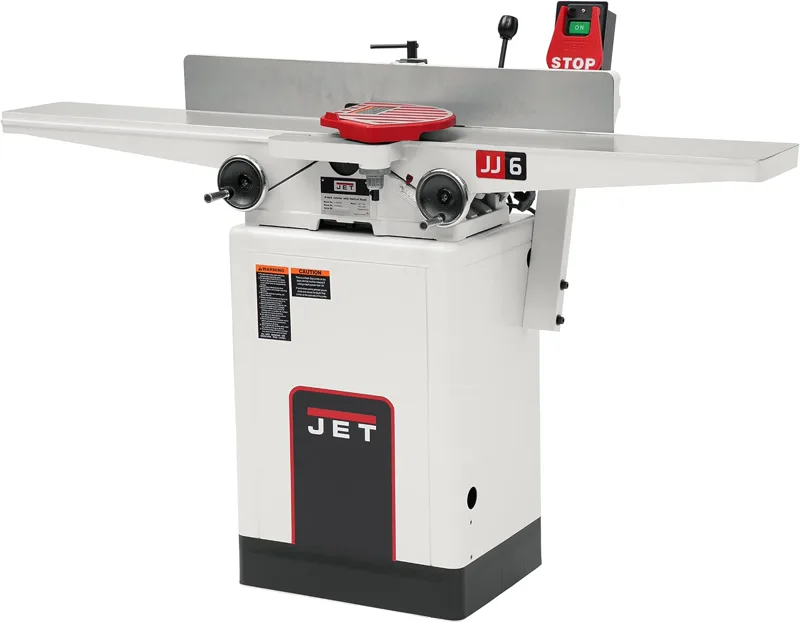
A six-inch machine covers the stock most shops actually buy
Six inches is the width of most dimensional hardwood, most cabinet parts, and nearly every rail and stile a small shop cuts. For a garage workshop building cabinets, shelves, and small furniture, a six-inch jointer will flatten the face and square the edge of almost everything that comes through the door.
The machine is also smaller, lighter, and cheaper to run. It fits on a mobile base, it does not need a dedicated 230-volt circuit in most cases, and it leaves floor space for the tools that earn more of the work. In a shop where the car still has to park inside, that is not a small advantage.
Eight inches buys you the second pass
Eight inches does not just add two inches of cut. It removes a whole category of workaround. A board that is nine inches wide can be flattened on an eight-inch machine with a single pass and a small ridge. On a six-inch machine it needs two passes with a stepped surface in the middle, and the step has to be planed away afterwards.
For anyone building glued panels, that difference is the whole job. Wide stock, bookmatched boards, and table tops all start with a flat reference face, and the wider the machine the fewer passes stand between rough lumber and a panel that closes without a gap.
Cutterhead type changes the cost of ownership
A straight-knife head is the least expensive way into jointing, and it is also the most demanding. Two or three knives have to be set to the same height, a nick in one knife means resetting all of them, and the finish is limited by how sharp the edge is on the day. It works, and it works best for someone who enjoys setup.
A spiral or helical head replaces the straight edge with dozens of small inserts set at an angle. A damaged insert is rotated or replaced in minutes, the cut is quieter, and the finish is closer to sanding-ready. The trade-off is a higher purchase price and a cutterhead that is heavier to clean when resin builds up.
Spiral, helical, and straight knives
The names are used loosely, but the practical difference is insert geometry. A true helical head shears the wood at a slight angle, while a spiral head with straight-set inserts cuts like a segmented straight knife. Both beat a straight head on tearout in figured stock.
Table length and support decide the quality of a long edge
A short bed lets the trailing end of a long board drop, and a dropped board cuts a curve. That is why table length matters more than most buyers expect: the infeed and outfeed have to support the board until the cut is finished. An eight-inch machine with a short bed will still produce a hollow edge on a long rail.
Support can be added with rollers or a stand, but the bed itself sets the ceiling. A machine with long cast tables and a solid fence gives you a straight edge without thinking about it, and a machine with short tables makes every long board a two-person job with a straightedge check at the end.
Benchtop frames trade mass for space
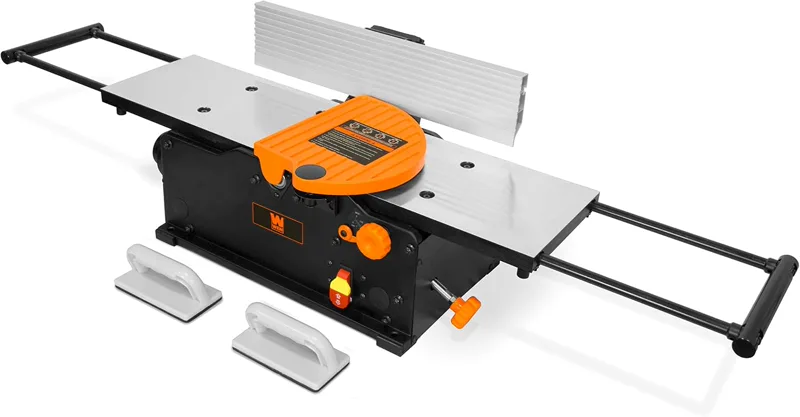
A benchtop jointer sits on a bench or stand and is lifted into place when needed. The frame is lighter, the tables shorter, and the motor smaller, but it takes almost no floor space and can be stored against a wall, which is often the only way a jointer fits in a single-car garage.
The compromise is stability. Light machines transmit vibration into the cut, and a bench that flexes will show up as a ripple in the finished face. Bolting the machine to a solid top and adding mass underneath is the usual fix, and it is worth doing before blaming the knives.
Where benchtop machines fall short
The limits appear on wide, heavy stock. A long board on a short bed is hard to control, and a heavy board on a light frame wants to tip. If most of the work is small parts, none of this matters. If most of the work is eight-foot boards, it matters on every cut.
Feed direction and grain decide the result
A jointer cuts with the grain or against it, and the difference is visible immediately. Feeding with the grain leaves a clean surface; feeding against it lifts the fibres and tears them. On figured stock no direction is fully clean, which is where a helical head earns its price.
Read the edge before the first pass. Look at the grain direction on the side of the board, not the face, and take light passes in the direction that leaves the cleanest surface. A shallow pass in the right direction beats a heavy pass in the wrong one.
Setup and knife changes set the real maintenance cost
A straight-knife head asks for a straightedge, a setting gauge, and patience. Knives have to sit level with the outfeed table, and a knife that is proud will leave a snipe at the end of every pass. Once the knives are set, they stay set for a while, but the first setup is an evening of work.
An insert head turns that evening into ten minutes. A chipped insert is loosened, rotated, and tightened, and the machine is back in service. For a shop running a lot of stock, the time saved pays back part of the purchase price within a couple of years.
Dust collection scales with width
A jointer produces long curls rather than fine dust, and those curls bridge in a narrow chute. Wider machines move more material per pass, so the port and the hose have to keep up. An undersized collector leaves chips on the outfeed table, which then get dragged back through the cut.
The usual arrangement is a four-inch port and a short hose to a collector with real volume. A shop vacuum works for a benchtop machine taking light passes, but it will not keep up with a wide board on a helical head.
Noise, wiring, and shop layout
Jointers are not the loudest machines in the shop, but they run long enough to matter. A helical head is noticeably quieter than a straight knife at the same motor size, and in a shared garage that decides whether the machine runs in the evening or waits for the weekend.
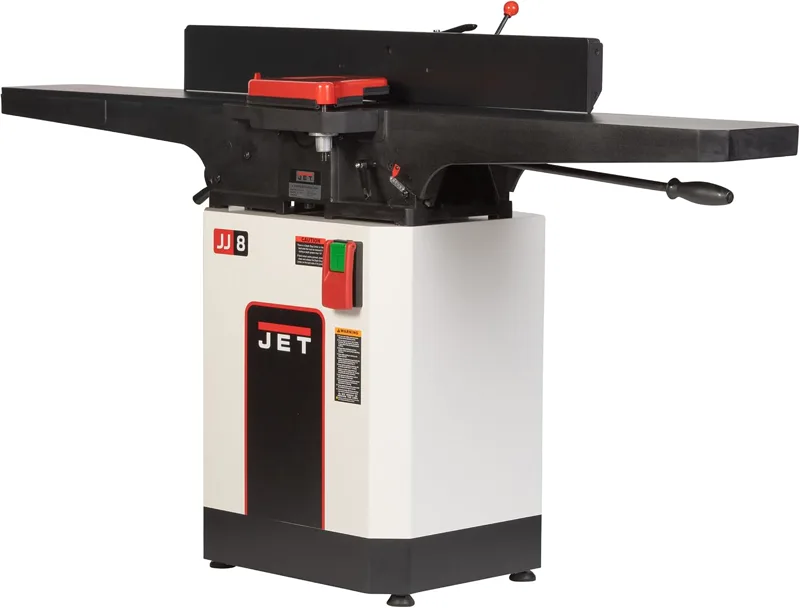
Wiring is the other practical limit. Most six-inch machines run on a standard circuit, while eight-inch floor models often want 230 volts. Checking the circuit before the machine is ordered is cheaper than discovering the requirement after delivery, and a dedicated outlet is a small job compared with moving a shop.
Matching the jointer to the planer
The jointer flattens one face; the planer makes the opposite face parallel. A planer that handles wider stock than the jointer can flatten will spend its life waiting, because the board has to be flat before it can be planed. The two machines should be chosen as a pair, not one at a time.
That usually means the jointer sets the practical width of the shop, and the planer follows. Buying a wide planer first and a narrow jointer second is the most common way to end up with two machines that cannot finish a wide board together.
Buying order for a small shop
If the budget only covers one machine this year, the jointer comes first. A planer cannot flatten a twisted board, and every project starts with a flat reference face. A jointer and a thickness planer together cover the whole job, and the jointer is the one that makes the other useful.
When the bigger machine is the cheaper one
An eight-inch machine that removes the need to buy dressed stock, or to drive to a shop with a wide jointer, can be the cheaper choice over a few years. That calculation only works if the floor space and the circuit exist, which is why measuring the shop comes before comparing the models.
A decision rule for a small shop
If the stock is dimensional and the shop is shared with a car, a six-inch machine with long tables is the better tool. If the stock is rough, the projects are panels, or the shop has room for a floor model, eight inches removes a recurring obstacle. The rest is layout and wiring.
- Dimensional stock, small shop, one circuit: six inches.
- Rough lumber, panels, daily use: eight inches.
- Long boards on either width: add support before you add capacity.
The planer versus jointer decision explains which machine to buy first, and the tools archive collects the rest of the workshop comparisons.
The table below compares the two capacities on the aspects that come up most often in a small shop. Swipe sideways on a phone to see the full row.
| Aspect | Six-inch jointer | Eight-inch jointer |
|---|---|---|
| Widest single pass | Six inches | Eight inches |
| Wide boards | Two passes plus a step | One pass and a ridge |
| Table length | Shorter on most models | Longer, more support |
| Footprint | Bench or small stand | Floor model, fixed space |
| Circuit | Usually 115 volts | Often 230 volts |
| Cutterhead options | Straight or helical | Straight, spiral, helical |
| Rough lumber | Workaround needed | Natural fit |
| Cost of entry | Lower | Higher |