Home office · Desks
One desk moves its top up and down at the push of a button. The other gives you drawers, surface and a lower bill. The room usually decides which one you should own.
A standing desk and a traditional desk get sold as a health argument, and that framing is where most of the money goes wrong. The real difference is mechanical. One work surface moves; the other does not. Storage, stability, cable behaviour and assembly all follow from that single fact, and so does the way the desk behaves in a small room.
This guide compares the two on the points that decide a purchase: footprint, height range, storage, steadiness, noise and assembly. It ends with a decision rule for renters and first offices.
The short answer
- Choose a standing desk if you spend most of the day at a screen and want to change position without leaving the room.
- Choose a traditional desk if your work runs on paper, tools or two monitors and you rarely feel the urge to stand.
- Measure the room before you compare desks. Depth and clearance behind the chair decide more purchases than height range does.
- A height-adjustable frame with a plain top usually serves a home office better than a fixed desk with elaborate drawers.
A standing desk trades storage for height
The frame is the expensive part of a standing desk, and it takes up the space a pedestal would normally occupy. Motors, legs, a control box and a crossbar all have to live under the top, which leaves very little room for deep drawers. Most standing desks answer this with a slim drawer, a hook for a bag, or nothing at all.
The practical consequence is that everything you would have stored inside the desk has to go somewhere else, and that furniture needs floor space the desk no longer uses.
A traditional desk trades height for surface area
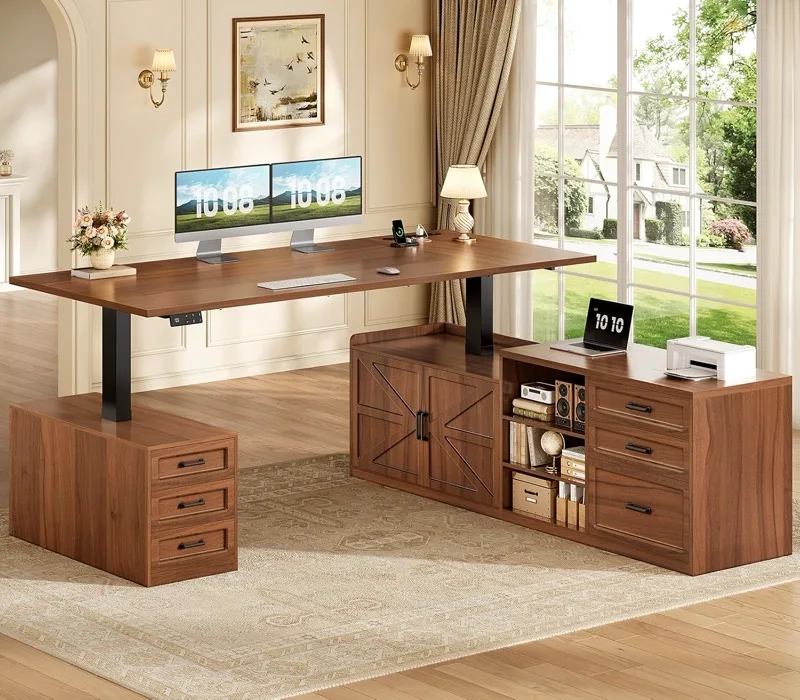
A fixed desk puts its mass where a standing desk cannot: under and beside the working area. Pedestals, file drawers, a keyboard tray and a hutch all fit because nothing has to move. That is why a traditional desk in the same footprint usually offers more usable storage and often a deeper top.
The trade is that the height is decided once. If two people share the desk, one of them sits at the wrong height all day. If the chair is replaced, the relationship between seat and top changes and the desk cannot follow. A fixed desk is a commitment to one working posture and one chair.
Height range decides whether standing is comfortable
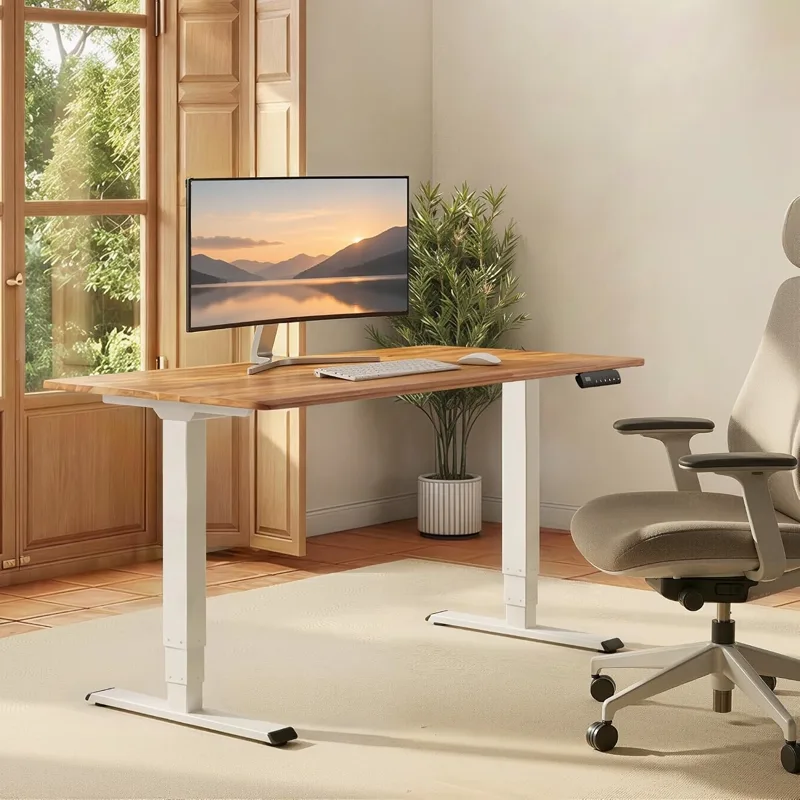
A standing desk is only useful if its lowest and highest settings suit the people who use it. The top has to come down far enough that a shorter user can sit with feet flat, and rise far enough that a taller user can stand with elbows near a right angle. A frame that stops short turns the standing position into a lean.
This is the one place where a traditional desk is simpler. There is no range to check, only a height, and a desk that is wrong for you is obvious within a week. With a standing desk the mistake is harder to spot because the desk looks capable until you try to use the top of its travel.
Footprint and depth decide what fits the room
Most standing desks need clear space behind the chair, because the frame and the crossbar sit close to the back edge and a skirting board can stop the legs from going where you want them. A desk pushed tight into an alcove often loses the last few centimetres of travel or ends up rocking against the wall.
A traditional desk can be pushed flush against a wall. That sounds trivial until the room is narrow. In a bedroom office or a landing, the ability to put the back edge against plaster is worth more than an adjustable height, because it buys walking space.
Stability is where the first price gap shows
A fixed desk is stable by construction. Four legs, a braced frame and a heavy top do not wobble, and there is nothing to adjust. A standing desk has to be stable at every height in its range, and the taller it goes the harder that becomes. Cheaper frames show it as a side-to-side sway when you type with the desk raised.
Wobble is not a cosmetic issue. It changes how you use the desk: a monitor that shakes makes you shorten the standing sessions, and a desk that moves when you write pushes you back to sitting. The frame, the number of legs and the bracing are what you are paying for, not the top.
Three setups, three different desks
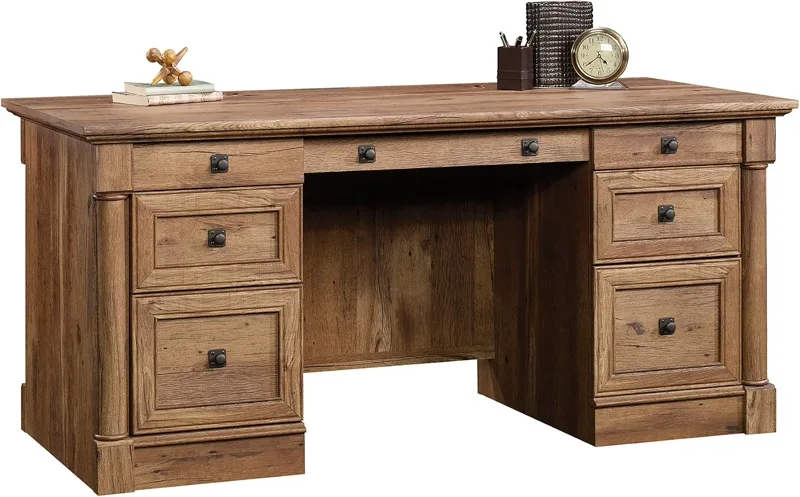
The same comparison lands differently depending on what sits on the desk. These three cases cover most home offices.
A laptop and one monitor
This is the lightest possible load, and it is where a standing desk makes the most sense. The desk carries a laptop, a screen and a mug, so stability at height is easy to achieve and the height range can be shared between two people. Storage can move to a shelf without much pain.
Dual monitors and paperwork
Two screens on arms put a lever on the back of the desk, and paperwork needs surface that stays still. A traditional desk handles both without drama. If you want height as well, look for a frame with a wide top and a crossbar, and accept that the drawers will be shallow.
A bedroom office
In a shared bedroom the desk is also furniture, and it is seen from the bed. A fixed desk with closed drawers hides clutter in a way an open frame does not. A standing desk wins only if you can keep the cables and the under-desk storage tidy enough to look at from across the room.
Storage is the difference you notice in week two
In the first week the height adjustment is the novelty. By the second week the question is where the printer paper, the spare cables and the notebooks went. A standing desk with no storage pushes all of that onto the floor or into a shelf, and a shelf is another piece of furniture in a room that may not have space for it.
A traditional desk with a file pedestal absorbs that clutter silently. The cost is that the pedestal cannot move with the desk, so a standing desk that adds a separate drawer unit has to plan for the unit to stay put while the top rises above it.
- If your clutter lives in drawers, a traditional desk is doing real work for you.
- If your clutter lives in a cupboard anyway, the storage argument disappears.
- If you add a rolling drawer unit to a standing desk, check that it clears the frame at the lowest setting.
How the two compare side by side
The table below compares the two desk types on the points that decide a purchase. On a narrow screen the table stacks into one card per row, so nothing is cut off.
| Aspect | Standing desk | Traditional desk |
|---|---|---|
| Work surface | Moves through a height range | Fixed at one height |
| Storage | Thin drawer or none | Pedestals and file drawers |
| Footprint | Needs clearance behind the chair | Sits flush against a wall |
| Stability | Depends on the frame at full height | Steady by construction |
| Shared use | Two users, memory presets | One height for everyone |
| Cable behaviour | Cables travel with the top | Cables stay where they are put |
| Assembly | Heavier, usually two people | Flat pack, simpler |
| Best for | Screen work and changing posture | Paper, tools and dual monitors |
Sitting and standing need a transition habit
A standing desk does nothing on its own. The value comes from changing position several times a day, and that only happens if the change costs nothing. A preset button costs nothing. A crank, a cluttered top or a monitor that has to be re-aimed after every move is enough friction to stop the habit within a month.
The habit also needs somewhere to stand. In a small room the desk rises into the space where the chair was, so the chair has to roll clear. If it cannot, the standing position becomes a shuffle rather than a posture you can work in.
Assembly and moving day
A standing desk arrives as a frame, a top and a control box, and the frame is heavy. Assembly usually needs two people to flip the assembled base and to lift the top without twisting it. Taking it apart to move house is the same job in reverse, with the added risk of losing the cable clips.
A traditional desk is often simpler to build and easier to move, because there is no wiring and no calibration. A pedestal desk can usually be carried by two people in one piece, which matters in a rental where you move every couple of years.
Noise, wobble and shared rooms
Motors are quiet but not silent, and in a shared flat the sound of a desk rising at seven in the morning carries. It is a short sound, not a continuous one, and most people stop noticing it after a week. The bigger issue in a shared room is movement: a desk that rises while someone is working beside it is distracting.
A traditional desk makes no sound and moves never. In a room that doubles as a living space, that stillness is worth something. So is the fact that a fixed desk can hold a lamp, a plant and a stack of books without any of them needing to be cleared before the desk changes height.
A decision rule for renters and first offices
If you rent, move regularly or share the room, start with a traditional desk. It is easier to move, easier to place against a wall and easier to live with when the room has another purpose. Add a standing desk later, when the room is yours and the desk can stay in one place.
If the room is stable and the work is screen-based, start with a standing desk and put the storage on the wall. The height range is the feature you will use every day, and the missing drawers are a problem you can solve with a shelf.
For more on the sitting side of the equation, our guide to choosing a standing desk chair covers what to look for when the desk can move but the chair cannot, and how long to stand at a standing desk covers the pacing question that decides whether the feature gets used.
What to buy first when you can only buy one
Three questions settle it without more reading.
- Does the room allow clear space behind the chair? If not, buy the fixed desk.
- Do two people share the desk at different heights? If so, buy the adjustable one.
- Does your work depend on drawers and a surface that stays still? If so, buy the traditional desk and stop looking.
Whichever way that goes, spend the money on the part that fails first. On a standing desk that is the frame and the control box. On a traditional desk it is the joints and the drawer runners. A cheap top on a good frame outlasts an expensive top on a bad one.
Browse the rest of our home improvement and tools guides for the furniture and fittings that go around a desk, from lighting to cable management.