
Kitchen appliances · Comparison
One machine sits on the counter and makes a small amount of soft ice very fast. The other is built into a cabinet and makes a large amount of hard ice slowly, all day. Choosing between them is mostly a question about how many people drink from your ice bin and where you are willing to give up floor space.
The short answer
- A countertop nugget machine is a lifestyle purchase: chewable ice, first batch in about ten minutes, no plumbing.
- An under-counter machine is a supply purchase: a large daily output held in an insulated bin, plumbed in, and out of sight.
- For two people and a few drinks a day, the countertop unit wins on effort and loses nothing that matters.
- For a household that fills a cooler on weekends or hosts often, the under-counter unit is the only one that keeps up.
- Neither is cheap to run, and neither survives neglect: both need descaling on a schedule you will not enjoy.
Two different products wearing the same word
“Ice maker” describes a machine that freezes water into ice. It does not describe where the machine lives, how much ice it holds, or who fills it. Those three details decide whether you end up with a machine you use every day or one you clean twice a year and resent.
The countertop nugget maker and the under-counter cube machine differ in almost every design decision. One is optimised for the first ten minutes. The other is optimised for the tenth hour. Understanding that split makes the rest of the comparison mechanical rather than emotional.
What a countertop nugget maker actually delivers
Nugget ice is not a cube. It is compacted flake ice, pressed into a soft pellet that holds a drink’s flavour and crunches when bitten. The machine makes it by scraping ice off a chilled cylinder and extruding it, which is why the output feels nothing like what a freezer tray produces and why the texture survives in a glass far longer than a hard cube that cracks and melts.
A countertop unit produces its first batch quickly, holds a modest bin — enough for a few rounds of drinks rather than a party — and reuses meltwater so the reservoir lasts longer between refills. It needs a socket and a flat surface, nothing else. That absence of plumbing is the entire appeal: you can put it on a counter in a rental, move it to a bar cart for a weekend, and take it with you when you move house.
The limits are equally structural. The bin is small, so a household of four will empty it during dinner. The ice is soft, so it does not survive in a cooler. And the machine is loud in the specific way that extrusion is loud — a steady mechanical grind that you notice in an open kitchen and forget in a closed one.
What an under-counter machine actually delivers
An under-counter machine is a refrigeration appliance. It is plumbed to a water line and a drain, it freezes water over an evaporator plate in a cycle, and it drops the resulting cubes or “hat” shapes into an insulated storage bin that keeps them frozen until someone scoops them out.
The advantage is throughput held in reserve. A large daily output means the bin refills faster than a household can empty it, so the answer to “is there ice” stops being a question. The machine is also out of sight, which matters more than people admit: a countertop appliance occupies the most contested surface in the kitchen, and an under-counter unit occupies a cavity that was mostly wasted anyway.
The cost is installation. You need a water supply, a drain, ventilation clearance at the front or rear depending on the model, and a cabinet opening at the stated dimensions. In a kitchen without a spare cavity, none of this is a small job, and a machine that fits a 15-inch gap will not fit an 18-inch one.
Side by side, in the terms that decide it
| Aspect | Countertop nugget maker | Under-counter machine |
|---|---|---|
| Ice type | Soft nugget, chewable | Hard cube or hat shape |
| Time to first ice | About ten minutes | Twenty to thirty minutes per cycle |
| Daily output | Small, sized for drinks | Large, sized for a household or a bar |
| Storage bin | A few pounds, melts back into the reservoir | Insulated, holds a full day’s production |
| Installation | Counter space and a socket | Water line, drain, cabinet cut-out |
| Noise | Continuous extrusion grind | Cyclical compressor and harvest clatter |
| Best use | Drinks for one to three people | Coolers, entertaining, a wet bar |
| Maintenance | Descale reservoir, clean the auger | Descale plate, clean bin, replace filter |
| Moving house | Carry it out | Disconnect it and hope the new kitchen fits |
Three machines that cover the range
Countertop nugget machines differ mainly in reservoir size and how much of the work they automate. Under-counter machines differ in output and bin capacity. The three below are not three prices for one job; they are three answers to three different kitchens.
The countertop standard: GE Profile Opal 2.0
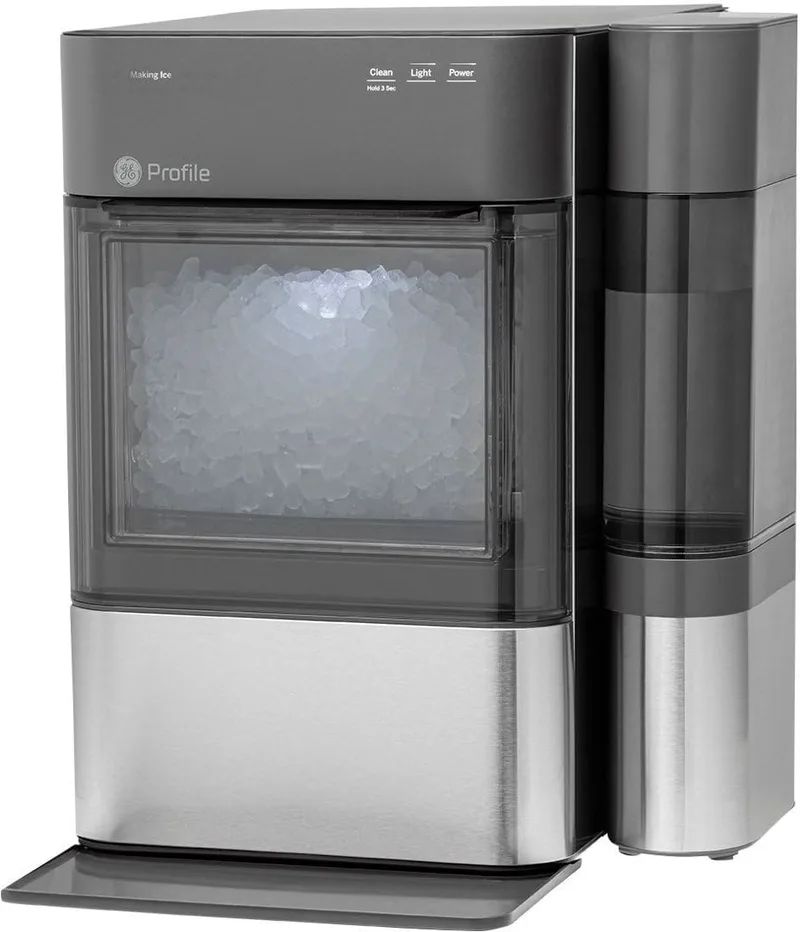
The machine most people picture when they hear “nugget ice”. It extrudes soft pellets, holds a removable drawer of ice, and can be paired with an app to schedule production so the bin is full when you get home rather than at three in the afternoon.
The version worth considering is the one with the attached tank, because it removes the need to plumb anything at all and roughly triples how long the machine runs between refills. If counter space is tight, measure first: the tank adds width, and a counter that fits the base unit may not fit the tank. See the GE Profile Opal 2.0 on Amazon.
The larger countertop option: GE Profile Opal 2.0 XL
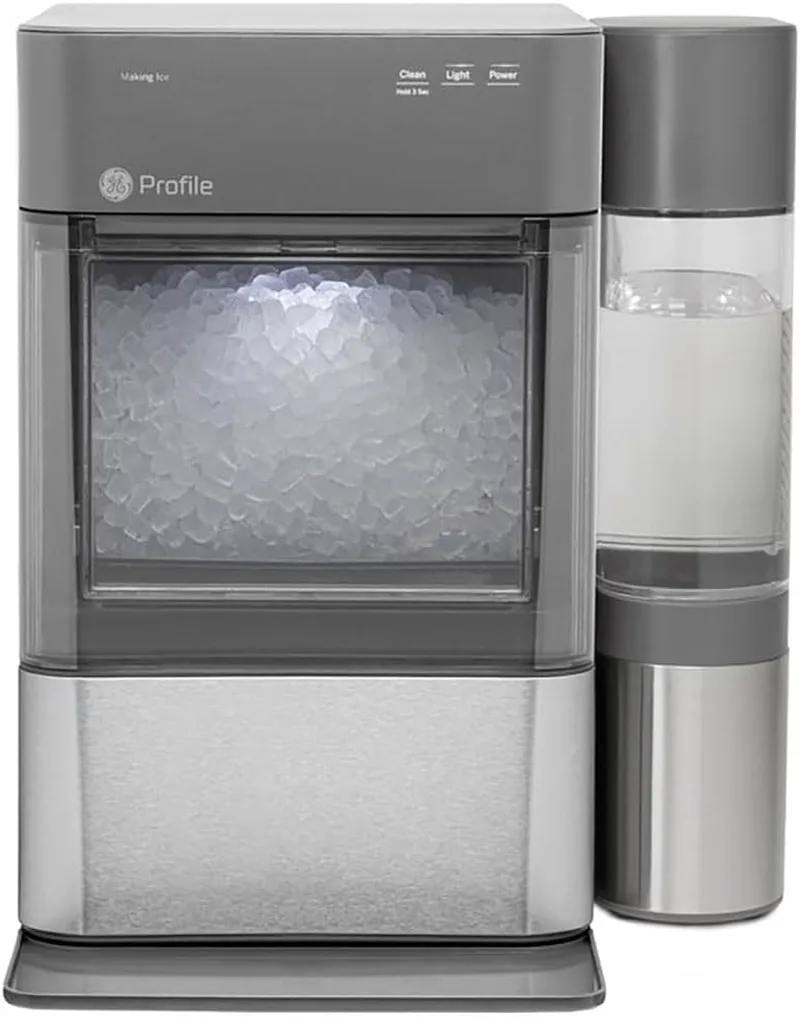
Same ice, bigger reservoir. The XL carries a one-gallon tank, so a household that drinks through a bin in an evening can refill once instead of three times. It produces at the same rate; what changes is how long it can keep producing without you.
This is the sensible pick for a household of three or four that wants nugget ice but is not willing to cut a hole in a cabinet. It is also the point at which the countertop category starts competing with the under-counter category on convenience rather than on volume. See the GE Profile Opal 2.0 XL on Amazon.
The built-in answer: EUHOMY 100 lb under-counter machine
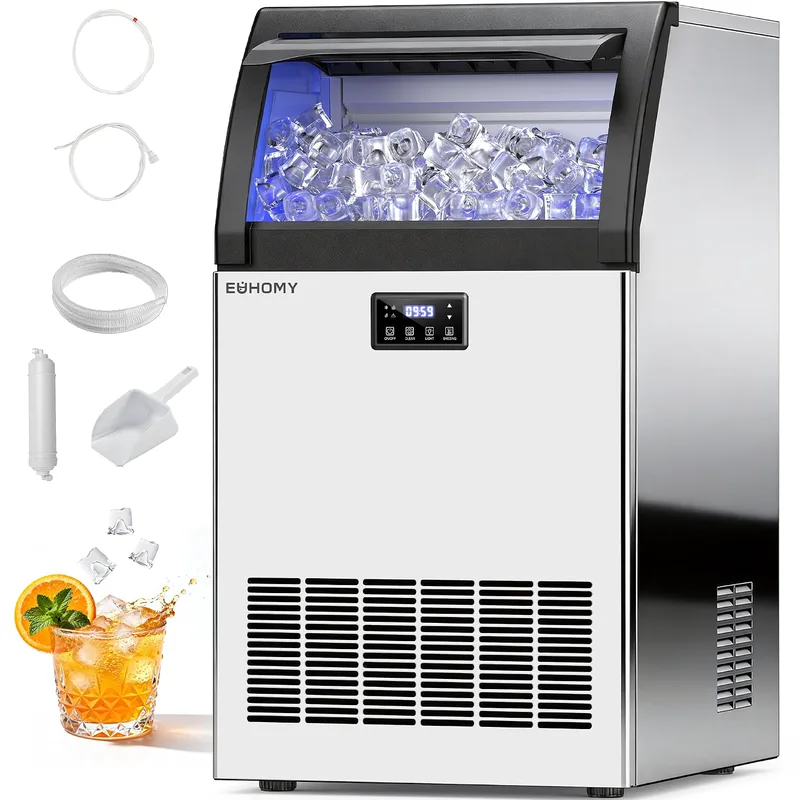
A stainless under-counter unit with a curved viewing window, a large daily output, and an insulated bin that holds a full day of ice. It is designed to sit in a cabinet run and be forgotten, which is exactly what a household that entertains wants.
Before ordering, confirm three numbers: the cabinet opening, the clearance the machine needs for airflow, and whether your drain is gravity or pump-fed. Getting any of those wrong turns an appliance into a renovation. See the EUHOMY under-counter ice maker on Amazon.
Where the countertop machine stops making sense
It stops when the bin is the bottleneck. A machine that produces steadily but stores a few pounds is a machine you will empty at the worst moment, and soft nugget ice that has sat in a bin for hours congeals into a single mass that has to be broken up before it can be scooped.
It also stops when the counter is the bottleneck. A kitchen with two feet of usable workspace cannot absorb another appliance, no matter how good the ice is. In that kitchen the machine ends up in a garage, which is where most unused countertop appliances go.
Where the under-counter machine stops making sense
It stops the moment the kitchen has no free cavity, because the alternative — a freestanding machine in the middle of a floor — defeats the point. It also stops for anyone who moves often, since the installation cost does not travel with the machine.
And it stops for low-volume households. An under-counter machine that runs one cycle a day to serve two glasses of water is an expensive way to keep a compressor warm, and the bin will sit half full of slowly fusing cubes.
Water, scale, and the maintenance nobody schedules
Both categories fail the same way: scale. Hard water coats the evaporator, the ice gets cloudy, output drops, and the machine works harder for less. Descaling is not optional on either design, and the interval is set by your water, not by the manual.
A countertop unit is easier to descale because you can carry it to a sink. An under-counter unit is harder because you are leaning into a cabinet with a bottle. If your water is very hard, budget for a filter either way — the same logic that makes a filter worth having in a wine cooler or beverage refrigerator applies to anything that freezes water for drinking.
Sanitation matters just as much. A bin that holds ice at near-freezing is not a sterile place, and a machine cleaned once a season will develop a smell that transfers to the glass. Wipe the bin, run the clean cycle, and replace the filter on the manufacturer’s schedule rather than on the day you notice a taste.
Which one to buy first
If you want better ice for drinks and you have a free socket, buy the countertop nugget machine. It delivers the specific thing most people are actually chasing — soft, chewable ice — with no installation and no cabinet surgery. Start with a tank model if you drink more than a couple of glasses an evening; the refills are what annoy people, not the noise.
If you host, fill coolers, or have a wet bar with a spare cavity, buy the under-counter machine. It solves a supply problem rather than a texture problem, and it will still be making ice at midnight on the day of a party.
The mistake to avoid is buying the automatic, plumbed version to serve two people, or buying the countertop version to serve a party. The appliances are good; it is the mismatch that gets them relegated to a garage shelf. The same rule of thumb shaped our rice cooker versus multi-cooker comparison: match the machine to the daily job, and let the occasional job be handled by something else.
Prices and availability change constantly on Amazon; the links above go to the current listing for each machine rather than to a fixed offer. As an Amazon Associate we earn from qualifying purchases.


