Home water · Under-sink filters
Three numbers on the box decide what you taste, how fast the tap runs, and what the system costs you every year.
An under-sink filter hides in a cabinet and gets judged by a single glass of water. The label on the box is a poor guide to that glass: it lists contaminants, while the decisions that matter are how small the pores are, how fast water moves through them, and what a new cartridge set costs.
This guide takes those decisions in the order they affect daily use, then covers installation, maintenance, and the point where a whole-house system becomes the saner answer.
The short version
- Start from the problem you can taste or see, not from the longest contaminant list.
- Read the micron rating together with the flow rate; one without the other says little.
- Compare five-year cartridge cost, not the price of the box.
- Measure the cabinet around the drain trap before choosing a housing size.
The three systems below use different filtration approaches and occupy very different amounts of cabinet space. On a phone, swipe the table sideways to see all three columns.
| Aspect | Carbon 3-stage | RO with tank | Tankless RO |
|---|---|---|---|
| Filtration approach | Carbon block stages | Membrane plus carbon | Membrane plus carbon |
| Minerals in the water | Mostly kept | Mostly removed | Mostly removed |
| Flow at the tap | Steady, supply dependent | Tank buffers the flow | On demand, pump assisted |
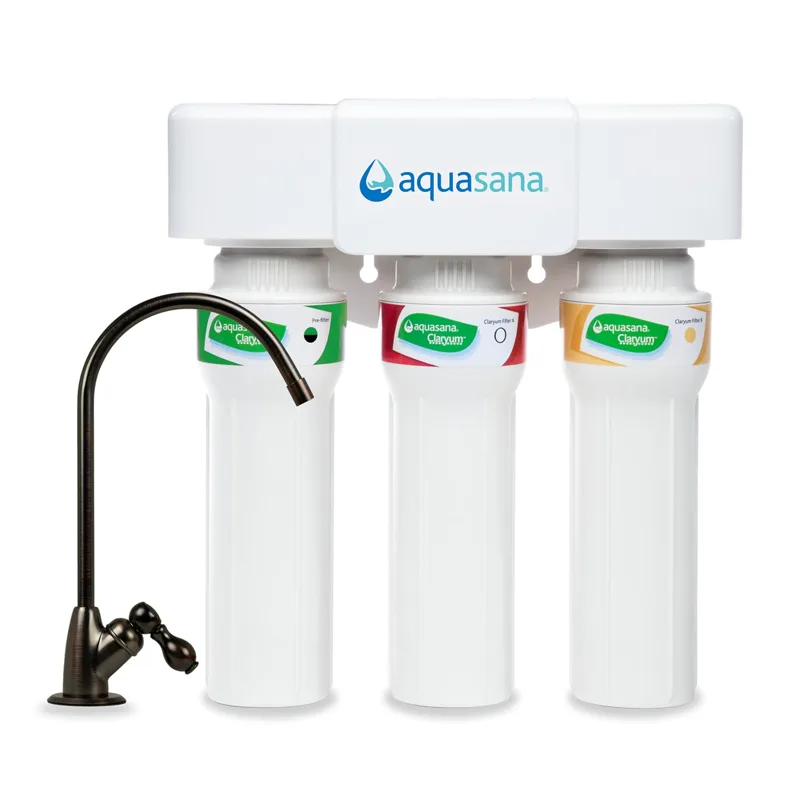
| Space under the sink | Housing only | Housing plus a tank | Housing plus power supply |
| Waste water | None | Concentrate to drain | Concentrate to drain |
| Cartridge routine | Two or three cartridges | Pre-filters plus membrane | Pre-filters plus membrane |
| Installation effort | Supply and faucet | Supply, faucet, drain | Supply, faucet, drain, power |
| Best for | Chlorine taste and odour | Broad removal with a tank | Broad removal in a tight cabinet |
This table compares how the three approaches behave in use. It is not a ranking, and it does not replace the tested claims on each product listing.
Decide what you want removed first
Under-sink filters are sold on a list of contaminants, but the practical starting point is your own water. Chlorine and its taste are the usual complaint in municipal supplies; sediment and rust show up after main repairs; hardness leaves scale; and older plumbing can add lead at the tap. A carbon filter addresses taste and chlorine well. Reverse osmosis goes further and removes most dissolved solids, including minerals you may want to keep. Name the one problem you can taste or see, then choose the technology that solves it.
Micron rating is a pore size, not a promise
A micron rating describes the nominal size of particle a filter is built to catch. One micron is a thousandth of a millimetre, and the numbers on cartridge labels usually run from five down to half a micron. Smaller pores catch more, but they also slow the flow and clog sooner. The rating says nothing about dissolved chemicals such as chlorine or lead, which are removed by adsorption or ion exchange rather than by screening. Read the micron number as one property among several, not as a score.
Carbon block, granular carbon, and reverse osmosis
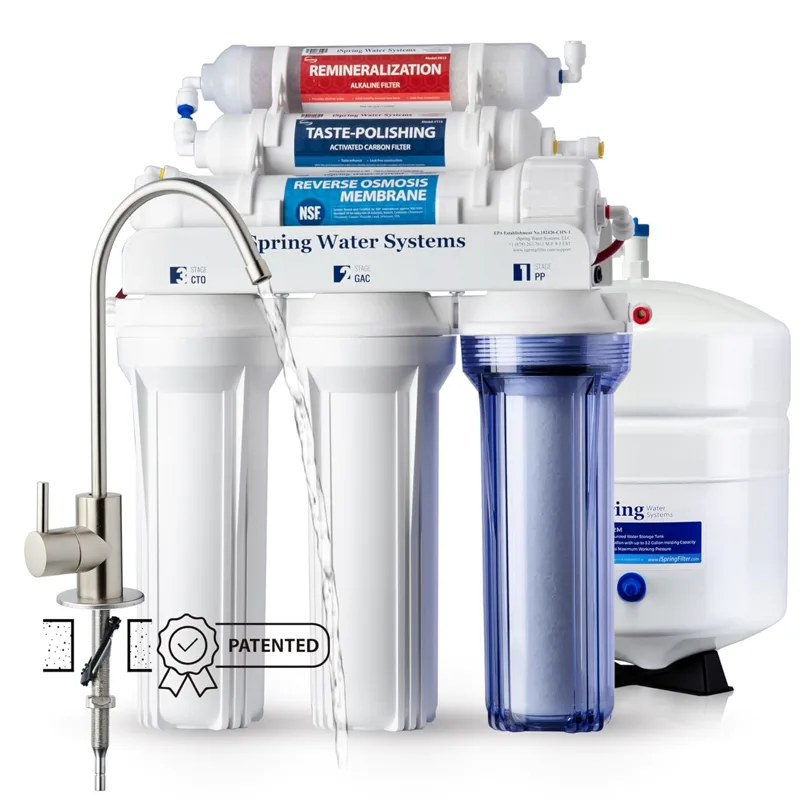
Carbon block cartridges press carbon into a solid form, which gives a predictable pore structure and good contact time. Granular carbon is looser and cheaper, and it can channel as water finds a path through. Reverse osmosis pushes water through a membrane with pores small enough to reject dissolved salts, and it needs a pre-filter to protect the membrane plus a drain for the concentrate. Carbon systems keep minerals in the water; RO takes most of them out.
How to read a filter spec sheet
Look for four things: the micron rating of each stage, the flow rate at a stated pressure, the rated capacity in gallons, and the certifications. A capacity without a flow rate tells you how long a cartridge lasts but not whether the tap will feel slow. A flow rate without a pressure tells you very little at all. Certifications matter because they are tested against a published standard rather than against a marketing sentence.
Flow rate decides whether the kitchen waits
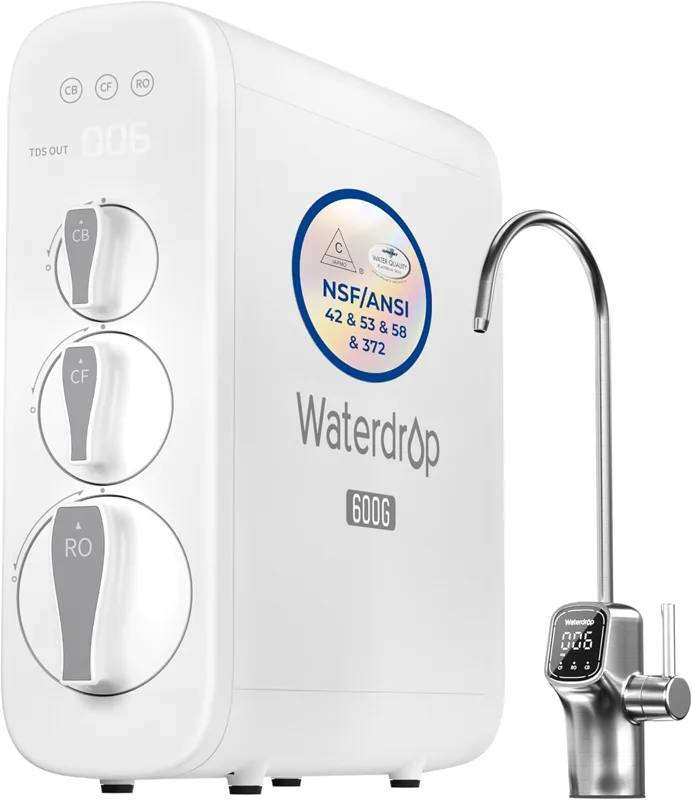
Flow rate is measured in gallons per minute at a specified supply pressure. A carbon system typically fills a glass at a rate that feels normal; a small RO system with a tank refills slowly but delivers from the tank at a good rate until it empties. Tankless RO units push water through the membrane on demand and depend on the membrane and pump for speed. If two people fill bottles every morning, the difference between a litre a minute and half that is the difference between a habit and a chore.
Cartridge cost is the real price
The purchase price covers housings, a faucet, and one set of cartridges. The yearly cost is that cartridge set multiplied by how often it needs changing, and it varies more than the hardware does. A two-stage carbon system with inexpensive cartridges can cost less over five years than a premium three-stage unit with proprietary filters. Work out the cost per thousand gallons from the rated capacity and the cartridge price, then compare that number rather than the sticker on the box.
Housing size and the space under your sink
Under a kitchen sink the usable space is rarely the full cabinet. The garbage disposal, the drain trap, and the shutoff valves all take room, and a filter housing has to leave access for cartridge changes. Measure the height from the cabinet floor to the trap, the depth to the back wall, and the width between the disposal and the side panel. A system mounted high on the cabinet wall keeps the floor clear; a floor-standing unit with a tank needs a footprint you may not have.
The faucet and the extra hole it needs
Most under-sink systems come with a dedicated faucet that needs its own hole in the counter or the sink rim. Drilling a counter is a job for a hole saw and a steady hand, and some composite counters chip. If you cannot add a hole, a diverter that shares the existing faucet is an option, though it adds a step every time you want filtered water. Check the faucet height against the window or cabinet above before committing to a position.
Installation fittings and the shutoff valve
Connection is usually the part that decides whether a Saturday project stays a Saturday project. Compression fittings need a clean cut and a wrench; push-fit connectors need a square cut and a firm push until the collar seats. Either way, turn off the supply at the valve under the sink, not at the main, and put a towel down. If the valve is seized or the pipe is corroded, replace the valve before starting; a filter installed on a failing valve is a leak waiting for a reason.
Low water pressure changes the choice
RO membranes need pressure to work, and carbon blocks slow the flow as they load. In a house with weak pressure, a multi-stage system can turn a quick glass into a slow one. A unit with a storage tank buffers that, because the tank fills slowly and delivers quickly. Pump-assisted RO solves it another way, at the cost of a power connection and some noise. Test the pressure at the sink with a gauge before choosing, rather than assuming the house is normal.
Filter life claims and a realistic schedule
Rated capacity assumes a certain water quality and a certain flow. Hard water, high sediment, and heavy use all shorten cartridge life. A calendar reminder every six months is a starting point, but the better signal is flow: when the tap slows noticeably or taste changes, the cartridge is due. Write the install date on the housing with a marker. Keeping a spare set on hand turns a chore into a five-minute job.
The first week: flushing and biofilm
New carbon cartridges shed fine dust, and new membranes need flushing. Follow the maker’s flush volume before drinking the water, usually a few gallons through the faucet. After that, run the tap briefly each morning if the system has been idle, since water sitting in a warm cabinet is a good place for biofilm. Sanitise the housing when you change cartridges if the maker recommends it, and do not let a filter sit unused for months and then assume it is still fresh.
Certification labels worth checking
Third-party certification means a model was tested against a published standard for the claims on the box. The certification body and the standard number should appear on the listing or in the manual, and the certified model numbers should match. A claim of lead removal without a standard behind it is a marketing sentence. For RO systems, check that the membrane and the full assembly are covered, not just the carbon pre-filter.
Maintenance habits that keep flow steady
Sediment cartridges protect the stages behind them, so change them on time even when the water still tastes fine. Keep the area around the housing dry, since a slow weep under a cabinet damages the board before it becomes visible. Label the tubing if you ever plan to move the unit. And photograph the cartridge part numbers before the old ones go in the bin, because proprietary sizes are easier to match from a picture than from memory.
When a whole-house filter is the better answer
An under-sink unit treats one tap. If the complaint is scale in the shower, chlorine smell from every faucet, or sediment that stains laundry, the problem is the whole supply and a point-of-use filter will not solve it. Whole-house systems sit at the entry point and need plumbing work, plus a drain for backwashing in some designs. The same logic shapes the tank versus tankless water heating decision: match the equipment to the whole supply, not to one tap.
Where these three systems sit
The examples above cover a three-stage carbon system, a tank-based RO unit with remineralisation, and a tankless RO unit. They are not ranked; the useful comparison is between their filtration approach and the space under your own sink. More home improvement and tool guides are organised the same way.
What to check before ordering
Confirm the faucet hole, the cabinet dimensions, the supply pressure, and whether a drain connection is available for RO. Check the cartridge part numbers and the yearly cost. Then check the return policy, because the one thing that cannot be measured from a listing is how the water tastes in your kitchen.