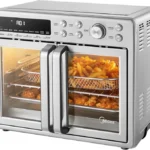
Kitchen appliances · Microwaves
The three measurements that decide whether a microwave fits your counter, your cabinet, and your cooking.
A countertop microwave looks like a simple box with a door, and most buying decisions get made on wattage alone. In a small kitchen that is the wrong order. The machine has to fit a specific stretch of counter, open without hitting a cabinet, and move air without cooking its own electronics.
This guide works through the choices in the order that actually constrains them: the jobs you need done, the power that supports those jobs, the space the unit occupies, and the controls you will live with every day.
The short version
- Measure the counter, the door swing, and the gap above before comparing models.
- Treat wattage as the speed setting for reheating, not as a quality score.
- Choose cavity size from your largest regular dish, not from the box label.
- Pay for the controls you touch daily; menus you never open are decoration.
The three examples below sit at different points on the countertop spectrum, from a compact reheating unit to a multi-function oven. On a phone, swipe the table sideways to see all three columns.
| Aspect | Compact 1,000 W | Family inverter | Multi-function |
|---|---|---|---|
| Power control | Stepped levels, on and off | Continuous inverter | Inverter plus convection |
| Cavity class | Compact | Family size | Large and deeper |
| Footprint | Shallow depth | Full depth | Deepest of the three |
| Door and window | Push-button, small window | Pull handle, wide window | Pull handle, large window |
| Best for | Plates, drinks, soup | Meals and defrosting | Reheating, crisping, baking |
| Clearance needs | Small gap above, rear vents | Taller gap above, side vents | Tallest gap above, generous rear space |
| Accessories | Turntable plate only | Turntable plate only | Racks, pan, and trivet |
| Upkeep | Wipe cavity, wash plate | Same, plus sensor window | Same, plus racks and accessories |
This table compares how the three machine types behave in use. It is not a ranking, and it does not replace the measurements on each product page.
Start with the jobs, not the wattage
Most small-kitchen microwaves do three jobs: reheating a plate, defrosting something taken out of the freezer, and heating water, milk, or a cup of soup. A fourth job, crisping or baking, moves the machine into a different class. Before comparing anything, write down which of those four you will do every week. If crisping is not on the list, a plain unit with a flat cavity and a glass turntable covers everything, and it leaves more of the space above the counter empty.
Wattage sets speed, not cooking quality
Wattage describes how quickly a given mass of food absorbs energy. More of it shortens reheating time and makes defrosting more even, because the outside of a frozen block spends less time thawing while the centre is still hard. It does not improve flavour, and it cannot replace stirring, resting, or cutting food into similar-sized pieces. The question in a small kitchen is narrower: do you reheat one portion at a time, or several plates in a row on a busy evening? The second pattern is where extra power pays for itself.
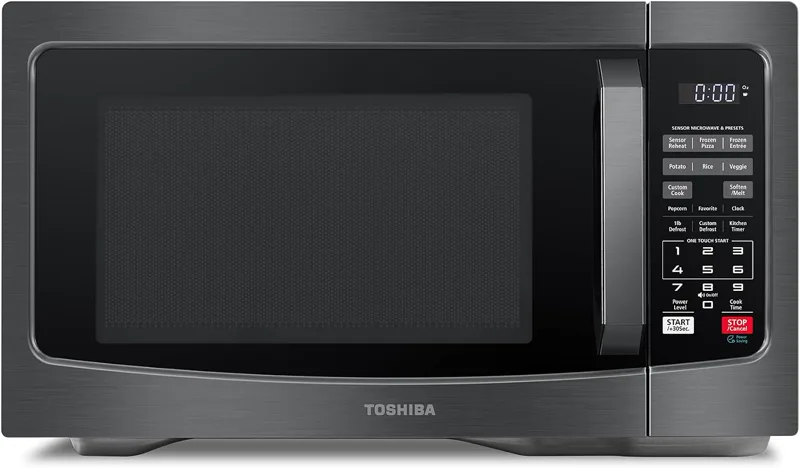
A quick wattage check before you buy
Look at the rated cooking output rather than the input draw printed on the back panel. Output is the number that describes what reaches the food. If a listing only shows input power, treat the output as roughly two thirds of it and compare models on that basis. Machines of the same stated wattage still differ in how they spread energy, so a turntable that turns slowly and a cavity that reflects evenly matter as much as the number on the door.
Cavity size and turntable size are different numbers
The interior volume in cubic feet tells you how much air the box holds. The turntable diameter tells you what will actually rotate inside it. A dinner plate can fit the cavity and still scrape the walls, and a rectangular casserole dish may clear the turntable but stop the door from closing. Measure your largest regular dish across and diagonally, then compare it with the turntable and the flat floor space behind it. The plate that matters is the one used for weeknight leftovers.
Footprint is three measurements, not one
The width on the spec sheet describes the box. What you need to know is the depth including the door hinge, the height including any feet, and the space the door needs when it swings. A deep unit can push its front edge past the counter line and make the kitchen feel narrower. Check where the vents sit as well: rear vents need a gap between the box and the wall, and side vents need room next to a cabinet run. A tape measure settles more than any feature list.
Clearance above and behind the cabinet
Microwaves move heat out of the electronics compartment, and in a small kitchen that compartment often sits under a cabinet. Manufacturers publish a minimum clearance for a reason, and squeezing a unit into a tighter gap because it happens to fit is a common way to shorten its life. Leave the stated gap above the top panel and behind the rear panel, and keep the door’s swing path clear of the counter edge. If the only free space is a shelf inside a closed cabinet, a different appliance may suit the room better.
Sensor cooking earns its keep on uneven loads
A sensor looks at steam or humidity and decides when to stop. That works well for a bowl of soup, a plate of rice, or a mug of milk, where the load is loose and the moisture rises predictably. It is less useful for a single slice of bread or a dense frozen block, where your own eye is more reliable. Sensor cooking is worth paying for if you routinely reheat uncertain portions and do not want to stand there watching. If you always heat the same two things, presets do the same job.
Inverter power changes how the low settings behave
A conventional microwave cycles the magnetron on and off to simulate lower power. An inverter keeps the power continuous at a lower level, which matters when you melt butter, soften cream cheese, or hold a sauce without splitting it. The difference is easiest to notice at the lowest settings; at full power both designs behave much the same. Where the microwave doubles as a gentle melting tool, inverter control is a real convenience rather than a marketing line.
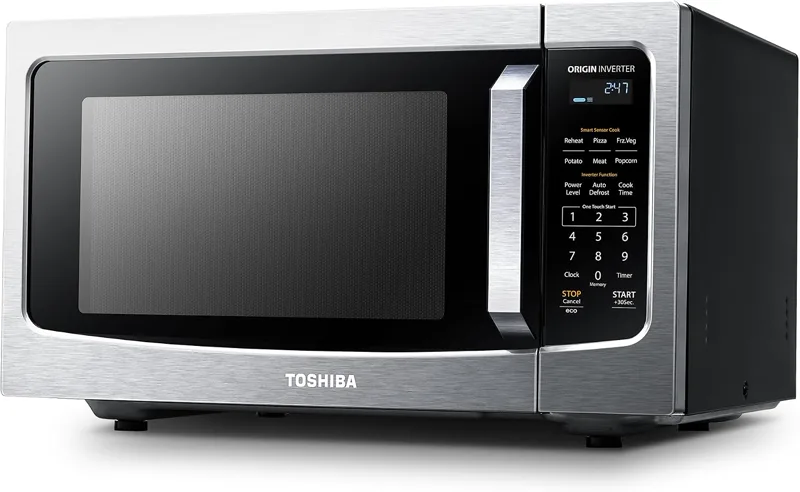
Preset menus and the controls you actually touch
Every model ships with a menu of programs, and most households use two or three. What does matter is how the controls feel: whether the buttons need a firm press, whether a dial stays where you leave it, whether the start button is large enough to find by touch. A flat membrane panel wipes clean easily but offers no feedback. A dial plus a single button is slower to program and far quicker for the thirty-second burst that most reheating actually is.
Noise, beeps, and the mute button
The fan, the turntable motor, and the door latch all make noise, and in an open-plan kitchen that noise is part of the experience. Beeps are the bigger irritation in practice, especially if the machine sits near a bedroom door or is used while someone works from home. Some models can silence the end-of-cycle tone; many cannot. If quiet operation matters, check whether the manual describes a mute function before you buy rather than after.
Door style and one-handed use
A push-button door needs a firm press and then swings open on its own; a pull handle needs a grip and stays where you leave it. In a narrow kitchen the handle can catch a sleeve or a drawer, while the button can be awkward when your hands are full. The difference is small on paper and obvious after a month of use. Handleless doors with a recessed grip trade a little cleaning convenience for a lower profile, which is often right where the counter is shared with a coffee machine.
Where the unit sits: counter, shelf, or built-in
A countertop model on a shelf under a cabinet loses headroom for the door. A built-in trim kit gives a cleaner line but fixes the opening size and the ventilation path, so it has to be chosen with the cabinet rather than after it. Over-range installations move the machine off the counter entirely but bring their own venting requirements. In a small kitchen the counter is usually the only place that satisfies the clearance the machine needs, so plan the other appliances around it. If you are already sharing counter space with an air fryer, decide which one earns the permanent spot.
A buying checklist for a small kitchen
Before ordering, run through the following in order. Each line takes a minute and removes a class of returns.
- Measure counter width, depth, and the gap to the cabinet above.
- Note the largest plate or dish you reheat regularly.
- Decide whether crisping or baking is a weekly job or a holiday one.
- Check where the vents sit and whether a wall or cabinet blocks them.
- Look for a mute function if the kitchen is open to the living space.
What to measure before you order
Width, depth with the door closed, height with feet, and the swing of the door are the four numbers that decide fit. Add the clearance figure from the manual above and behind the unit. If the machine will sit next to a wall, measure the door swing from the hinge side. Photograph the tape measure against the counter so the numbers are still with you when you compare listings later.
Cleaning and the interior finish
Stainless steel interiors wipe clean and hide stains; painted interiors are cheaper and show scratches sooner. A flat floor without a recessed turntable well is easier to wipe, and a plate that lifts straight out is easier to wash than one clipped to a drive hub. Steam from covered food condenses on the ceiling and runs down the walls, so a smooth surface with rounded corners saves a minute every week. Keep the sensor window clean if the model has one, since a film of grease dulls its reading.
When the simplest model is the right answer
A modest microwave that fits, vents properly, and heats evenly is a better purchase than a feature-heavy one wedged into a gap that blocks its airflow. Combination ovens earn their space when you use the crisping and baking modes often; otherwise their extra height and accessories take room a small kitchen does not have. Buy for the weekly pattern, then spend the difference on the counter space you keep free.
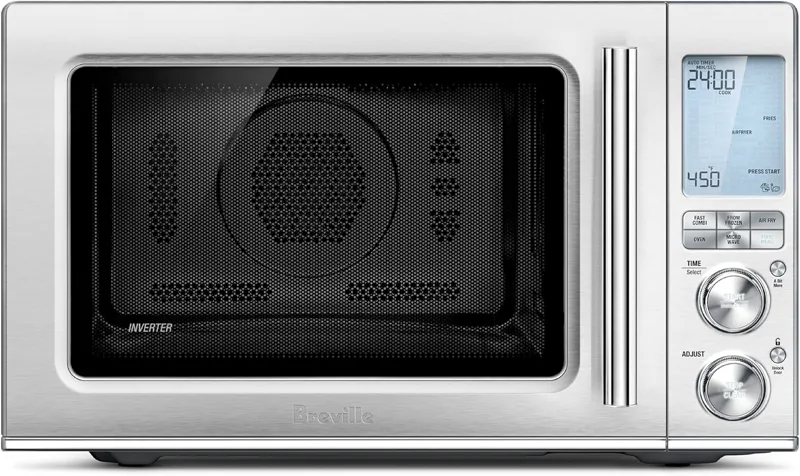
Where these three models sit
The three examples used above cover a compact reheating unit, a family-size inverter model, and a multi-function oven that also crisps and bakes. They are not ranked, and the right choice depends on the measurements you took rather than on the order they appear here. More kitchen appliance buying guides follow the same approach.