Workshop tools · Band saws
How much resaw capacity a small shop really uses, and where the money belongs.
Resawing is the job most people buy a band saw for, and the job that separates a benchtop machine from a 14-inch saw faster than any line on a spec sheet.
The useful question is not which size is better. It is how much resawing you actually do, and whether the saw that fits your space has the frame, blade support and clearance to do it without fighting you on every cut.
The short answer
- Curves, small parts and occasional thin slices: a 10-inch benchtop saw with a rigid frame and a good blade covers it.
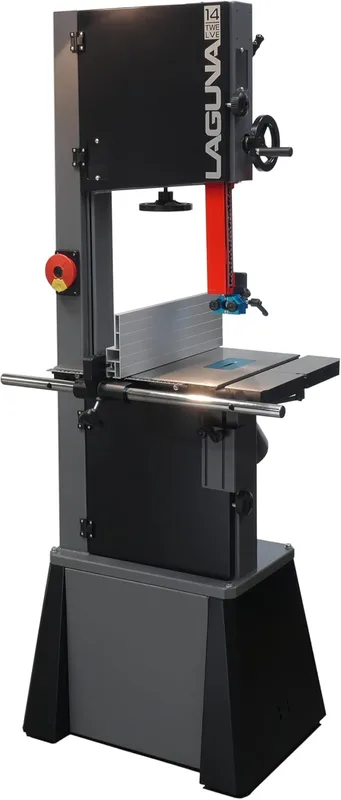
- Repeat resawing of hardwood into veneer or book-matched panels: a 14-inch saw with a cast frame and room for a wider blade is the realistic starting point.
- Resaw height and blade width set the ceiling before motor size does. Check both against the stock you plan to cut.
- On either size, blade quality and setup decide the cut. Buy a resaw blade and spend an hour tuning before blaming the machine.
Benchtop and 14-inch saws at a glance
The first three rows decide whether a saw can resaw at all. The rest decide how pleasant the work is. On a narrow screen, swipe the table sideways to see the second column.
| Aspect | Benchtop, around 10-inch | 14-inch floor saw |
|---|---|---|
| Footprint | Bench or small stand | Owns a floor corner |
| Resaw height | Capped low; check the exact figure | Room for thicker stock |
| Blade width | Narrow blades, tight curves | Takes wider blades for straight resaw |
| Frame | Sheet metal or light casting | Cast iron or heavy steel |
| Power supply | Standard outlet | Often dual voltage; check the circuit |
| Moving it | Lifts onto a bench or rolls on casters | Heavy; plan the spot before delivery |
| Best work | Curves, small parts, light resaw | Sustained resaw, veneer, hardwood |
| Entry direction | Lower cost to start | More machine, more commitment |
What resawing actually asks of a saw
Resawing is a rip cut taken along the grain with the board standing on edge. The blade has to stay in one plane through a tall cut, clear the dust it makes, and keep tension while the wood tries to pinch it.
Every difference between a benchtop saw and a 14-inch machine shows up in that sentence. Taller cuts need more frame stiffness, more blade support above the work, and more motor to keep the blade moving when the cut loads up.
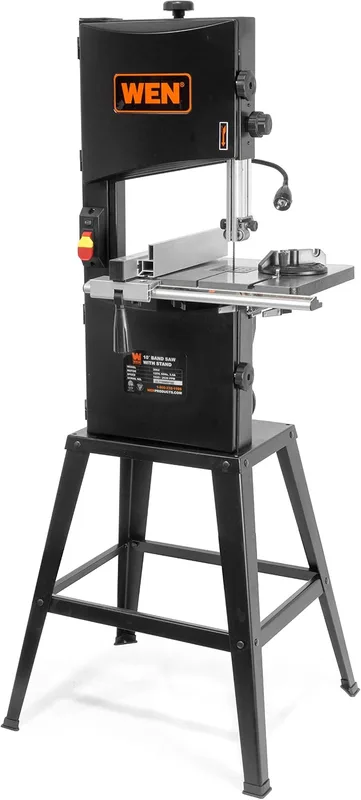
Frame rigidity decides the cut before the motor does
A band saw frame is a spring. Under load it flexes, and when it flexes the blade twists out of plane, which is what a wandering cut actually is.
Benchtop saws use lighter frames to keep weight and cost down. That works for thin stock and curves, and it shows its limits the moment you push a tall hardwood board through slowly enough to keep the blade tracking.
A 14-inch saw carries a heavier frame for exactly this reason. It is not about prestige. It is about holding geometry while the blade is under load for the length of a long cut.
Resaw height and blade width set the ceiling
Reading resaw height honestly
Resaw height is the distance between the table and the upper guide, and it is usually the first number people compare. The honest way to use it is to subtract the thickness of your sled or fence setup, then compare against the tallest board you actually own.
Many benchtop saws resaw far less than their cutting depth suggests, because the upper guide cannot be raised clear of tall work. If resawing is the plan, check the height with the guide in place rather than the marketing headline.
Why blade width matters more than people expect
A wide blade resists twisting. A narrow blade turns tight curves. A saw that cannot tension a wide blade will not resaw straight no matter how carefully you set the fence.
That single limit often decides the class of machine. If the saw’s manual caps you at a narrow blade, plan on curves and light resaw, not veneer work.
Guides, tension and drift
Guides hold the blade steady just above and below the cut. On a small saw they are often the first component to feel cheap, and the first place a careful owner upgrades.
Tension is the other half. A blade that is under-tensioned bows in the cut, and the correction people instinctively make is to push harder, which makes it worse.
Drift is usually a setup problem
Blade drift gets blamed on the machine more often than it deserves. A dull blade, uneven set, a misaligned fence or a table that is not square to the blade will all produce a cut that veers.
Fix those before you compensate with fence angle. Once the fence is skewed to chase a bad blade, every later cut inherits the error.
Tables, fences and infeed support
A cast table with a solid fence is worth more than an extra fraction of motor power. Resawing depends on feeding a tall board in a straight line, and that is a table-and-fence problem.
Infeed and outfeed support matter just as much on a small saw. A long board that sags at the back of the table lifts the front edge off the cut, and the blade follows the gap.
Roller stands, a tall featherboard and a simple pivot fence cost little and change the result more than most upgrades.
Dust, noise and the space the machine occupies
Resawing makes a lot of dust in a narrow kerf, and a band saw without extraction spreads it across the shop. Both classes of machine have a dust port; what differs is how easy it is to connect a hose without blocking the lower guides.
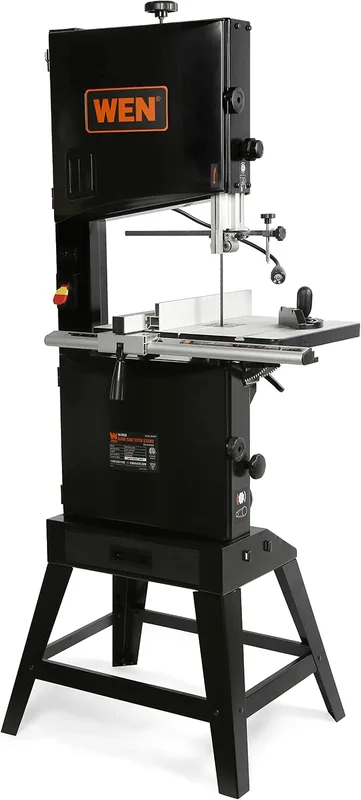
A 14-inch saw also asks for floor space, clearance in front and behind for long boards, and usually a second person or a mobile base when it arrives on a pallet. Benchtop machines fit on a bench you already own, which is the whole reason they exist.
Where a benchtop saw is the right answer
If your resawing is occasional, your stock is thin, and your shop shares a wall with a bedroom, a benchtop saw is not a compromise. It is the correct size for the work.
It also wins on setup time. A machine that lives on the bench gets used for five-minute jobs that a floor saw would make you plan around.
The limit is honest: wide blades, tall hardwood and repeat veneer cuts are where a small frame stops being fun.
Where the 14-inch saw earns its footprint
A 14-inch machine makes sense when resawing is a routine task rather than a curiosity. The heavier frame, wider blade capacity and greater resaw height translate into cuts you can repeat without re-tuning between boards.
It also holds value as a shop anchor: once it is set up and squared, it becomes the machine you build other operations around.
The cost is not only the machine. It is the space, the circuit, the mobility plan and the blades that a bigger saw can actually use.
Blades are the cheapest upgrade you will make
A resaw blade with the right tooth count and set transforms a modest saw, and a dull blade makes a good one look broken. Keep two blades: one for curves, one for straight resaw.
Learn to change and tension a blade properly, and to check that the teeth point the right way. That single skill prevents most of the frustration people attribute to machine quality.
A setup routine before the first cut
- Check the blade is seated on both wheels and correctly tensioned for its width.
- Set the upper guide just above the work and the side guides a hair off the blade.
- Square the table to the blade, then set the fence parallel to the blade’s actual travel.
- Confirm dust extraction is connected and the lower guides are clear.
- Cut a scrap of the same stock and measure the drift before cutting anything valuable.
What happens after the board is sawn
Resawn boards usually need flattening and thicknessing before they become parts. That is a different machine and a different set of decisions.
Our guide to choosing between a bench planer and a sander covers which tool does what in that sequence.
If the sawn face needs flattening on a small machine, the notes on bench sanders explain what a sander can and cannot fix.
A short buying checklist
- Measure the tallest board you realistically plan to resaw, then check resaw height with the upper guide fitted.
- Confirm the widest blade the saw can tension, because that sets the straight-cut ceiling.
- Look at the frame and table material before the motor badge.
- Plan infeed and outfeed support, especially if you cut longer than a metre.
- Decide where the machine will live, and how it will get there.
- Budget for one good resaw blade from the start.
Bottom line
Buy the saw that matches the resawing you actually do. A benchtop machine with a rigid frame, a proper fence and a good blade handles curves, small parts and occasional thin slices well.
Repeated hardwood resawing is a 14-inch job, and no amount of tuning will give a light frame the stiffness it does not have.
Whichever you choose, the blade, the guides and the fence decide the result. For more workshop buying guides, browse our tool guides and reviews.
If you are working through the sanding stage next, our comparison of orbital and belt sanders explains which machine suits which surface.