
Workshop tools · Sanders
One shapes curves and edges, the other flattens panels. Only one of them fills the gap in most small shops.
A spindle sander and a drum sander both wrap abrasive around a cylinder, and that is where the resemblance stops. One is a shaping tool that follows a line you have already cut. The other is a surfacing machine that flattens and evens boards before anything else happens.
Buying the wrong one is not a quality problem. It is a machine that sits unused because it never meets the work you actually do.
The short answer
- Curves, edges, cutouts and small shaped parts: an oscillating spindle sander earns its bench space first.
- Wide glue-ups, figured boards, thin stock and repeatable thickness: a drum sander is the machine that saves hours.
- If you already own a planer and a random orbit sander, the real gap in a small shop is flattening, not curve sanding.
- Both machines live or die on dust extraction. Without it, abrasive loading decides how often you use them.
The two machines side by side
They solve different problems before the specification sheets start to matter. On a narrow screen, swipe the table sideways for the second column.
| Aspect | Oscillating spindle sander | Drum sander |
|---|---|---|
| What it works on | Curves, edges, inside cutouts | Flat panels, glue-ups, thin stock |
| Typical capacity | Spindle diameter and sanding height | Width per pass and stock thickness |
| How you feed it | By hand, against the spindle | Conveyor feed, hands off the work |
| What it leaves behind | A fair curve, an even edge | A flat face, an even thickness |
| Abrasive | Sleeves and drums, quick change | Wraps or rolls, slower changeover |
| Floor space | Benchtop | Benchtop up to floor-standing |
| Dust load | Moderate and local | High, needs real extraction |
| Usual mistake | Expecting it to flatten panels | Expecting it to thickness rough lumber |
What each machine actually does to the wood
A spindle sander puts a vertical abrasive drum through a hole in the table and oscillates it up and down while it spins. You offer the edge of a workpiece to the drum by hand, so the machine follows a shape you have already cut on the band saw or jigsaw.
A drum sander turns the same idea sideways. A horizontal drum sits above a conveyor belt, the board passes underneath, and the drum takes a light cut across the full width. Nobody holds the work; the machine decides the surface.
That difference decides the purchase. The spindle sander refines a shape. The drum sander creates the flat reference the rest of the project depends on.
Where a spindle sander earns its place
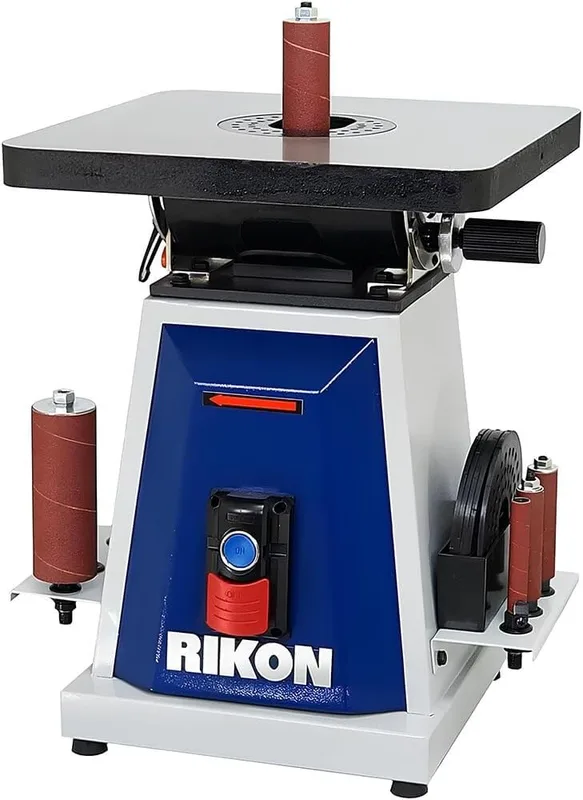
Every curved cut leaves a rippled edge. Chair parts, template-routed profiles, inside cutouts, toy and instrument parts, and any job where a router bit or jigsaw blade has to stop short all end at the spindle sander.
Multiple spindle diameters matter more than motor size here. A machine that ships five sleeves from half an inch to two inches lets you match the drum to the radius instead of forcing the workpiece into one curve.
The oscillation is the quiet feature that keeps it useful. A drum that only spins cuts in one band of abrasive; a drum that also travels up and down spreads the wear and clears the swarf that would otherwise load the sleeve.
Where a drum sander changes the workflow
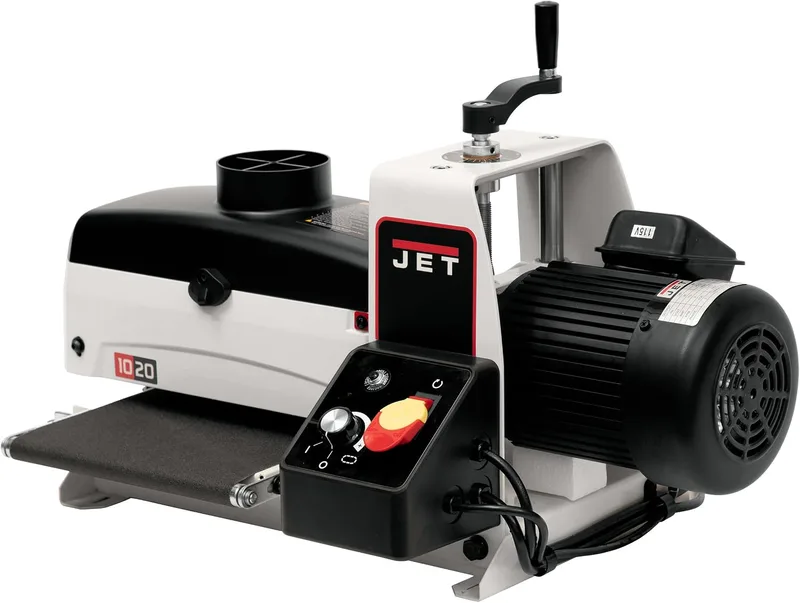
The drum sander exists for the jobs a planer cannot finish: glue-ups wider than the planer’s capacity, thin stock that a planer would chew, end-grain boards, and figured wood that tears out under planer knives.
Open-ended designs extend the reach. A ten-inch machine sands ten inches in one pass and twenty inches in two: flip the board end for end and repeat. In a small shop that arithmetic matters more than the headline width.
What it is not is a thickness planer. Take light passes, let the conveyor set the pace, and treat every pass as a finishing cut rather than stock removal.
Capacity: read the numbers the way the manual does
Three figures decide whether a drum sander fits your work: single-pass width, two-pass width, and the thickness range it will accept. A machine that handles stock from a thirty-second of an inch to three inches covers cutting boards and veneer in the same session.
Minimum board length matters just as much and gets ignored. Short parts can slip on the conveyor before the drum reaches them, which is why hold-downs and a feed belt in good condition belong in the specification, not in the accessories list.
One pass or two
Single-pass width is the honest number. Two-pass capacity only works when the board is straight enough to flip and the seam lines up, so plan your widest panel around the single-pass figure and treat the two-pass claim as a bonus.
Thickness range and short parts
A wide thickness range sounds generous, but the low end is where most damage happens: thin stock needs a light pass and a flat bed, or it lifts and gouges. Check the minimum length before you plan small parts.
Abrasive is the running cost nobody budgets for
Sleeves for a spindle sander are cheap and quick to change. Wraps for a drum sander are longer, wider and more expensive, and a loaded wrap cuts hot and burns the surface it was meant to smooth.
Plan a small inventory rather than a single grit: a coarser abrasive for flattening and a finer one for finishing. Cleaning sticks and a rubber abrasive cleaner extend the life of both, and neither costs much.
Track how many boards each wrap delivers. When a wrap starts loading after a few passes instead of a few dozen, it is done, and pushing it further costs more in burned stock than a replacement costs.
Dust collection decides how often you use either machine
A drum sander produces a steady cloud of fine dust, and most of it arrives at a four-inch port. A shop vacuum keeps up for a few minutes and then clogs, while a real extractor with enough airflow keeps the abrasive clean and the shop breathable.
If that choice is still open, our breakdown of a dust extractor versus a shop vac for sanding explains the airflow difference in practice.
A spindle sander is gentler, but the dust still leaves at the drum. A pickup placed at the source saves more time than a broom at the end of the session.
Feed control, snipe and the flatness question
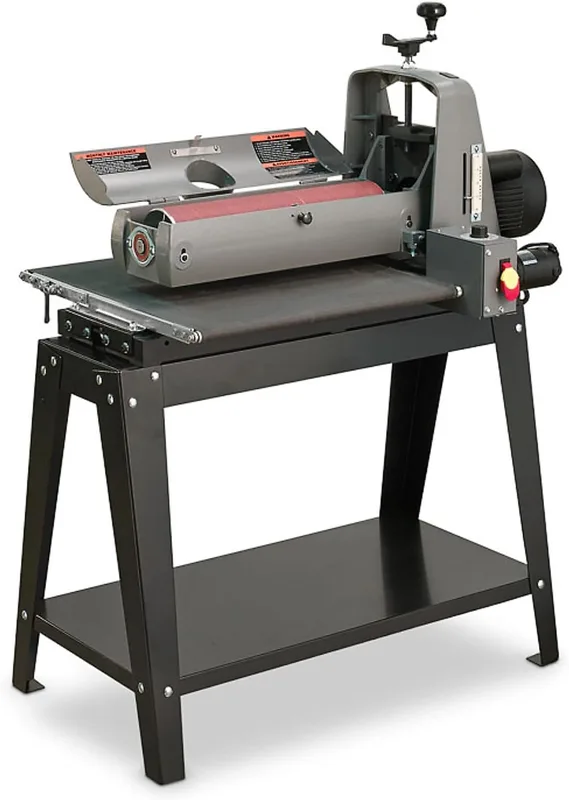
Feed control separates the drum sanders that are pleasant to live with from the ones that are not. Machines that vary conveyor speed, or adjust it to the load, let you slow down on figured wood and speed up on soft stock.
Snipe is the other thing to watch. If the hold-down rollers are not set right, the leading and trailing ends of a board come out thinner than the middle, and the fix is adjustment rather than a new machine.
Flatness is a setup question too. Before trusting a drum sander with a project panel, check that the conveyor bed and the drum are parallel across the width, then prove it on a test board.
When one machine can stand in for the other
Some jobs blur the line. A drum sander with a fine abrasive can soften a shaped edge if the part sits flat on the conveyor, and a spindle sander with a large drum can flatten a small panel you keep moving against it.
Neither substitute is efficient. Edges come out rounded rather than fair, and small panels come out dished because hand pressure is never even. Treat those passes as emergencies, not as a plan.
Bench space, weight and where it lives
A benchtop spindle sander weighs about as much as a packed suitcase and can live on a rolling cart or a shelf bracket. A drum sander needs a stable top, and the floor-standing versions want a footprint and a circuit of their own.
Decide the location before the machine arrives. A sander that has to be lifted onto a bench for every job gets used less than one that stays plugged in and ready.
Which one comes first in a small shop
- If most of your projects are boxes, boards and panels, start with the drum sander.
- If you build chairs, toys, instruments or anything with shaped parts, the spindle sander pays for itself first.
- If neither job dominates, buy the spindle sander and lean on a hand plane for flat work.
- Budget for extraction before you budget for a second machine.
- Leave room to add the other one later, because they complement each other rather than compete.
Setup checks before the first board
- Confirm the table is square to the spindle or drum, not merely level.
- Dress the abrasive and check that the sleeve or wrap is tight and evenly seated.
- Take a light first pass and measure the result before a second one.
- Check conveyor tracking and hold-down pressure if you run a drum sander.
- Test on the same species as the project board before committing it.
Bottom line
The two machines answer different questions. A spindle sander makes curved work look finished; a drum sander makes flat work possible in the first place.
Most small shops need the drum sander first once projects get wide, and the spindle sander first once projects get shaped. Neither one replaces good abrasive, a flat reference and dust extraction.
If you are still deciding how to flatten and finish by hand, our guide to bench sanders explains where each machine stops being useful.
For the rest of the workshop, browse our tool guides and reviews.


