Workshop tools · Air compressors
Two ways to put air in a small shop, and the trade-offs the spec sheet never shows.
Air compressors are sold as one category and used as two different tools. One is a cart that follows the work; the other is a machine that owns a corner of the shop. The labels overlap, the marketing overlaps, and the decision usually comes down to something no spec sheet mentions: where the air has to be when you need it.
This guide compares the two formats by how they behave in a small shop — placement, wiring, noise, moisture, and the way each one stops keeping up. If you are still deciding whether a compressor belongs in your shop at all, overview of the main types of air compressors is a better starting point, and the rest of this page will still make sense after it.
Quick verdict
- If the air has to follow the work — driveway, trailer, second building — choose a wheeled unit and stop apologising for it.
- If the shop is one bay and the tools run for minutes rather than seconds, plan for a stationary machine.
- Settle the wiring and the noise question before you compare features, because both can veto the better machine.
- Size around the tool that runs longest, not the one you reach for most often.
The two formats solve different problems
A compressor is three things: a pump, a tank, and a place to stand it. A portable unit bundles all three onto a cart so the air can travel. A stationary unit spreads them across a footprint you reserve and never move. That single difference — where the machine lives — drives almost every other trade-off between the two.
A shop that sprays a fence outside, fills tires in the driveway, and runs a nailer in three rooms wants air that travels. A shop that planes, sands, and sprays in one bay wants air that never moves. Neither instinct is wrong. They are answers to different questions, and the rest of this page is about telling those questions apart.
Portable units are built around the wheel and the handle
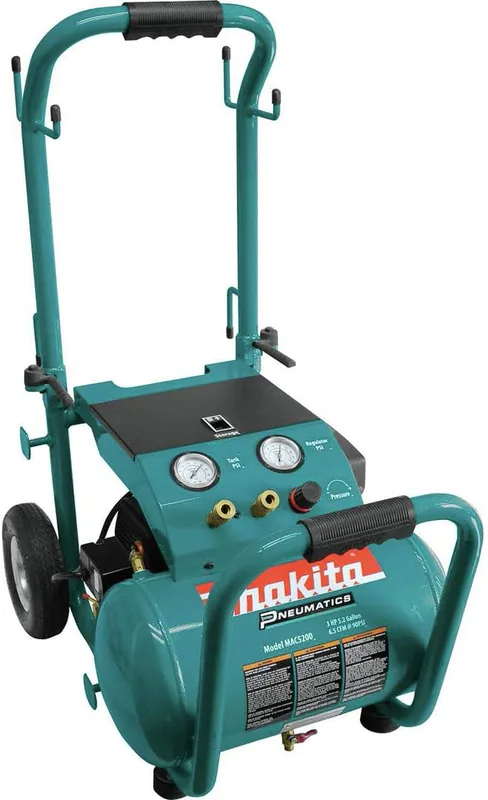
The frame, the folding handle, and the low center of gravity exist for one reason: the machine has to leave the bench. Builders keep the pump light and the body narrow so one person can roll it through a door and up a ramp. That design pressure has a cost. Parts are packed tightly, and the housing that protects them also makes them harder to reach when something needs attention.
What a wheeled unit really gives you
It gives you scheduling freedom. You can run the compressor where the noise does not matter and bring it back when the job is done. It also gives you a second life for the same money, because the unit that sprays a fence can top off tires on the way home. The trade is that every hose run is short by design, and anything that wants a steady supply of air will outrun a small tank.
Stationary units are built around the tank and the pump
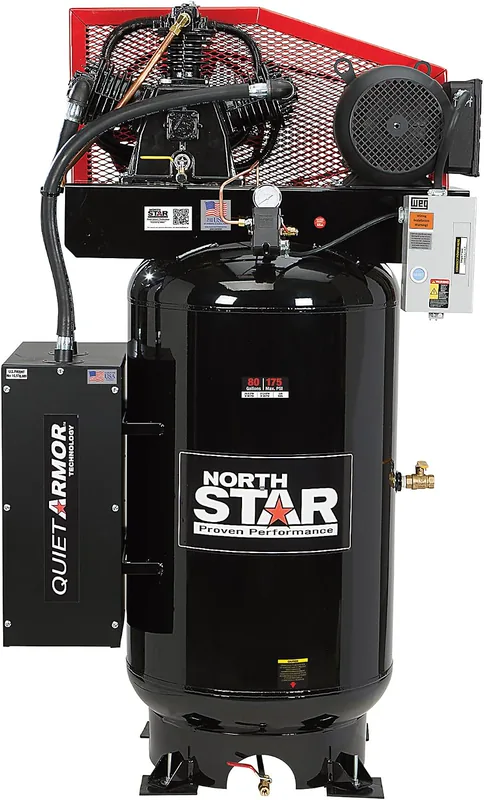
A floor-mounted compressor is designed for a spot it will not leave. The tank is larger, the pump sits on a bedplate, and the motor is heavier than anything you would want to wheel around. Because nothing has to fold, the layout stays open: belts, guards, drains, and filters are all reachable with a wrench. The machine is not more complicated than a portable one. It is simply allowed to be a machine instead of a suitcase.
Air delivery matters most when a tool runs without stopping
Intermittent tools — a nailer, a blow gun, a tire chuck — draw a burst and then rest. Continuous tools — a sander, a grinder, a spray gun held open for a full panel — do not rest, and the pump has to keep up while they run. This is the question that separates the two formats in daily use. If your worst case is a burst, a portable unit is not a compromise. If your worst case is a minute of continuous draw, the tank is only a buffer and the pump is doing the work.
Spraying deserves its own warning here, because a gun that stays open turns a comfortable compressor into a machine that never catches its breath. If finishing is part of the plan, the compressor question overlaps with the gun question, which we work through separately in the comparison of HVLP turbines and compressor-driven spray guns.
Noise is a shop-layout problem as much as a machine problem
Every compressor is loud enough to interrupt a conversation, and the gap between models is usually smaller than the gap between placements. A portable unit sitting beside you will feel louder than a stationary unit behind a wall, even when the two pumps are comparable. Decide where the noise will live before you decide which machine makes it.
Wiring decides what you can run before you buy anything
Portable units are built to plug into what a house already has, which is why they can follow the work into a garage or a driveway. Stationary units are often built around a circuit that has to be planned, and the cost of that circuit belongs in the budget next to the machine. If the panel is full or the run is long, the wiring can change the answer entirely. Check what the shop can supply before you fall for a floor model.
When a stationary unit needs a dedicated circuit
Any machine that draws more than a shared household circuit can carry will want its own breaker, and that usually means an electrician, a permit, and a day without power in that bay. The work is routine, but it is neither free nor instant, and it is the reason plenty of small shops stay portable longer than they expected to.
Tank size covers spikes, not duty cycles
The tank is a reservoir, not a source. It absorbs the difference between what a tool pulls in a burst and what the pump can deliver in the same second. A bigger tank smooths more spikes and gives the pump more time to recover, which is why stationary units feel calmer in use. It does not turn a small pump into a large one. Once the tank is drawn down, the pump sets the pace, and no amount of stored air changes that.
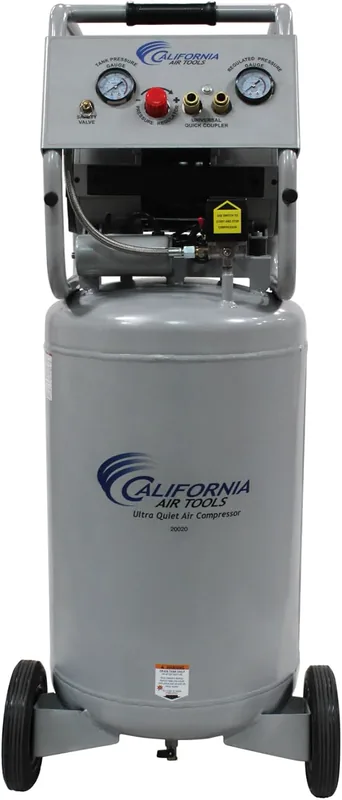
Buy the tank for the spikes you actually get and the pump for the draw you actually have. A tall tank on wheels is the flexible compromise most small shops end up living with.
Mobility is worth it only if the air travels with you
Ask where the air is needed, not where the compressor is. If the answer is one bay, mobility is a feature you pay for and never use. If the answer includes a driveway, a trailer, a second building, or a job site, mobility is the entire point and everything else should be judged around it. Most shops overestimate how often they will move a compressor and underestimate how often they will wish for more air where they stand.
Drainage and moisture control belong in the plan from day one
Compressed air carries water, and every tank collects it. A portable unit is drained by tipping the tank and cracking a valve, which is easy and therefore easy to skip. A stationary unit can be plumbed to a drain leg and a separator so the water leaves before it reaches a tool. Finishing work punishes a wet line faster than anything else in the shop, so decide where the water goes while you are still deciding where the machine goes.
- Put the drain at the lowest point of the system, and leave room to reach it.
- Add a separator or filter before the first tool, not after the last one.
- Keep a short whip hose for draining so the job takes seconds instead of minutes.
Vibration and plumbing change how a stationary install feels
A floor unit can be bolted to pads, hard-piped to a manifold, and fitted with a regulator at the wall. That turns the compressor into part of the shop instead of an appliance you plug in. The upside is steady, quiet air at every station. The downside is that the installation is now something you maintain, and a leak anywhere in the line is a leak you have to hunt down.
A small shop usually outgrows a portable before it wears one out
Portable compressors rarely die of use. They get replaced because the worst case in the shop grew: a bigger gun, a longer sanding session, a second person working at the same time. The machine was fine; the job changed. That is the honest argument for buying one step above today’s work, and the honest argument against buying three steps above it.
Service access should be part of the buying decision
Look at how the oil is checked, how the belt is tensioned, and how the drain is reached. On a portable unit those tasks often happen by feel around a housing. On a stationary unit they happen standing up. Neither is difficult, but the version you can see yourself doing is the one that gets done, and neglected service is what shortens a compressor’s life.
A simple test before you commit
Run your loudest tool for as long as you normally would with the compressor you already have. If the pump never catches up, write down the tools that caused it. Those tools, not the average of everything you own, are the ones the next purchase has to satisfy.
Sizing the system around your worst tool, not your average one
The average tool in a shop is a nailer. The tool that decides the compressor is whatever runs longest and hardest. Name it, then ask whether it needs air for seconds or for minutes. Every other choice — format, tank, placement, wiring — follows from that answer, and it follows far more reliably than it does from a list of features on a product page.
- Longest continuous tool: points to a stationary machine.
- Burst tools plus a driveway: points to a wheeled unit.
- Mixed work in one bay: points to a wheeled unit with real tank capacity, and a plan for the second step.
A two-step plan beats one oversized purchase
Shops change. A plan that starts with a portable unit and a good hose, then adds a stationary machine when the work justifies a dedicated bay, keeps money in tools that actually get used. The reverse — buying a floor machine for work you have not started yet — leaves a large object occupying space and waiting for a reason to exist.
The table below compares how the two formats behave in daily use. On a phone, slide it sideways to see the third column.
| Aspect | Portable wheeled unit | Stationary floor unit |
|---|---|---|
| Where it lives | Rolls to the work | Reserved spot on the floor |
| Footprint | Folds down between jobs | Permanent bay plus clearance |
| Air on tap | Bursts and short sessions | Long draws without waiting |
| Noise | Follows you around | Can sit behind a wall |
| Wiring | Plugs into what you have | Often needs its own circuit |
| Water in the line | Drained by tipping the tank | Plumbed to a drain leg |
| Moving it | One person, one door | A pallet and a plan |
| Service access | Reached around a housing | Reached standing up |
Read that table as a comparison of behavior, not as a ranking of individual machines. The right column is not better; it is simply built for a shop that stays put.
More workshop comparisons, including the sander and dust-extraction decisions that share a bay with a compressor, live in the tools archive.