
Home improvement · Ceiling fans
A bedroom fan has one job: move air without becoming the loudest thing in the room. These three keep the motor quiet, the controls within reach, and the price under three hundred dollars.
Most ceiling fan advice is written for a great room. It talks about blade span for open plan spaces, light output for a dinner table, and style for a chandelier replacement. A bedroom asks a different set of questions, and they are almost all about noise, dimming, and whether you can turn the thing off without getting out of bed.
This guide covers three fans that solve the bedroom problem at three price points: a low-profile Hunter, a smart Hunter, and a budget Minka-Aire hugger. It walks through blade span, motor type, light kits, controls, reversibility, mounting height, noise, and the checks that matter before you cut a hole in the ceiling. If you are still deciding between a ceiling fixture and a floor-standing unit, our bladeless tower fan picks cover the alternative.
Quick answer
- Best for a primary bedroom with a normal ceiling: a 52-inch low-profile fan with an integrated LED and a remote, because it clears the bed and dims without a wall switch.
- Best if you want app and voice control: a smart fan with a DC motor, which is also the quietest option at low speed.
- Best for a tight budget or a low ceiling: a flush-mount hugger with a pull chain, which does the basic job for the least money.
- Skip all three if the room already has a fan you never turn off. Replace the switch, not the fan.
What separates a bedroom fan from a living room fan
A living room fan is judged on presence and airflow across a wide space. A bedroom fan is judged at two in the morning, when the sound of a motor matters more than the finish and the light needs to come on at ten percent instead of full brightness.
That shifts the priorities: a quiet motor, a dimmable light, a control you can reach from bed, and a blade span matched to a small room. Everything else, including the finish and the number of blades, is decoration.
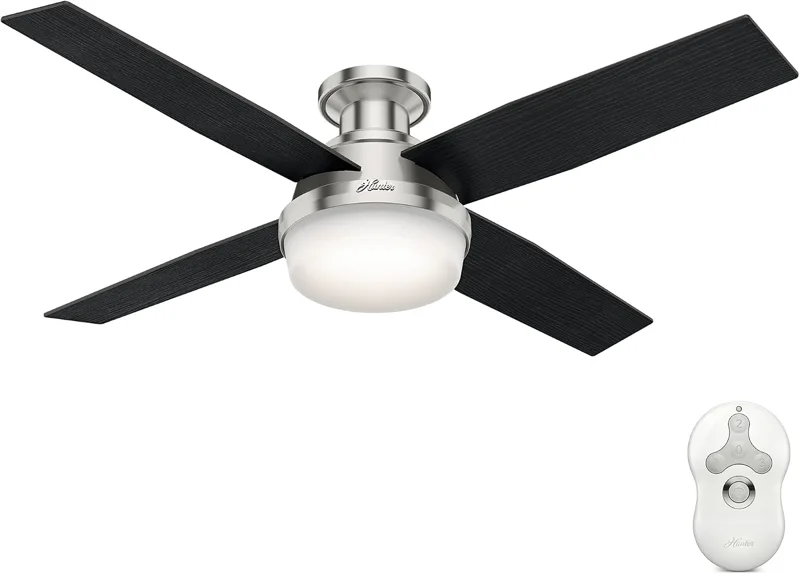
The three picks at a glance
The table below compares the fans on the things that change how a bedroom feels. On a phone you can swipe the table sideways to see every column.
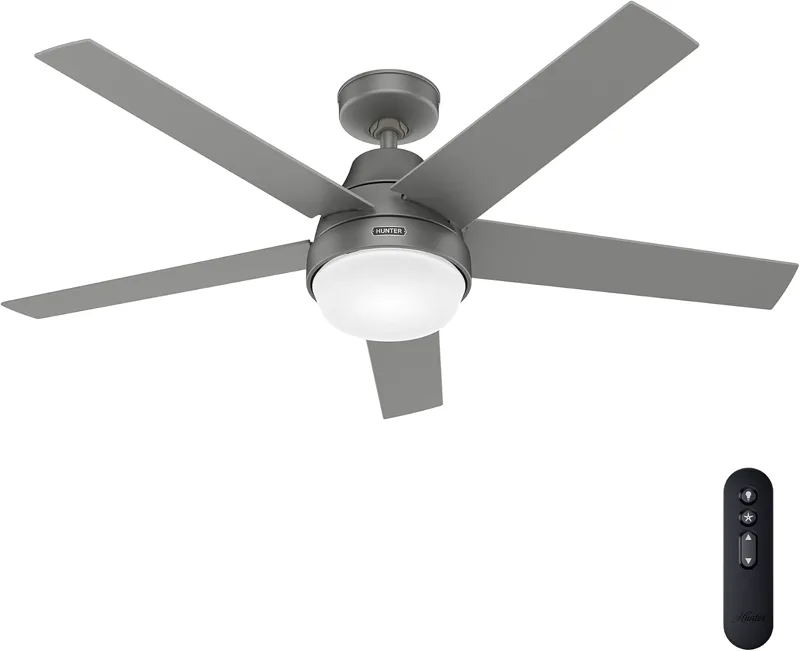
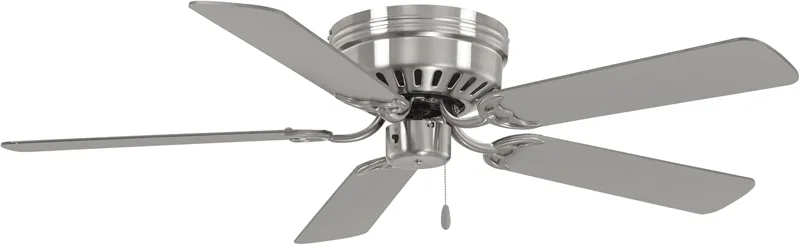
| Aspect | Hunter Dempsey 52″ | Hunter Aerodyne 52″ | Minka-Aire Mesa 52″ |
|---|---|---|---|
| Mounting | Low profile, close to ceiling | Standard downrod | Flush-mount hugger |
| Motor | AC, three speeds | DC, six speeds | AC, three speeds |
| Light | Integrated LED, cased glass | Integrated LED, dimmable | No light kit |
| Controls | Handheld remote | Remote plus app and voice | Pull chain |
| Blade span | 52 inches, five blades | 52 inches, five blades | 52 inches, five blades |
| Noise at low speed | Quiet, audible in a silent room | Quietest of the three | Quiet, some motor hum |
| Best ceiling height | Eight feet or higher | Nine feet or higher | Eight feet or lower |
| Main trade-off | No app control | Highest price of the three | No light, no remote |
This is a comparison of how each fan behaves in a bedroom, not a ranking of one product over another. Photo: Amazon product listings.
Blade span has to match the room, not the ceiling
Blade span is the diameter the fan sweeps, and it sets how much air moves. A 52-inch fan suits a room up to roughly 400 square feet, which covers most bedrooms. A smaller room can use a 42-inch fan, and a large master suite can justify a 60-inch model.
Oversizing a fan does not make a room cooler; it makes the fan run at low speed more often, which is usually the right outcome anyway. Undersizing is the mistake that shows up in July, when the fan is at full speed and the far side of the bed is still warm.
A DC motor is the quiet upgrade worth paying for
AC motors are cheap, reliable, and audibly present at low speed. DC motors cost more up front and run smoother, with more speed steps between off and fast. In a bedroom, that difference is the whole point: you want a gentle breeze, not the lowest setting of a motor that only knows how to push.
DC fans also use less electricity, though at bedroom duty cycles the savings are small. Buy the motor for the noise floor, not the energy label.
Light kits: lumens before looks
An integrated LED is the default on modern bedroom fans, and the useful number is lumen output, not the shape of the glass. A bedroom needs enough light to read by and a low setting that does not wake the other side of the bed. A dimmable kit with a wide range does both.
If the room already has lamps and a switched outlet, a fan without a light is a reasonable choice. Just decide before installation, because adding a light kit later means matching a discontinued part.
Remote control earns its place in a bedroom
Reaching up to a pull chain is fine in a laundry room. In a bedroom, a remote is the difference between turning the fan down at night and leaving it on high. Look for a remote that holds its last setting and a wall cradle so it does not disappear into a drawer.
Pull chains are still the most reliable control ever made, and they never need a battery. If the fan is on a wall switch and the chain is within reach, a chain-only fan is a legitimate budget choice.
Reversible airflow pays for itself twice a year
Every fan in this guide reverses. In summer the blades push air down to create a breeze; in winter they pull air up to circulate warm air that has stratified near the ceiling. The winter setting does not heat the room, but it does even out the temperature, which lets the thermostat sit lower.
The switch is usually on the motor housing, which means climbing a ladder twice a year. Fans with a remote reverse from the bed, and that convenience is worth paying for if the ceiling is high.
Mounting height decides how much air reaches the bed
Fan blades should sit at least seven feet above the floor, and higher is better for airflow. A standard downrod puts the blades around eight to nine feet in a normal room; a low-profile or hugger mount keeps them closer to the ceiling and is the only option when headroom is tight.
Measure floor to ceiling before you buy, then subtract the fan height from the listing. A fan that hangs too low is a hazard in a small room, and a fan mounted too high moves less air over the bed.
If the ceiling is low
An eight-foot ceiling rules out a long downrod. A flush-mount hugger like the Minka-Aire Mesa sits against the ceiling and leaves the room feeling taller, at the cost of a little airflow. In a low room, a smaller fan running faster beats a large fan that does not fit.
If you read in bed
Reading light wants a dimmable LED with a wide range and a colour temperature that does not read blue. A fan with an integrated light and a remote gives you both without a second lamp, and the low setting is what you will actually use at night.
If the room sits above a garage
Rooms over a garage run hot in summer and cold in winter, and a fan helps with the first problem more than the second. Reversing the fan in winter evens out the temperature, but insulation is the real fix. Treat the fan as comfort, not climate control. If the room also feels damp, a dehumidifier is the better first purchase.
Noise ratings are a starting point, not a promise
Fan noise comes from three places: the motor, the blade passing air, and vibration transmitted into the ceiling. A quiet motor on a poorly balanced fan is still noisy, and a well-balanced fan with a cheap motor hums at low speed.
Balance the blades after installation, tighten the mounting screws, and check that the box is rated for fan duty. Most “loud fan” complaints are installation problems, not product problems.
Smart features you will actually use
App control earns its keep in two situations: scheduling the fan to run during the hottest part of the afternoon, and turning it off from bed without hunting for a remote. Voice control is a bonus, and integration with a broader smart home is only worth it if you already run one.
Buy smart for the motor and the dimming range, not for the app. A fan that is pleasant to use manually will still be pleasant when the app is abandoned; the reverse is not true.
Which one fits a primary bedroom
For a primary bedroom with a standard ceiling, the low-profile Hunter Dempsey is the easy answer: 52 inches of span, an integrated LED, and a remote that lives in a cradle by the bed. It is not the quietest fan here, but it is quiet enough that most people stop noticing it within a week.
If the bedroom is your office as well, or you are a light sleeper, spend the extra on the Aerodyne. The DC motor and its six speeds make the difference between “on” and “barely moving air”, which is the setting you will use most.
Which one fits a guest room or a kids’ room
Guest rooms and kids’ rooms want simple and rugged. A pull chain cannot be lost, and a fan without a light kit is one less thing to break. The Minka-Aire Mesa covers that brief for the least money, and its flush mount suits the lower ceilings that small rooms often have.
If the room is used for homework, add a lamp rather than paying for a light kit. A dedicated desk light beats a ceiling light for reading and drawing anyway.
What to check before you buy
Four checks catch most of the mistakes buyers make in this aisle:
- Measure the room and the ceiling. Span and mounting height are the two numbers that decide whether the fan works.
- Confirm the ceiling box is fan-rated. A light-fixture box will not carry a moving fan.
- Decide on the light before you buy. Adding a kit later is harder than choosing at checkout.
- Read the control options. A remote that reverses and dims is worth more than one that only changes speed.
None of these are in the marketing headline, and all of them decide whether the fan is a fixture you forget about or a project you regret.
The short answer, if you want to stop reading here
Buy the Dempsey for a normal bedroom and a normal budget. Buy the Aerodyne if quiet matters more than money and you want app control. Buy the Mesa for a guest room, a kids’ room, or any ceiling too low for a downrod. All three are 52-inch fans, all three reverse, and all three stay under three hundred dollars.
None of them will cool a room that has no insulation and a west-facing window, and none of them replace air conditioning. Pick the one that matches the room you actually sleep in.


