Kitchen · Food preservation
One sealer keeps the bag outside the machine, the other pulls a vacuum around the entire bag. The choice comes down to what you actually put inside it.
A vacuum sealer is one of those appliances that either joins your weekly routine in the first month or spends the rest of its life behind the stand mixer. The difference is rarely about build quality. It is about whether the machine matches the food you bring home.
Two designs cover almost the whole market. A countertop sealer works with the bag hanging outside the machine. A chamber sealer drops the bag into a box and pulls vacuum from every side at once. They look similar on a shelf and behave nothing alike on a Sunday afternoon.
Quick answer
- Choose a countertop sealer when you seal dry portions, frozen meat and leftovers, and want the machine to live in a drawer between uses.
- Choose a chamber sealer when marinades, soups, sauces and wet braises are the point of owning it.
- Decide by bag cost and storage volume before you look at suction claims.
- Buy the design whose routine you will repeat, not the one with the longer feature list.
The two sealers part ways before the bag is sealed
The useful split happens at the moment air has to leave the bag. A countertop machine pulls air through the open mouth of a bag while the rest of the bag sits on the counter. A chamber machine places the sealed bag inside a box, removes air from the box, and lets the pressure difference collapse the bag around the food.
That mechanical difference decides which foods each design handles calmly and which foods it handles with a towel and a sigh. Everything else is secondary.
A countertop sealer works with the bag outside the machine
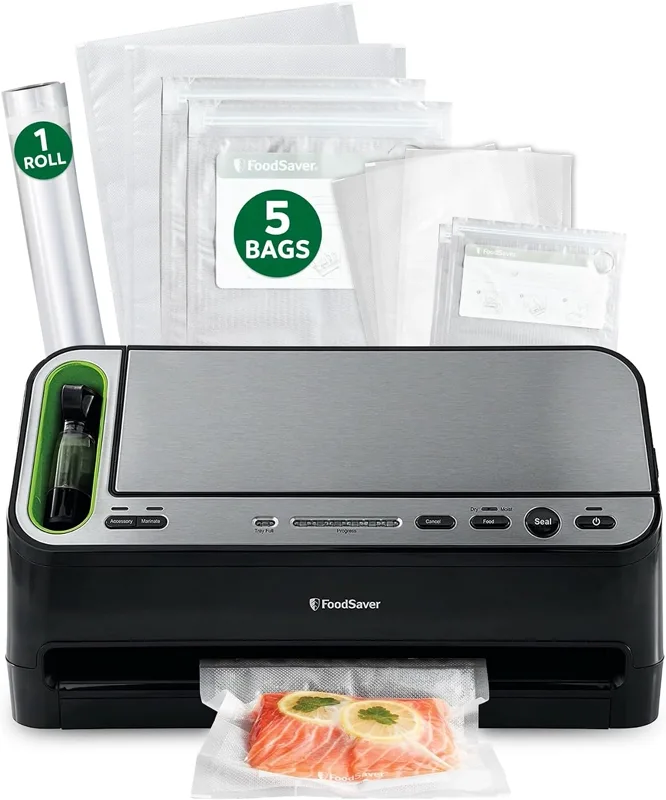
An external sealer is the familiar appliance: a lid, a sealing strip, a small pump and a roll of bag material. You fill a bag, flatten the opening, clamp it down and wait for the pump to pull air out of the bag and the strip to weld it shut.
It takes up roughly the footprint of a toaster and can be stored upright. It also handles a bag in whatever length you cut from a roll, which is why it suits odd shapes such as a whole chicken or a loaf of bread.
A chamber sealer pulls vacuum around the whole bag
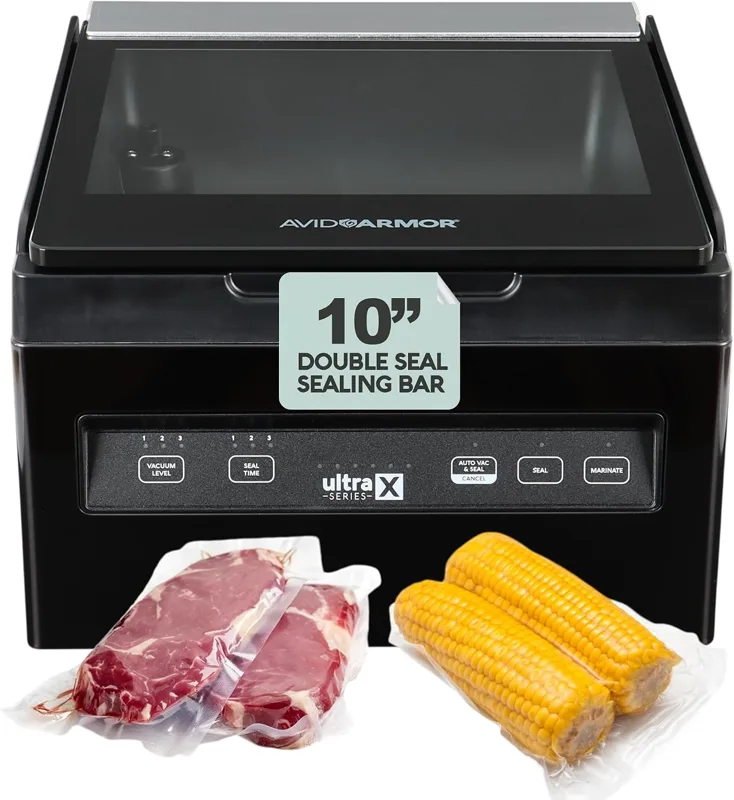
A chamber sealer is a box with a lid. The bag goes inside, the lid locks, and the pump evacuates the chamber rather than the bag. When air returns to the chamber, atmospheric pressure presses the bag tight around the contents from every direction.
Because the bag does not have to keep a flat opening while air is pulled through it, liquids stay put. A bag of chili or a marinating steak seals without the liquid climbing toward the seal.
Liquids change the decision more than any spec
If you cook in batches, the food you want to freeze is often wet: stew, sauce, stock, a braise with gravy. An external sealer can manage these with patience and a folded bag, but the margin for error is small and the mess is memorable.
A chamber sealer treats a bowl of soup as an ordinary job. That single capability is why people who preserve wet food stop shopping and start saving.
What happens to a wet marinade in an external sealer
Liquid rises toward the opening as air leaves the bag, and once it reaches the sealing strip the weld fails or seals around a puddle. The usual workarounds are to freeze the liquid first, to hang the bag over the counter edge, or to use a dedicated liquid setting that pauses the pump. All three work, and all three add a step you have to remember.
Bag cost and bag format shape the long run
External sealers use embossed channel bags or rolls that you cut yourself. Chamber sealers use smooth, plain bags that are usually sold in fixed sizes and cost less per bag in quantity.
Over a year of weekly freezing, that gap in bag cost can matter more than the difference in machine price, especially for anyone sealing several portions at a time. The catch is that chamber bags come in set dimensions, so unusual shapes need a bigger bag than the food deserves.
Counter space is a fair test of commitment
A chamber sealer is heavy, boxy and happiest with a permanent home. It does not tuck into a drawer, and lifting it onto a counter every week is the kind of friction that quietly ends a habit.
An external sealer is light enough to store away and quick enough to set up on impulse. In a small kitchen, that difference in effort decides how often the machine is used far more reliably than any feature comparison.
Throughput decides whether batch cooking feels worth it
A chamber sealer cycles one bag at a time, but each cycle is predictable and hands-off once the lid closes. An external sealer needs you to hold or position the bag, watch the vacuum, and confirm the seal.
For a handful of portions, the difference is a few minutes. For a freezer restock of thirty portions, the chamber machine’s repeatable rhythm is the reason people describe it as a workshop tool rather than a gadget.
Maintenance rewards different kinds of owners
Both designs ask for clean sealing surfaces and dry food paths. An external sealer collects crumbs and liquid in a drip tray you can rinse. A chamber sealer collects them inside the box, where a wipe-down is easy but easier to postpone.
Chamber machines also need their oil changed eventually, which is a scheduled task rather than a surprise. External units tend to fail at the sealing strip first, a part that is cheap and quick to replace.
Keep the sealing strip clean and the pump lasts
Most premature failures come from a strip with a film of grease on it, or from a bag that was too full and pulled liquid into the pump. Wiping the strip after every session and leaving headroom at the top of the bag prevents both, whichever design you own.
Where each design fits a home kitchen
An external sealer fits a kitchen that seals dry goods, portioned meat and leftovers, and wants the appliance out of sight between sessions. A chamber sealer fits a kitchen that cooks in volume, freezes wet dishes and has a permanent metre of counter to give.
Neither is a compromise. They are sized to different ambitions, and the honest question is which ambition describes your ordinary week rather than your holiday cooking.
- Dry portions and frozen meat: an external sealer is enough.
- Soups, sauces and marinades: a chamber sealer removes the workaround.
- Mixed use with limited storage: start external and upgrade only if liquids keep defeating you.
How the two designs compare side by side
The table below describes behaviour rather than a winner. Swipe sideways on a phone to see every column, and read each row against the way your own kitchen actually works.
| Aspect | Countertop external | Chamber |
|---|---|---|
| How air leaves | Through the bag mouth | From the whole chamber |
| Wet food | Needs workarounds | Handled without drama |
| Bag type | Embossed rolls, cut to size | Smooth bags, fixed sizes |
| Bag cost | Higher per bag | Lower in quantity |
| Footprint | Small, storable | Large, permanent |
| Throughput | Hands-on per bag | Repeatable cycles |
| Upkeep | Strip and drip tray | Chamber wipe, oil changes |
| Best fit | Everyday portions | Bulk and wet cooking |
Sous vide and freezer prep pull in opposite directions
Sous vide cooking rewards a chamber sealer because a bag can hold a marinade or a knob of butter without the seal fighting back. Freezer prep rewards whichever machine you will actually load on a weeknight, which is often the smaller external unit.
If both habits matter, the decision is about which one you would abandon first. Buy for the habit you refuse to give up and work around the other.
Buying bags ahead is the quiet recurring cost
Every sealer is a commitment to buying bags forever. The sensible move is to price a year of bags in the size you will use most, then compare that total against the machine you are considering. A cheaper sealer with expensive proprietary bags can cost more than a chamber unit within a couple of seasons.
Stock a small reserve before the freezer session, not during it. Running out mid-batch is the fastest way to end up with half-sealed food and a bad temper.
What a starter kit does not tell you
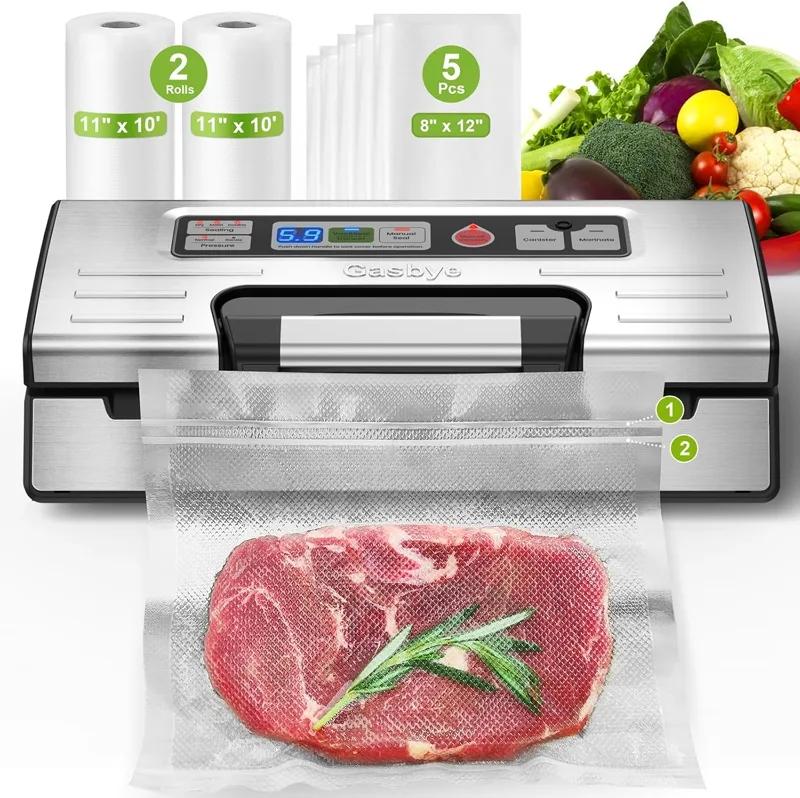
Boxed kits usually include a short roll and a handful of pre-cut bags, enough for two sessions. They rarely include the bag size you will settle on, and almost never the accessory hose you need for rigid containers. Treat the kit as a sample rather than a supply.
A practical way to choose
Write down the last five things you wished you could seal. If most of them were dry, an external sealer will do the job and fit your kitchen. If most of them were wet, a chamber sealer will save you a workaround every single time.
Then measure the counter you are willing to surrender permanently, and check whether the machine you want can live there. A sealer that has to be lifted out of a cupboard is a sealer that stops being used, and that is a more expensive mistake than either design. For the storage side of the same routine, our chest freezer versus upright freezer comparison covers how the food you seal ends up organised.
- List the foods you actually seal, not the ones you imagine sealing.
- Price a year of bags in the format each design requires.
- Check the permanent counter footprint before you fall for a model.
What actually changes once the sealer is on the counter
A sealer changes how you shop more than how you cook. Buying meat in larger packs and dividing it yourself becomes worthwhile, and leftovers stop being a countdown. The machine pays for itself in fewer discarded portions, not in dramatic dinners.
That is also why the smaller, easier machine often wins. The best sealer is the one you reach for without resentencing your evening to a cleanup. More kitchen storage and cooking comparisons live in our Kitchen & Cooking guides.