Workshop tools · Dust collection
One design dumps the chips in a bag, the other spins them out of the airstream first. The difference shows up on the third bag change, not on the spec sheet.
Two collectors can look like the same machine in a catalogue photo and behave like different tools in a garage. A single-stage unit pulls the whole airstream through the impeller and straight into a filter bag. A cyclone spins that airstream first, drops the bulky debris into a drum, and only then sends the fine dust on to a filter.
This comparison is about behaviour rather than specifications: how each design handles a planer, a long run of duct, an emptying session, and a garage that has to stay usable. It is not a ranking of individual machines, and the differences that matter are the ones you notice at the tool rather than on the box.
The short answer
- Decide on capture first. A hood that sits close to the cut and a short hose will outperform a larger motor with a loose connection every time.
- Choose a single-stage collector when it lives beside the machine and the bag comes off easily.
- Choose a cyclone when the run is long, the filter is fine, and the drum has to be emptied often without releasing dust.
- Plan the emptying session and the noise before you plan the airflow, because both decide how often the machine actually gets used.
A single-stage collector moves everything through the impeller
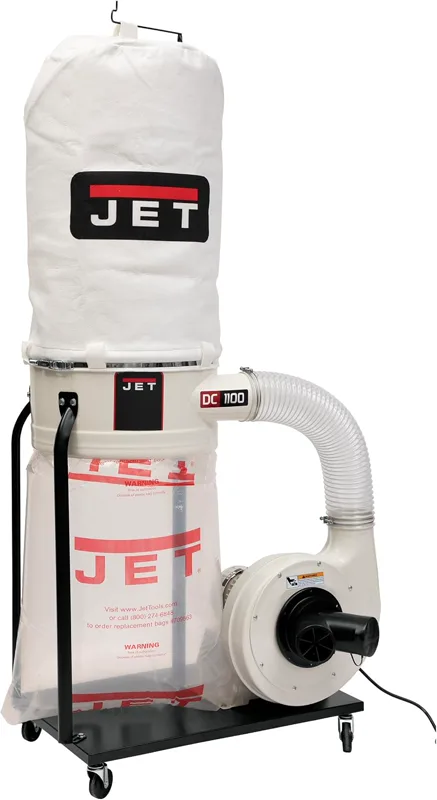
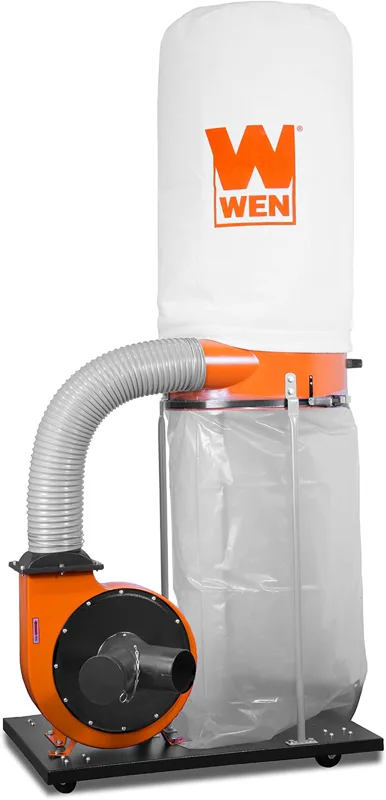
In a single-stage machine the chips and the air take the same path. Debris passes the impeller, travels up into a bag or canister, and the filter catches whatever is light enough to stay suspended. It is a short, simple route with very little to go wrong, and the whole machine can be wheeled from tool to tool.
The trade-off is that the filter sees every chip. A bag with a coarse weave passes the fines and keeps the shavings, while a pleated canister catches far more and loads up faster. Either way the material that reaches the filter is the material you have to deal with, and the impeller is the only thing pulling it along.
A cyclone drops the chips before the filter
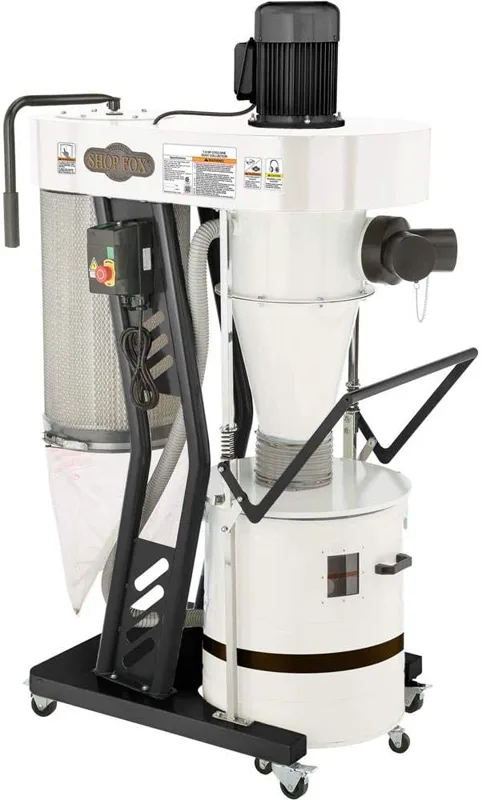
A cyclone uses the shape of the housing instead of a bag to do the first separation. Air enters tangentially, spins down the cone, and the heavy particles fall out of the airstream into a drum below. Only the fine fraction continues to the filter, which is why cyclone filters stay cleaner for longer and why the drum fills instead of the bag.
The cost is height and complexity. A cone needs vertical room, the drum needs clearance underneath, and the transition from drum to cone has to seal or the whole separation collapses into a leak. In a basement shop with a low ceiling, that geometry is often the deciding constraint rather than the price of the machine.
Hood capture decides more than motor size
It is possible to spend a great deal on airflow and lose most of it at the cut. A planer hood that sits too high, a table saw guard with a wide slot, or a router table with an open front all let the chips escape before the air can take them. The collector then has to move far more air than the job requires just to catch what is left.
The practical test is a handful of shavings on the table. If the hood cannot lift them at the point of cut, a bigger collector will not fix it, and a smaller one with a tight hood will look better in use. Sealing the cabinet, closing the gaps, and shortening the flex hose are free improvements that show up immediately.
Filter media sets what the air returns to the room
A collector in a closed garage is a recirculating system: whatever the filter misses goes back into the air you are breathing. A coarse bag filter is fine for chips and poor for the fine dust that stays airborne for hours. A pleated canister with a fine rating catches more, but it also loads faster and needs cleaning more often.
That trade-off is where the two designs diverge most in daily use. A cyclone holds the bulk of the debris away from the filter, so the fine layer builds slowly. A single-stage machine sends everything up front, so the filter does the whole job from the first minute of the first cut.
Duct runs turn nominal airflow into real airflow
Every foot of hose and every elbow costs pressure, and a small collector has very little pressure to lose. A short, straight, smooth run from the machine to the tool delivers close to the rated figure. The same machine behind fifteen feet of corrugated hose, two elbows, and a blast gate delivers a fraction of it.
Long runs and small inlets
A four-inch inlet on a long run behaves like a smaller inlet on a short one. If the run cannot be shortened, the next best step is to reduce the number of transitions and keep the hose as straight as the shop allows. A collector that is asked to pull through a restrictive run will sound busy and move very little.
Bag changes and drum height shape the workday
Emptying is the part nobody plans for. A bag hangs, sags, and has to be wrestled off a collar while it is full of fine dust. A drum rolls out, takes a liner, and goes back under the cone with far less handling. In a shop where the collector runs for hours, that difference shows up twice a week.
Height matters as much as the method. A drum that fits under a bench is easy to swap. A cone that needs a step ladder to reach the filter release is one you will clean less often than you should, and a dirty filter is the same as a smaller machine.
Noise and placement matter in a shared garage
A collector is loud enough to dominate a conversation, and the noise rises with airflow. In a detached shop that is a nuisance. In a garage under a bedroom it is a scheduling problem, because the machine runs exactly when the family is home and the project is loudest.
Placement helps more than any soundproofing. A machine in a corner reflects sound back at the operator. A machine against an open door, on a rubber mat, with a short hose to the tool, is noticeably easier to live with, and it is also easier to leave running for the next cut.
Footprint and ceiling height decide the layout
A single-stage unit is compact and low. It tucks beside a bench, rolls under a shelf, and leaves the wall free. A cyclone is tall, and the cone has to sit above the drum with enough room to lift the lid. In a basement with ducts at head height, that vertical stack may not fit at all.
Measure the whole path before ordering: the machine, the drum, the clearance to lift the drum out, and the swing of the hose. Shops that skip this step end up with a collector parked in the middle of the floor, which is the one place it cannot stay.
Circuit and amperage assumptions need checking
Larger motors draw more current at start-up, and a shared garage circuit is often already loaded with a fridge or a charger. A machine that trips a breaker on every start will be run less often, and a run that ends with a reset is worse than no run at all.
Check what the circuit can carry before the machine is chosen, then check it again once the ducting is planned. A dedicated circuit is a small job compared with rewiring a shop, and it removes the most common reason a new collector sits unused.
Planing and jointing produce the heaviest chip load
A planer throws a wide, heavy ribbon of chips, and a jointer produces long curls that bridge and clog. Both tools want volume rather than pressure, which is exactly what a bag-and-impeller design delivers. A cyclone handles the same load and keeps the drum filling predictably instead of packing the bag neck.
Wide boards and deep cuts
The heaviest cut is the one where the full width of the knife is buried in the board. That is also the cut where a hood gap hurts most, because the chip stream is deflected upward and outward. Setting the hood close and taking a lighter pass keeps the stream inside the airflow.
Small tools want a different setup
Sanders, routers, and biscuit joiners produce fine dust and very little volume. A large collector is inefficient for them: the air moves too fast through a small port, and the machine is louder than the job. A shop vacuum with a fine filter and a small hose often collects better at the tool.
Sanders, routers, and shop vacuums
The usual arrangement is both: a collector for the planer, jointer, and table saw, and a vacuum for everything with a two-inch port. Trying to make one machine do both jobs usually means the small tools are connected through an adapter that leaks, which is the worst of both worlds.
Emptying the drum is a dust event of its own
Every collector releases dust when it is opened, and the release is the part that ends up on the shelves. A drum with a liner contains almost all of it. A bag that has to be unclipped and carried across the shop distributes a fine layer over everything on the way.
The habit that helps most is emptying before the drum is full. A shallow layer of chips is easy to lift out; a drum filled to the collar has to be dragged, tipped, and often swept up afterwards. Ten minutes at the right moment saves an hour of cleaning.
A decision rule for a small shop
If the collector lives beside the machine and the run is short, a single-stage unit with a good canister is the simpler tool. If the run is long, the filter is fine, or the drum has to be emptied often, a cyclone earns its footprint. The rest is layout.
- Short hose, one tool, occasional use: single-stage.
- Long run, several tools, daily use: cyclone.
- Fine dust from sanding and routing: a vacuum, not a collector.
The guide to dust extractors versus shop vacuums for sanding covers the small-tool end of the same decision, and the tools archive collects the rest of the workshop comparisons.
The table below compares the two designs on the aspects that come up most often in a small shop. Swipe sideways on a phone to see the full row.
| Aspect | Single-stage | Cyclone |
|---|---|---|
| Separation | Filter does the work | Cone does the work |
| Filter loading | Fast | Slow |
| Drum or bag | Hangs and sags | Rolls on a liner |
| Height needed | Low | Tall |
| Duct tolerance | Poor | Better |
| Mobility | Easy | Heavier |
| Fine dust return | Higher | Lower |
| Emptying effort | Awkward | Simple |