Finish quality is decided long before the gun touches the wood: by how stable the air supply is, how clean the surface is, and whether the room lets overspray leave.
Turbine or compressor is the second question. The first is what you intend to spray, and how often.
The short answer
- Home shop, furniture, doors and trim, mostly waterborne finishes and lacquer: a turbine kit is the simpler path, and the parts arrive matched.
- You already own a real compressor, or you need to spray thick primers and paints: a compressor-driven gun gives you the control those materials need.
- An undersized compressor paired with a compressor gun is the one combination to avoid. The pattern will pulse no matter how good your technique is.
- With either system, the finish is decided by stable air, a clean substrate and a room that lets overspray leave.
Turbine or compressor at a glance
The rows below are about how the two systems behave, not about which one is better in general. On a narrow screen, swipe the table sideways to see the second column.
| Aspect | Turbine HVLP | Compressor and gun |
|---|---|---|
| What you buy | Turbine, hose and matched gun as one kit | Compressor, gun, hose, filters and fittings |
| Air supply | High volume, low pressure, warm and dry | Stored high-pressure air, regulated at the gun |
| Control at the gun | Fan and fluid, air is fixed | Pressure, fluid and fan all adjustable |
| Coating range | Common furniture finishes, waterborne friendly | Wider range with different nozzle sets |
| Setup and footprint | Compact unit, long light hose | Tank and compressor take floor space |
| Colour changes | One gun to flush | Gun, line and regulator to clean |
| Noise | Continuous blower noise while spraying | Compressor cycles under load |
| Best for | Home shop, furniture, trim | Cabinet runs, mixed coatings, shop already on air |
How each system makes air
A turbine uses a motor-driven blower to push a high volume of warm, low-pressure air down a fat hose to a gun designed for that supply. A compressor stores air at high pressure in a tank and delivers it through a regulator to a gun that converts pressure into atomization.
Both are called HVLP, and both can produce excellent finishes. But the air behaves differently at the nozzle, and that difference shapes coating choice, hose length and how much tuning you do between coats.
What the turbine does well
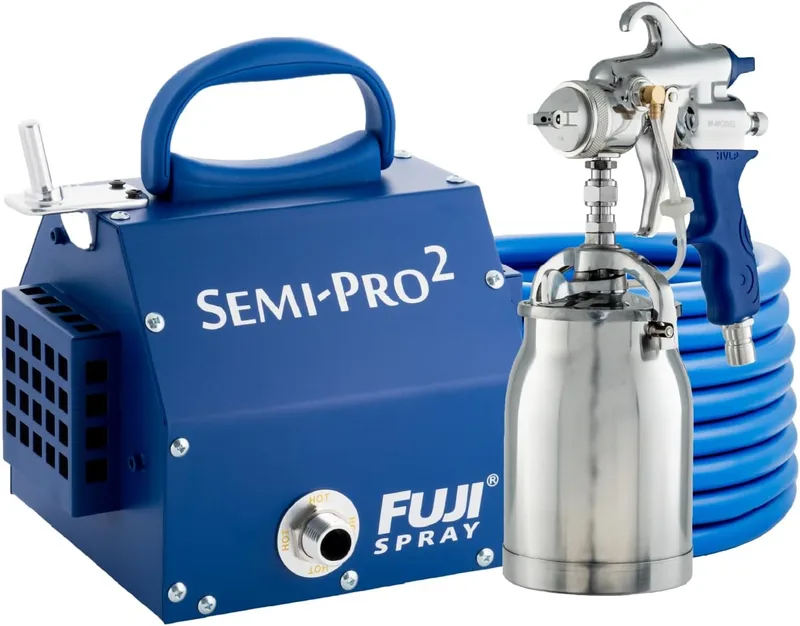
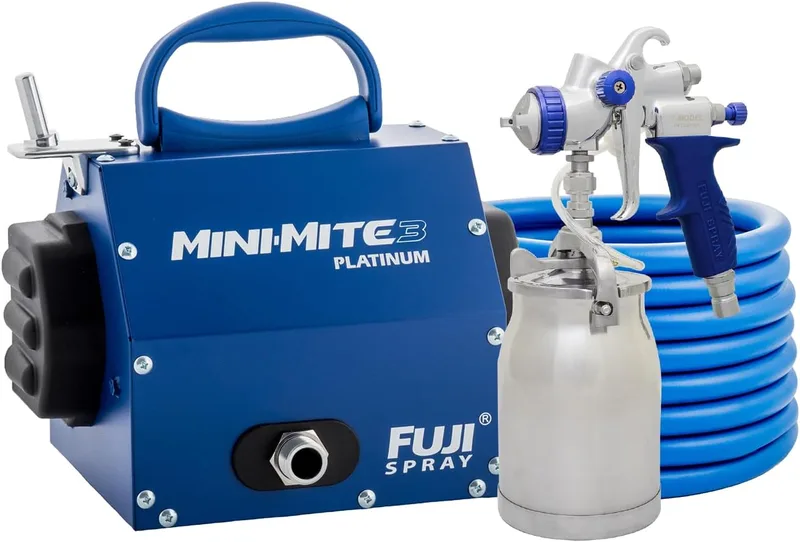
The warm, dry air is forgiving with waterborne finishes, and the long flexible hose lets you move around a piece without dragging a heavy line. Because blower and gun are sold as a set, atomization is predictable out of the box.
The compressor’s trade-off
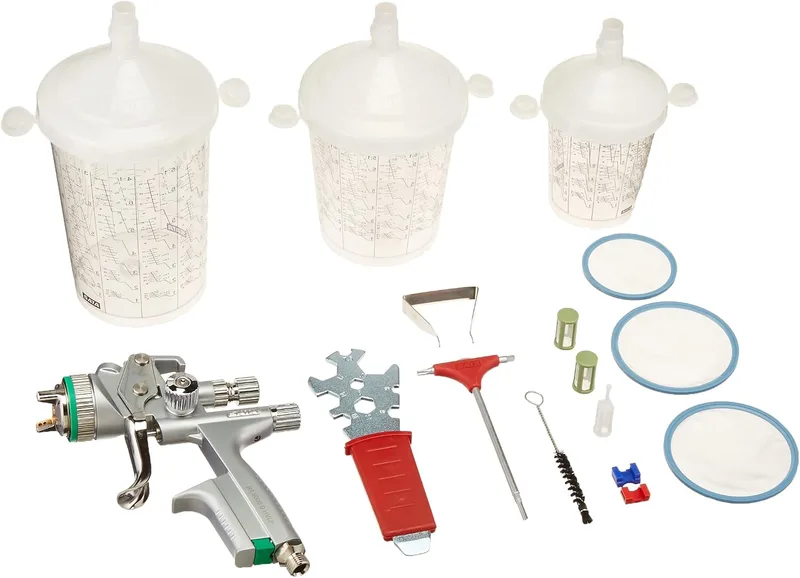
A compressor system gives you pressure control at the gun, a wide range of guns and nozzle sets, and the ability to spray heavier materials with the right combination. It also powers other tools, which matters in a shop that already runs on air.
The compressor sizing trap
Most disappointing HVLP results at hobby level trace back to a compressor that cannot sustain the required airflow. Tank size is not the constraint. Sustained delivery is.
A large tank lets you spray in short bursts before pressure drops, which can mask an undersized pump for the first minute and then ruin the finish on the second pass.
Read the gun’s air requirement against the compressor’s delivery at the pressure you will actually use, not the peak figure on the box, and add margin for a long hose and a filter. If the numbers are close, the setup will pulse.
Atomization, orange peel and dry spray
Reading the finish instead of the gauge
Orange peel comes from coating that lands too thick and too cold to flow out. Dry spray comes from coating that partly dries before it reaches the surface. Both are atomization and technique problems, and both are easier to solve when the air supply is stable and adjustable.
A turbine delivers a fixed volume of air, so you adjust the pattern and the fluid flow rather than the pressure. That is simpler, and it also means the coating has to suit the gun.
A compressor gun lets you tune pressure to the material. That is more flexible and more demanding: too much pressure drives the coating dry, too little leaves it pebbled.
Coating compatibility
Waterborne finishes, lacquer, polyurethane, shellac and paint each behave differently through a nozzle. Thin finishes atomize easily and punish overspray. Thick ones need more energy and a larger nozzle.
Before choosing a system, list the coatings you actually plan to spray and confirm the gun has a nozzle and needle set suited to them. A matched turbine gun covers the common furniture finishes well within their range. A compressor gun with interchangeable sets covers more, and asks more decisions of you.
Overspray, transfer efficiency and the room
HVLP was developed to cut overspray by lowering pressure at the nozzle, and both system types benefit. What changes is how much overspray lands on the floor, the walls and your lungs.
Whatever you buy, plan the room around the spray: cross-ventilation or extraction, a filter behind the workpiece, and a clear path for the air to leave. A finish that looks perfect on the bench and dusty on the second coat usually has a room problem, not a gun problem.
Prep belongs to the same workflow. If you are spraying cabinets or built-ins, the surface you sand to matters as much as the coating you apply. Our guide to sanders for cabinet work covers the stage before the gun.
Gun ergonomics: gravity versus bottom feed
Gravity-feed guns put the cup on top, which makes them easier to clean and lets you spray at awkward angles with a smaller cup. Bottom-feed guns carry more material and keep the centre of gravity lower, which some finishers prefer on large flat panels.
Cup size, gun weight and how the controls fall under your hand matter more than the spec sheet suggests. Fatigue shows up in the last coat of a long session.
Noise, heat and where the machine sits
Turbines are loud, and the sound is continuous while the gun is in use. Compressors cycle, and a small one will cycle constantly under spray demand, which is its own kind of fatigue.
Both need to sit outside the spray zone so the intake does not pull overspray into the motor, and both benefit from a short, straight hose run instead of a coiled pile on the floor.
Moisture and air quality
Compressed air carries moisture, and moisture in the line shows up as tiny craters that appear only after the coat flashes off. A filter and a water trap at the gun end are not optional in humid weather.
Turbine air is warm and comparatively dry, which is one reason waterborne finishes behave well through a turbine. Warm air also changes how a coating flows, especially in a cold room.
The learning curve, honestly
Both systems reward practice on scrap. The difference is where the mistakes come from.
With a turbine, most beginner problems are technique: distance, speed, overlap, and triggering off the edge of the piece. With a compressor gun, technique problems are mixed with setup problems: pressure, fluid flow, fan width and moisture.
The second set is solvable, but it takes longer to separate a bad habit from a bad setting.
If you are spraying as part of a larger build, the prep work either supports the finish or undermines it. Our guide to choosing between a bench planer and a sander explains where each tool fits in the sequence that ends at the gun.
Cost of entry versus cost of running
A turbine kit bundles everything you need in one purchase and has no consumables beyond coating and cleaning supplies. A compressor system spreads the cost across compressor, gun, filters, hose and fittings, and the compressor is usually the item upgraded first.
If you already own a suitable compressor, the marginal cost of a good gun is modest. If you do not, the honest comparison is a complete turbine kit against a compressor plus gun plus air treatment.
Which one fits which job
- Occasional furniture, doors and trim in a home shop: turbine, for simplicity and matched parts.
- Cabinet runs with a compressor already in the shop: compressor gun, for control and material range.
- Automotive or high-gloss work: compressor gun, with proper air treatment.
- Waterborne finishes in a small space: turbine, for warm dry air and a short setup.
- Mixed materials including thick primers: compressor gun with the right nozzle set.
Maintenance between sessions
Clean the gun immediately after every session, not at the end of the day. Flush the fluid path, wipe the nozzle, and check the packing and needle for coating build-up.
Turbines need their filters cleaned or replaced on a schedule, and the hose should be stored without tight kinks. Compressors need the tank drained and the filter at the gun checked before a finish coat. Most ruined-gun stories are dried coating in a passage that was never flushed.
Dust control belongs in the same routine. A dusty shop ruins more finishes than a mediocre gun does, and the sanding stage is where most of that dust is made. Our notes on maintaining a bench sander cover the habits that keep dust out of the air before the gun comes out.
Bottom line
Choose the turbine if you want a complete, matched system and a shorter path to a decent first coat. Choose the compressor gun if you already have the air, need material flexibility, or intend to grow into more demanding finishes.
In both cases the finish is decided less by the badge on the machine than by stable air, clean substrate and a room that lets the overspray leave. For more on the tools around this workflow, browse our tool guides and reviews.