Home improvement · Floor care
A steam mop is the cheapest way to get tile and sealed hardwood properly clean without a bucket, and under two hundred dollars the differences that matter are tank size, pad contact, and how much of the machine you have to carry up the stairs.
Steam mops sit in an awkward place in the floor-care aisle. They cost more than a sponge mop, do less than a wet-dry vacuum, and the marketing leans on phrases like “chemical-free sanitising” that are hard to check. What they actually do is simple: boil water, push the vapour through a cloth pad, and let the heat and moisture lift grease that a dry mop just spreads around.
That is enough for most kitchens, bathrooms, and entryways. It is not enough for a floor with a lot of loose debris, which needs vacuuming first, or for unsealed wood, laminate with open seams, or anything that was glued down with a water-sensitive adhesive. The three models below cover the useful range under two hundred dollars, and each one is aimed at a slightly different household.
Quick answer
- Best all-rounder: Bissell PowerFresh Deluxe 1806 — a scrub brush built into the head, variable steam, and the shortest warm-up of the three.
- Best for stubborn tile and grout: Shark Steam & Scrub S8201 — rotating scrub pads do the work a flat pad cannot, at the highest price here.
- Best for tight spaces and light duty: Amzart 13-in-1 — a handheld conversion and a long cord for bathrooms, stairs, and rented kitchens.
All three are corded, all three use removable microfiber pads, and all three need the floor swept or vacuumed before they go on. None of them replaces a vacuum, and none of them is the right tool for a whole house of carpet.
What a two-hundred-dollar budget actually buys
At this price the hardware is mature: a heating element, a tank, a pump, and a swivel head. The money goes into the parts you touch — the pad, the scrub brush, the handle height, the length of the cord — and into how quickly the machine makes steam. A cheap steam mop that takes forty seconds to heat is fine; one that dribbles water onto the floor is not.
Above two hundred dollars you start paying for larger tanks, faster heat, and accessories. Below a hundred you mostly lose pad quality and temperature control. The middle is where most households should shop, which is why these three sit between about $110 and $190.
The Bissell PowerFresh Deluxe 1806 is the easiest to live with
The 1806 pairs a flat microfiber pad with a built-in SpotBoost brush that flips down for grout lines and dried spills. Steam level is adjustable, warm-up is quoted at thirty seconds, and the scent discs are optional — the machine works without them. For a kitchen with a mix of tile and sealed wood, that combination covers both without changing attachments.
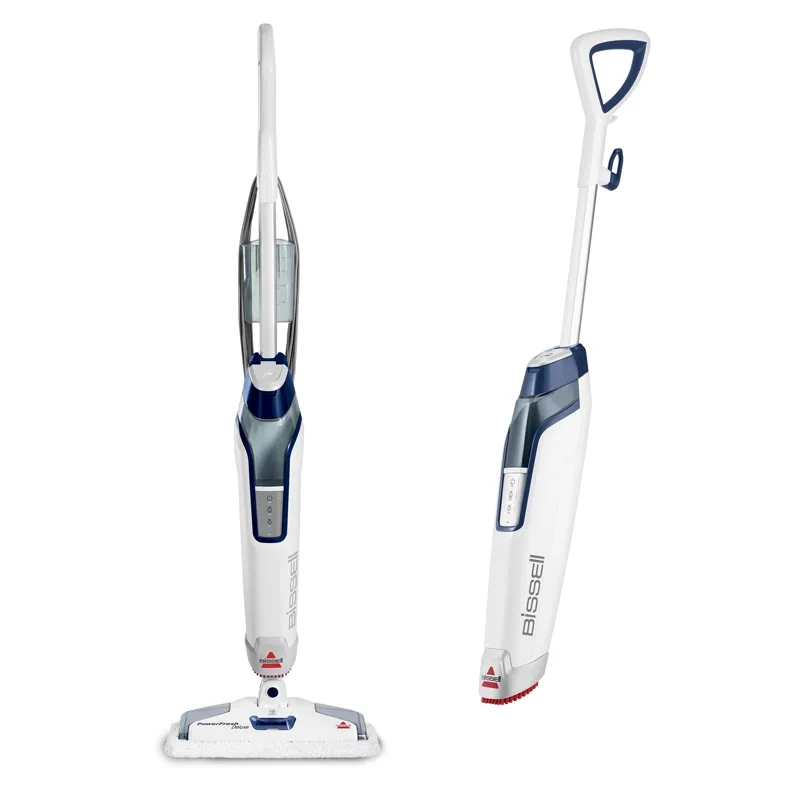
The trade-off is the pad. A flat microfiber pad glides over tile and leaves an even finish, but it does not agitate. Dried sauce or a scuff mark needs the brush, and the brush needs a few extra passes. Households with a lot of grout will notice the difference; households with smooth, sealed floors will not.
The Shark Steam & Scrub S8201 handles grout and textured tile
The S8201 replaces the flat pad with two rotating scrub pads and adds a Steam Blaster mode that pushes a concentrated burst at a stuck spot. Three steam settings let you back off on sealed wood and lean in on tile. It is the heaviest and most expensive of the three, and the one that makes the biggest visible difference on grout that has gone grey.
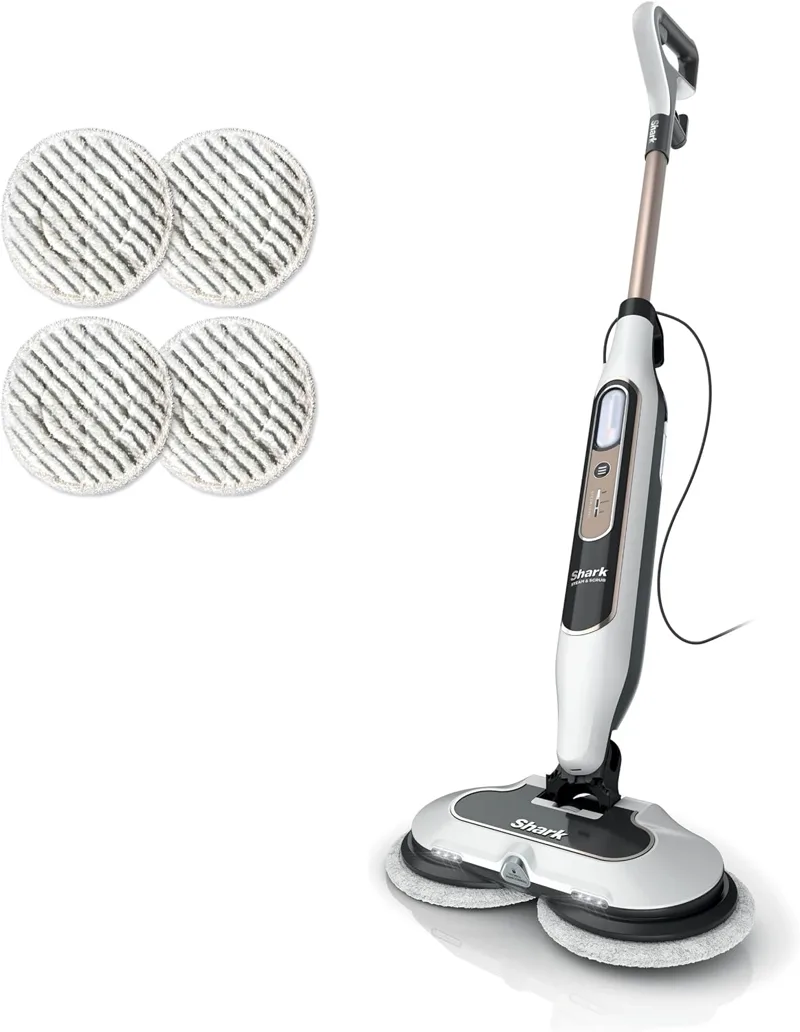
Rotating pads are also the reason to think twice. They are more expensive to replace than flat microfiber, they add height to the head so the machine does not slide under a low radiator or cabinet toe-kick, and the rotation can be too much for a delicate finish. On ordinary ceramic or porcelain tile, none of that matters.
The Amzart 13-in-1 covers small floors and stairs
The Amzart converts from a stick mop to a handheld steamer, which makes it the only one of the three that can do a bathroom wall, a shower door, or the grime around a toilet base. The tank is smaller and the head is lighter, so it is the easiest to carry upstairs and the least tiring on a long pass. A 23-foot cord means fewer outlet changes in a hallway.
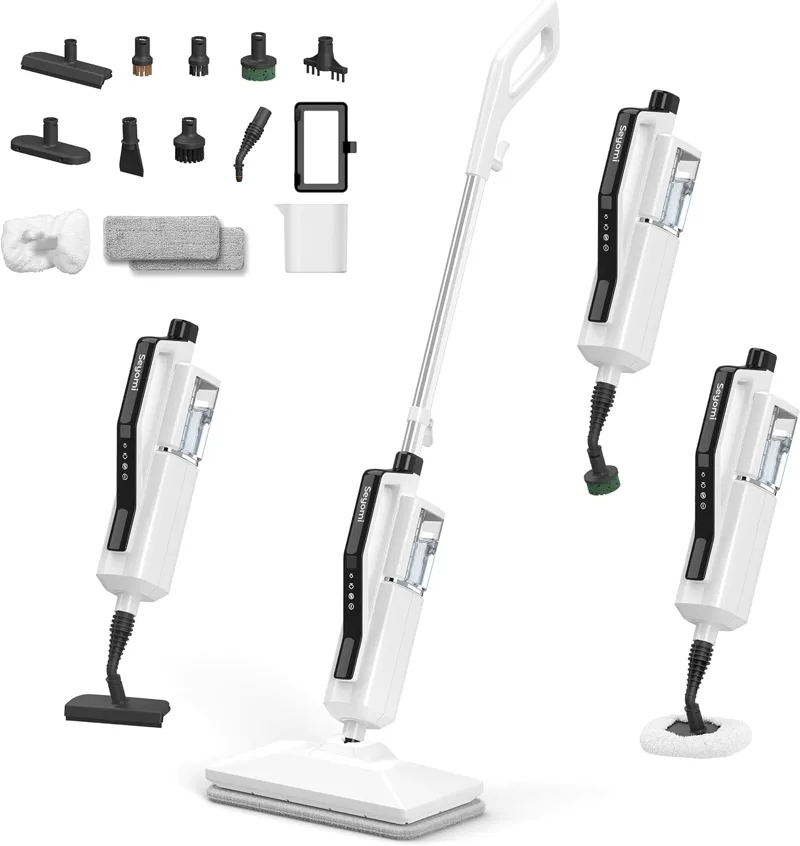
The cost of that flexibility is a smaller water tank and a lighter build. A whole kitchen and hallway will need a refill partway through, and the stick mode is less planted than the Bissell. For an apartment, a rental, or a house where the steam mop is mostly for the bathroom, that is a fair trade.
Tank size decides how much floor you finish per fill
Steam mops quote tank volume in ounces or millilitres, and the useful number is not the volume but the run time at the setting you will actually use. A small tank on high steam runs dry in about ten minutes of continuous work; a larger tank at a lower setting can cover a kitchen and a hallway before a refill.
Refilling is not a big deal, but it happens with hot water and a cap that needs to cool. If the floor plan is open and the mop will run for twenty minutes at a time, buy the larger tank. If it is for a bathroom and an entry, the smaller one is easier to store and faster to heat.
Sealed wood, laminate, and vinyl: read the finish first
Steam is safe on sealed hardwood, engineered wood with a factory finish, and most vinyl and luxury vinyl plank. It is not safe on unsealed wood, bamboo with an oil finish, laminate with visible seams, or anything where water has already caused swelling. The test is simple: a few drops of water on the surface should bead, not soak in.
On sealed wood, use the lowest steam setting and keep the mop moving. Standing steam in one spot can dull a finish or leave a white mark, and no manufacturer warranty covers a finish that was damaged by holding the head still.
Pads, brushes, and the recurring cost
Every steam mop here uses washable microfiber pads, and every one of them will need replacement pads eventually. Flat pads are cheap and available in multipacks. Rotating scrub pads cost more and wear faster because they are doing mechanical work. Budget for one spare set either way; a mop with a soaked, clogged pad just pushes dirty water around.
Wash pads separately from towels, without fabric softener, and let them air dry. Softener clogs the fibers and the pad stops picking up grit, which is the whole reason it works.
Weight and cord length matter more than features
A steam mop is a tool you push for ten to twenty minutes, so a pound of extra weight in the head is felt by the end of a hallway. Cord length decides how many times you unplug and replug, and a short cord in a large kitchen is a daily annoyance. Neither number appears in the marketing headline, and both matter more than the number of attachments in the box.
How the three picks compare side by side
The table compares the machines on the things that change daily use. Prices are the ones shown at a New York 10001 delivery address when this was written and will move with promotions.
| Aspect | Bissell 1806 | Shark S8201 | Amzart 13-in-1 |
|---|---|---|---|
| Cleaning head | Flat pad plus flip-down brush | Two rotating scrub pads | Flat pad, handheld mode |
| Steam control | Variable | Three settings plus burst | Two levels |
| Warm-up | About 30 seconds | Fast, quoted in seconds | Quoted at 15 seconds |
| Best surface | Sealed wood and tile | Tile and grout | Bathrooms, stairs, small floors |
| Weight | Moderate | Heaviest | Lightest |
| Storage | Upright, compact head | Bulkier head | Breaks down |
| Price checked | $114.99 | $189.00 | $109.99 |
| Main trade-off | Brush needs extra passes | Cost and pad wear | Small tank, lighter build |
Which one fits your floors
For a kitchen with sealed hardwood and a bit of tile, the Bissell 1806 is the simplest answer: it heats fast, the brush handles the grout line where the two floors meet, and the price leaves room for spare pads. For a bathroom or a tiled kitchen where grout has gone dark, the Shark S8201 does visibly more work, and the rotating pads are the reason.
For a rental, a small apartment, or a house where the steam mop is a bathroom tool rather than a floor system, the Amzart is the one that fits in a closet and converts to a handheld when the shower needs attention. It is the least capable on a large open floor and the most useful in the corners.
Whichever you pick, sweep or vacuum first. A steam mop moves dust into a paste, and a paste is harder to remove than the dust was. The robot vacuum versus cordless stick comparison covers the step before this one, and the robot mop picks for tile floors cover the hands-off alternative for everyday upkeep.
More floor-care guides, including vacuums and hard-floor cleaners, sit in the home improvement archive.