Home improvement · Dehumidifiers
Pint ratings, drain routes, and defrost cycles decide whether a basement stays dry or just stays musty.
A basement dehumidifier is usually bought in a hurry, after a smell or a damp patch appears, and most of the disappointment comes from two decisions made without much thought: the pint rating and where the water goes. Get those two right and the machine runs quietly in a corner for years. Get them wrong and you are emptying a bucket twice a day while the room still smells of damp.
This guide explains what the numbers on the box actually measure, how to match capacity to a real basement, and the small installation details that decide whether the unit keeps up.
The short version
- Find and fix the water source before you size the machine; a dehumidifier is not a drain repair.
- Match the pint class to the room and to how damp it feels, then round up rather than down.
- Choose the drain route first. A pump is worth more than an extra pint of capacity.
- In a cold basement, check the defrost range before anything else on the label.
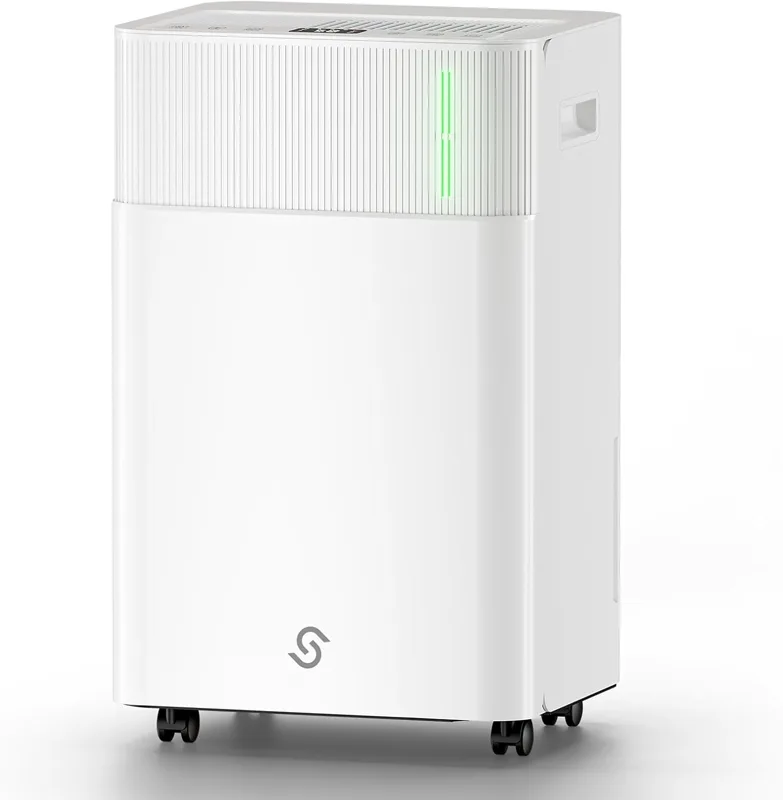
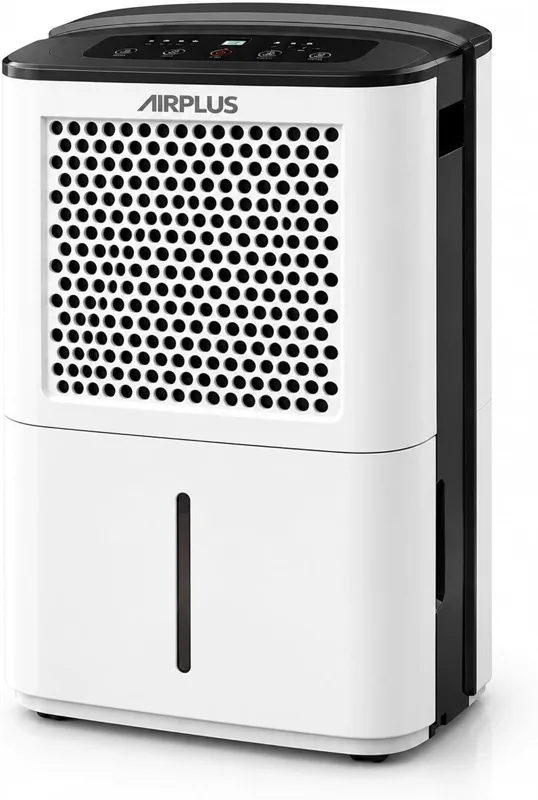
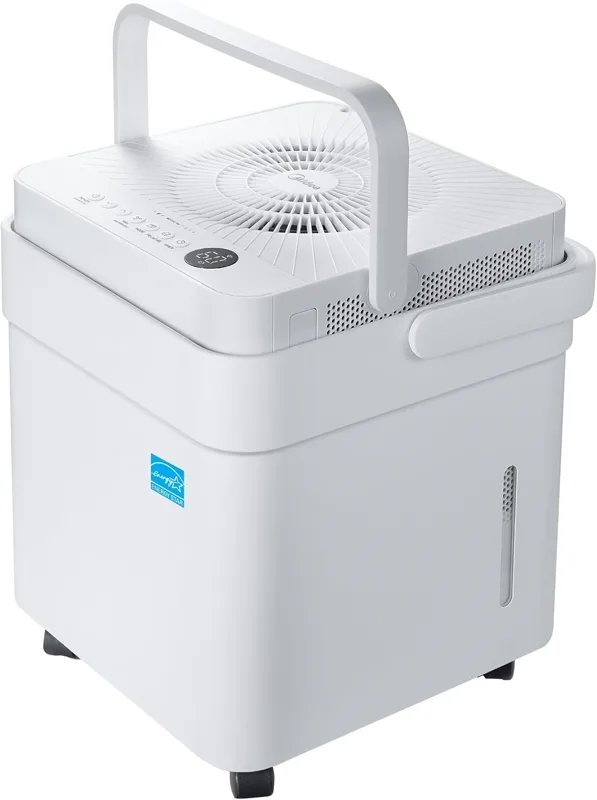
The three units used as examples below are all in the 50-pint class but built in different shapes. Swipe the table sideways on a phone if the columns run past the screen.
| Aspect | 52-Pint Tower | 50-Pint Slim Tower | 50-Pint Cube |
|---|---|---|---|
| Water-removal class | 50-pint class | 50-pint class | 50-pint class |
| Stated coverage | Up to 4,500 sq ft | Up to 4,500 sq ft | Up to 4,500 sq ft |
| Shape | Tall tower | Tall, slim tower | Cube |
| Continuous drain | Hose outlet | Hose outlet | Hose outlet |
| Bucket access | Front pull-out | Front pull-out | Front pull-out |
| Where it fits | Corner of a finished room | Narrow gap or closet edge | Under a shelf or stair |
| Listed for | Basement and bedroom | Bedroom and general rooms | Basement |
| Watch out for | Height under a shelf | Bucket depth in a tight gap | Clearance above the cube |
This table compares how the three shapes behave in a room. It is not a ranking, and the numbers that matter for your basement are the ones on each product page.
Fix the water source before you buy capacity
A dehumidifier removes moisture from the air. It does not stop water from entering. If a downspout empties against the foundation, if the floor slopes toward the wall, or if a pipe sweats, the machine will run continuously and still lose. Spend an hour on gutters, grading, and visible leaks first. A basement that stays dry after that needs a smaller unit than one that is fighting an active leak, and no pint rating compensates for water arriving faster than it can be removed.
What a pint rating actually measures
The pint figure is the amount of water the unit can pull from the air in 24 hours under a standard test, at a fixed temperature and humidity. Real basements are rarely at that temperature or that humidity, so the number is a comparison tool rather than a promise. It is still the most useful figure on the box, as long as you compare units tested the same way and you read it together with the room size and the air temperature the machine is rated to work in.
Reading a pint rating across test standards
Test standards changed, and older marketing material still floats around with the pre-change numbers on it. A unit labelled under the newer standard can look weaker than an identical older unit, because the test conditions are harsher. When you compare two machines, compare labels from the same era, or expect a gap that has nothing to do with build quality.
Size by square footage and how damp the space feels
Start with floor area, then adjust for how the space behaves. A sealed, painted basement that smells faintly after rain is a different job from a bare stone cellar with visible seepage. Damp rooms need the next size up, and rooms that open into stairwells or laundry areas need more again, because the machine is drying air that keeps being replaced. Oversizing slightly costs a little more to run; undersizing costs you the room.
Sizing example for a 1,000 square foot basement
A thousand square feet at normal humidity usually lands in the 50-pint class under a modern rating. If that space is clearly damp, if it has a laundry corner, or if the ceiling is open to joists that stay cold, move up rather than down. If it is small, closed, and dry, a smaller unit will cycle less and last longer.
The bucket is a maintenance schedule, not a feature
Bucket size decides how often you touch the machine. In a genuinely damp basement, a modest bucket can fill in a day, and every one of those days is a day you have to remember. Treat bucket capacity as a fallback for power cuts and shoulder seasons, not as the main plan. If the basement is damp enough to need a dehumidifier in the first place, plan for continuous drainage from the start.
Gravity drain, pump, or bucket: choose by where water can go
A gravity hose only works if the outlet sits higher than the end of the hose, which means a floor drain, a sump pit, or a slope you can rely on. A built-in pump lifts water upward and out through a window or into a sink, at the cost of noise and one more part to fail. The bucket is the option that always works and always needs you. Choose by the drain you actually have, not by the one you wish you had, because the wrong choice turns a dry basement into a daily chore.
Defrost cycles decide whether it works in a cold basement
A compressor dehumidifier pulls moisture onto cold coils, and those coils frost up when the room is cool. The machine then stops drying while it defrosts, which is why a unit rated only for warm rooms can run all night in a cold basement and collect almost nothing. Look for the lowest temperature the maker lists for operation, and expect efficiency to fall as the room gets colder.
Compressor or desiccant for a cool space
Compressor units are the common choice: efficient in warm, humid rooms and cheaper per pint removed. Desiccant units use a drying wheel and keep working at low temperatures, which makes them the better fit for an unheated cellar, a garage, or a cabin. They cost more to run per pint in warm conditions, so the right answer depends on the temperature your basement actually sits at through winter, not on the room’s size.
Placement matters more than the rating
A dehumidifier circulates the air around it. Push it into a corner with its back against a wall and it will dry the same small pocket over and over while the far end of the basement stays damp. Leave clearance on all sides, keep it away from drapes and stored boxes, and put it near the dampest area rather than next to the stairs where it is convenient. If the space is broken into rooms, one machine in the middle of a doorway does more than a bigger machine in a closed room.
Setpoints: lower is not better
Running a basement at an extremely low humidity setpoint wastes energy and makes the space uncomfortable. A steady setting in the comfortable band, checked with a cheap hygrometer in a second location, is more useful than chasing the lowest number the display allows. Once the room holds steady, the machine cycles instead of running flat out, which is also the state in which it lasts longest.
Doors, airflow, and the closed-room assumption
Most sizing advice quietly assumes a closed room. Real basements have a stairwell, a laundry door, and a furnace that pulls air. Decide whether you are drying the basement or the whole house, because a unit sized for the basement will not keep up with a door left open to a humid ground floor.
- Close the door to the rest of the house while the machine brings the room down.
- Keep furniture off the damp wall so air can move behind it.
- Run the furnace fan occasionally if the basement has no return air of its own.
Filters, coils, and the cleaning routine
A dehumidifier pulls a lot of air through a small filter, and a clogged filter makes the machine work harder for less water. The coil behind it collects dust that turns into a mat, and a matted coil is the most common reason a working unit stops keeping up. Two minutes a month prevents most of it.
- Rinse or vacuum the filter monthly, and more often in a dusty basement.
- Check the coil for a grey mat and brush it gently rather than bending fins.
- Empty and wipe the bucket before storing the unit for the season.
Noise and where the unit sits relative to rooms above
Compressors hum and fans whoosh, and a basement ceiling is a thin barrier. If the machine sits directly under a bedroom or a living room, the noise will be noticed at night. Put it under a hallway, in a utility area, or on a rubber mat, and if noise is the deciding factor, a quieter model is worth more than an extra feature you will never use.
Running cost and how to read the energy label
A dehumidifier is a compressor and a fan, so its running cost scales with how many hours it actually runs. An efficient unit that is correctly sized runs less than an oversized one short-cycling in a small room. Read the energy figure together with the pint class and the temperature range, and remember that a unit working outside its rated temperature band can use more power for less water removed.
When a dehumidifier is the wrong tool
If the basement floods, if water runs down the walls after rain, or if the smell returns within a day of the machine stopping, the problem is drainage and waterproofing rather than humidity. A dehumidifier can hold the line while you fix those things, but it cannot substitute for them, and buying a bigger machine to compensate is how people end up running one continuously for years.
Signs the basement needs a different solution
Standing water after storms, efflorescence on the walls, and rust on anything stored at floor level are all signs of water arriving rather than air holding moisture. Deal with the source, then size the machine for the air that is left.
If you are choosing between drying the air and cooling it, our comparison of dehumidifiers and air conditioners explains where the two overlap badly. More of our home improvement guides cover the basement and garage equipment that tends to arrive with one.